Expert Summary
Move beyond mere consent to cultivate enthusiastic, mutual desire—learn to spot responsive vs. spontaneous desire, improve communication, and rekindle intimacy.

Beyond Consent: Navigating the Nuances of "Active Desire" in the Bedroom
Consent is the foundation of intimacy, but it’s not the whole story. Many relationships settle for the absence of a "no" instead of aiming for mutual enthusiasm. This gap can lead to what experts call "polite accommodation", where one partner agrees without genuine interest.
Here’s why this matters:
- Most couples know only 62% of what pleases their partner and just 26% of what they dislike.
- Better sexual communication is linked to more frequent orgasms (r = .23) and higher satisfaction (r = .35).
- Understanding "active desire" helps both partners feel fully engaged, moving intimacy from routine to meaningful.
Active desire isn’t just about saying "yes." It’s about creating a connection where both partners feel excited and involved. By focusing on emotional safety, open communication, and understanding different desire styles (like spontaneous vs. responsive), couples can build a deeper bond. This guide offers practical steps to recognize, communicate, and nurture active desire, helping turn intimacy into a shared, fulfilling experience.
Do This One Thing With Women To Create More Sexual Connection
sbb-itb-069f7a3
What Is Active Desire and Why It Matters
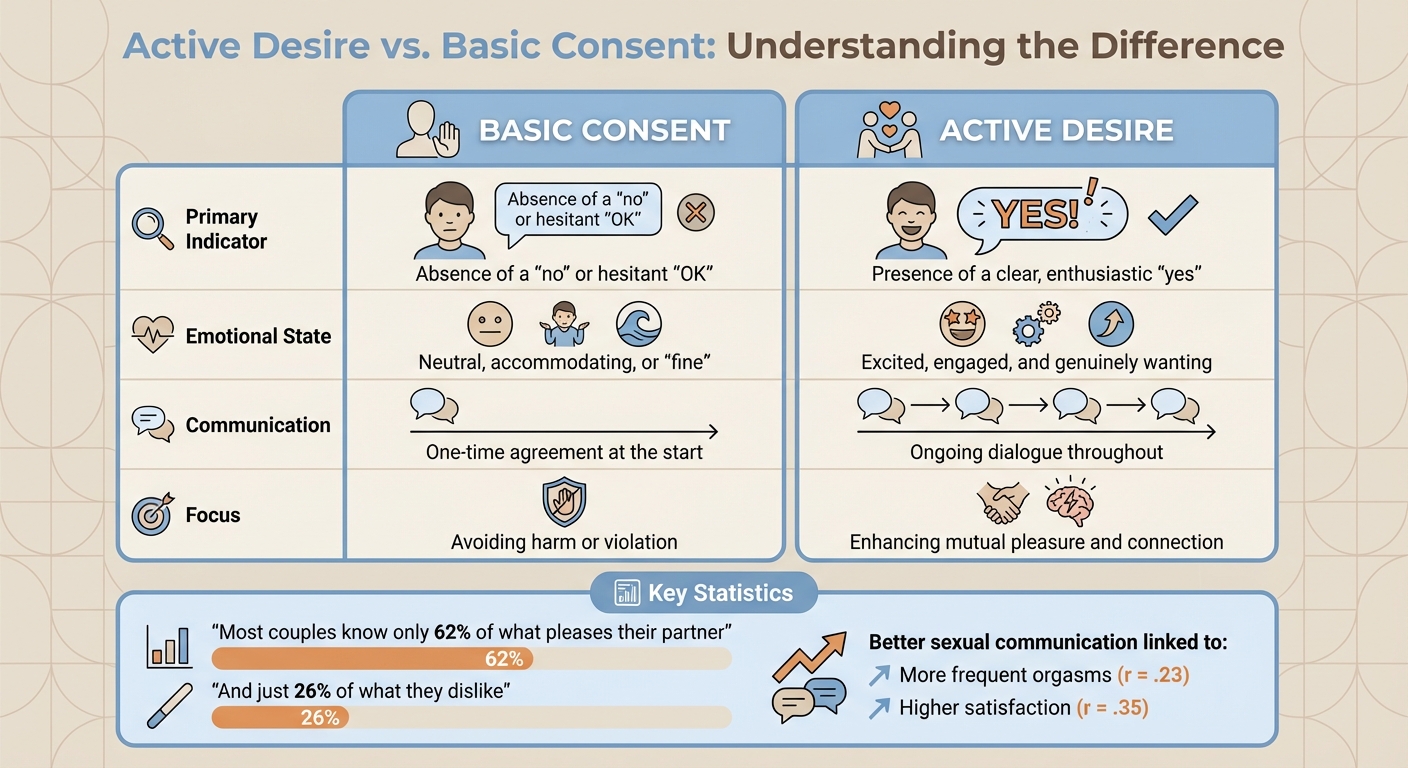
Active Desire vs Basic Consent: Key Differences in Intimate Relationships
Defining Active Desire
Active desire goes beyond mere agreement - it's about mutual enthusiasm. Think of the difference between someone saying "OK, fine" and someone genuinely wanting to connect with you. Dr. Yamicia Connor, an OBGYN, explains it well:
"Enthusiastic consent means both partners are genuinely excited about the sexual activity, not just agreeing to it" [2].
The concept centers on both partners being fully engaged, not just going along with the moment. Studies reveal that 70-85% of individuals, particularly those assigned female at birth, experience responsive desire. This type of desire often develops after an emotional or physical connection is established [10]. Recognizing this pattern is key because it shows that active desire can be cultivated.
"Desire is not a drive, like hunger or thirst. It's an emotion that arises in context. You are not broken." - Emily Nagoski, Ph.D. [8]
When partners focus on creating the right environment - emotional safety, reduced stress, and intentional touch - desire naturally follows. This approach changes intimacy from something that just happens to you into something you build together. The benefits are tangible: research links better sexual communication to more frequent orgasms (r = .23) and higher overall satisfaction (r = .35) [2].
With active desire defined, it’s helpful to explore how it contrasts with the concept of basic consent.
Active Desire vs. Consent
The distinction between active desire and consent is crucial. Consent is the ethical foundation, while active desire represents the ideal for meaningful intimacy. While basic consent asks, "Is this OK?" active desire asks, "Do you truly want this right now?"
Understanding this difference is essential. Here's how the two concepts compare:
| Feature | Basic Consent | Active Desire |
|---|---|---|
| Primary Indicator | Absence of a "no" or hesitant "OK" [7] | Presence of a clear, enthusiastic "yes" [7] |
| Emotional State | Neutral, accommodating, or "fine" [7][2] | Excited, engaged, and genuinely wanting [2] |
| Communication | One-time agreement at the start | Ongoing dialogue throughout [2] |
| Focus | Avoiding harm or violation | Enhancing mutual pleasure and connection [2] |
Consent is about ensuring safety and boundaries, while active desire brings enthusiasm and engagement into the mix. When both partners are actively involved, intimacy becomes a shared journey rather than something one person initiates while the other passively agrees. Shifting from "Is it OK?" to "How does this feel?" turns the focus from simply obtaining permission to creating a pleasurable, connected experience [2].
How to Recognize and Express Active Desire
Signs of Active Desire in Your Partner
Active desire often shows up through enthusiastic words and unmistakable non-verbal cues. One of the clearest verbal indicators is enthusiastic consent - your partner isn’t just agreeing but is genuinely excited about intimacy [2]. This might sound like explicit requests such as, "Tell me what you need", or immediate feedback about what feels good [2].
Physically, active desire can manifest through changes like quicker breathing, increased muscle tension, or heightened responsiveness to touch [2]. But it’s important to remember that desire doesn’t always look the same. For example, spontaneous desire may appear before any physical interaction, leading to early initiation or physical arousal [3][5]. On the other hand, responsive desire often kicks in only after physical touch, cuddling, or emotional connection has begun [5][4]. Neither style is superior - they’re simply different ways of experiencing desire. Recognizing these variations allows you to adapt your approach and foster a more passionate, mutual connection.
Desire might also be expressed through direct actions like flirty texts, playful "lust notes", or setting the mood with gestures like drawing a bath or playing music [3][6]. The real key is understanding your partner’s unique ways of expressing desire rather than expecting them to align with your own.
By learning to recognize these cues, you can better engage in meaningful conversations that deepen mutual intimacy.
Communication Tools for Active Desire
Once you’ve identified these signals, the next step is to talk openly about them with your partner. Choose a relaxed, distraction-free setting for these discussions [2][11]. This creates a low-pressure environment where both of you can share honestly. Research shows that partners typically understand only 62% of what pleases their significant other and just 26% of what displeases them [2], which underscores the need for clear communication.
Using "I" statements can help express your needs without causing defensiveness. For instance, instead of saying, "You always rush", try, "I really enjoy it when you touch me slowly" [2][11]. Be specific - offering clear guidance like, "I respond well to slow, circular motions", makes it easier for your partner to understand and act on your preferences [2].
"The question itself becomes a gift - acknowledgment that her pleasure matters, that their intimacy is a conversation rather than a performance" [2].
Shifting from a performance-driven mindset to a collaborative dialogue can open the door to deeper exploration. Discuss what dampens your desire (your "brakes", such as stress, body image concerns, or feeling rushed) and what enhances it (your "accelerators", like emotional connection, specific types of touch, or feeling relaxed) [8]. These conversations help build a shared understanding of each other’s desires. The benefits are clear: studies link sexual communication to higher orgasm frequency (r = .23) and greater satisfaction (r = .35) [2].
Practical Strategies to Build Active Desire
Creating the Right Environment
Turn your bedroom into a haven for relaxation and intimacy - it’s a simple yet powerful way to shift your focus from daily stress to moments of pleasure [6][5]. Experts suggest setting a "hard cut-off" time each evening to step away from stress-inducing activities, helping your mind transition into a more relaxed state [9].
Small details can make a big difference. Try using massage oils, dim lighting, or soft music to create a calming atmosphere. This is especially important for the roughly 50% of women and 20% of men who experience what’s known as responsive desire, where context plays a bigger role than spontaneous urges [12]. Dr. Cheryl Fraser, Ph.D., puts it perfectly:
"If you are in a long-term relationship, I want you to think of spontaneous desire as a teenager who spontaneously offers to clean the garage for you. It's rare, it's wonderful... but you definitely shouldn't count on it" [6].
Once the environment feels right, shift your attention to exploring what makes each other tick.
Discovering Erotic Preferences Together
Understanding your unique erotic preferences can deepen intimacy and connection. The five erotic "blueprints" - Energetic (aroused by anticipation), Sensual (needing full sensory engagement), Sexual (favoring direct stimulation), Kinky (excited by power dynamics), and Shapeshifter (enjoying variety) - offer a framework for exploring your sexual wiring [13][14].
A fun way to learn more about each other is by playing the A-B Game. One partner experiments with different types of touch (like light versus firm), while the other rates how it feels on a scale from 1 to 5 [14]. This body-mapping exercise eliminates guesswork and helps build a shared language around pleasure.
For those with responsive desire, pre-activation activities can help set the mood. Try reading erotica together or sharing fantasies before intimacy to spark arousal [1]. And keep in mind, one in five men experiences periods of low sexual desire [14]. These tools can be helpful for anyone trying to understand how their body and mind respond to erotic stimulation.
Using Mindfulness and Foreplay
After uncovering your preferences, mindfulness can be a game-changer. It helps you stay present, shifting your focus from stress or performance worries to the connection you share with your partner [15]. Research shows that even three 90-minute mindfulness sessions can significantly improve sexual response and desire in women [15]. Taking 20 minutes to meditate or jot down tasks to clear your mind before intimacy can also make a difference [15].
Foreplay is another key element. Engage all five senses to fully immerse yourself in the experience [17]. Sensate focus, which involves touching each other without the immediate goal of sex, can break up routine and ease performance anxiety [16]. For responsive partners, extending foreplay to 15–20 minutes gives both the body and mind time to align [2]. Dr. Denise Renye captures this beautifully:
"Responsive desire is not a deficiency. It is often a reflection of the nervous system's need for conditions that allow pleasure to surface" [5].
Even small practices, like syncing your breathing or holding eye contact, can strengthen emotional connection and turn ordinary moments into deeply meaningful experiences [17].
Overcoming Common Challenges to Active Desire
Working with Mismatched Libidos
When it comes to navigating differences in desire, understanding and compassion are key. Studies show that 30–40% of couples experience mismatched libidos, and it’s important to remember that this isn’t a sign of a problem in the relationship [20]. Often, these differences are rooted in natural variations in how people experience desire, rather than a lack of attraction [19].
One common issue is the pursuit-withdrawal cycle, where one partner's eagerness can unintentionally cause the other to pull away. Instead of assigning blame, approach this dynamic with curiosity and openness [21]. Tools like the "Dreams Within Conflict" exercise from the Gottman Institute can help couples uncover the deeper needs behind their actions. For instance, one partner might seek intimacy to feel loved, while the other may need to feel accepted [19].
"Desire differences are not pathological. These labels are cruel. There's usually nothing wrong with either partner. They simply have different erotic needs." - Michael Castleman, M.A. [18]
Another practical suggestion from sex therapists is to schedule intimacy. This avoids constant negotiations and sets clear expectations. For many couples, this might mean aiming for once a week if they’re under 40, or two to three times a month if they’re over 40. These arrangements should be revisited regularly to ensure they work for both partners [18]. By addressing mismatched libidos with empathy and structure, couples can foster a deeper connection and keep desire alive.
Once mismatched libidos are addressed, the next hurdle often involves managing the external pressures that can weigh heavily on intimacy.
Managing Stress and External Pressures
Stress can be a major roadblock to active desire. When life feels overwhelming, the body often reacts by shutting down desire, interpreting intimacy as just another demand rather than a source of joy [21].
"Sometimes the body shuts down desire not because something is 'wrong,' but because it's protecting you from overload." - Melissa Zentner, LMHC [22]
Creating a stress-free environment at home can make a big difference. Set a "hard cut-off" time in the evening to disconnect from work emails, financial worries, or social media. Make the bedroom a stress-free zone, free from logistical discussions [9]. Instead of focusing on scheduling "sex", carve out time for closeness in other ways, like taking a shower together or giving each other massages [23].
Small, daily gestures - like sending a flirty text, sharing a quick hug, or playing a favorite song - can also help keep the connection alive. It’s equally important to identify and address the "brakes" that might be holding you back, such as fatigue, side effects from medications, household responsibilities, or a lack of privacy [19]. Removing these obstacles can help reignite intimacy and create space for a stronger connection. By tackling stress and external pressures thoughtfully, couples can nurture the mutual engagement that fuels active desire.
Using Personalized Tools to Increase Active Desire
Using Roma Llama to Spark Desire

When routine and stress dampen intimacy, personalized storytelling can help rekindle desire by offering a tailored, imaginative escape. Roma Llama is a platform that lets couples co-create romance stories, allowing them to choose elements like spice levels, character types, and plot details - all for just $4.99 per story. This creative exercise provides a safe, engaging space where fiction becomes a tool to spark mutual enthusiasm.
What makes Roma Llama stand out is its ability to transform passive consent into an active, interactive experience. Its private, no-login approach fosters a sense of psychological safety, making it easier for partners to explore desires that might feel awkward to discuss openly. This can be especially helpful for couples dealing with mismatched libidos or for those who benefit from external cues to ignite interest.
"Roma Llama is a breakthrough in digital intimacy. It provides a safe, imaginative space for couples to rediscover one another through shared creative exploration."
– Olivia A., Sex Therapist [24]
By turning fiction into a bridge for deeper connection, this tool not only sparks individual desire but also lays the groundwork for shared intimate experiences.
Creating Shared Intimate Experiences
The real magic of collaborative storytelling lies in the process itself. When couples come together to build a story - choosing character names, exploring dynamics, and deciding on levels of intimacy - they foster emotional closeness and improve responsiveness, both of which can naturally enhance sexual desire.
This shared activity creates a unique, mutual "erotic language", eliminating guesswork and transforming creativity into a form of foreplay. As David B., a long-term relationship advocate, put it, "The guided storytelling felt like a collaborative breakthrough - a safe harbor for our most intimate aspirations." [24] It's no surprise that users frequently give the platform high ratings on Trustpilot.
Think of crafting a story as mental foreplay. The anticipation built during the process - discussing favorite themes, personalizing characters, and selecting key moments - can act as a powerful trigger for responsive desire. Research supports this approach, showing that emotional intimacy can serve as both a trigger and a reward for sexual interest. This creates a positive cycle where closeness fosters desire, and desire strengthens the bond, making the relationship more fulfilling overall.
Conclusion: Building Enthusiasm and Connection in Your Relationship
Desire doesn’t just happen - it’s something you cultivate through effort, trust, and shared exploration. In long-term relationships, desire often grows in response to connection rather than sparking out of nowhere. By embracing vulnerability, listening with intention, and letting intimacy evolve naturally, you create the foundation for a relationship that can truly thrive.
The suggestions in this guide - from mindfulness techniques to storytelling exercises - provide actionable ways to rekindle that spark. According to research, more than half of couples experience a drop in sexual satisfaction within the first year[25]. This highlights the importance of making small, meaningful changes in your daily life. Simple routines, like the 7-7-7 rule (a date every week, a getaway every seven weeks, and a vacation every seven months), or shifting your mindset from "Am I in the mood?" to "Am I willing?", can have a profound impact on your relationship[26][27].
"Attraction grows where attention goes. You don't have to fake it. You have to practise it." – Vanessa Marin, Psychotherapist[27]
Desire thrives when you focus on your partner with intention. Whether it’s through non-sexual touch, sharing your thoughts and feelings openly, or appreciating the qualities you love about them, these small actions can reignite passion. The brain’s chemistry plays a role too - dopamine drives motivation, and oxytocin strengthens bonding, creating a cycle that deepens connection when intimacy is prioritized[25].
Take a step forward by starting small. Pick one suggestion from this guide - a communication tool or a simple shift in your environment - and try it for the next week. Observe how your partner responds, and adapt based on what feels right for both of you. Active desire isn’t about being perfect; it’s about showing up consistently with curiosity and an open heart.
FAQs
How can I tell if my partner has responsive desire?
Responsive desire tends to emerge after emotional or physical arousal, rather than appearing out of the blue. It’s often marked by the need to feel safe, relaxed, or emotionally connected before the spark of desire kicks in. If your partner seldom initiates intimacy but responds to particular cues or conditions, they might experience responsive desire. In other words, their interest in intimacy usually develops following a moment of connection, rather than arising spontaneously.
What do we do if one of us wants sex more often?
When one partner has a higher sex drive than the other, open communication and mutual understanding are crucial. Creating a sense of emotional safety and reducing any feelings of pressure can make a big difference. It's also worth considering factors like stress levels, hormonal changes, or other life circumstances that might be affecting desire.
Pressuring the partner with a lower libido is counterproductive and can damage intimacy. Instead, focus on strengthening your connection in other ways - spend quality time together, show affection in non-sexual ways, and take the time to understand each other's needs and feelings. Approaching the situation with patience and empathy can help both partners navigate this difference while staying emotionally close.
How can we talk about sex without it feeling awkward?
Talking about sex doesn’t have to feel awkward if you approach the conversation with honesty, openness, and a focus on understanding each other. Start by creating a relaxed environment where both of you feel at ease. Use clear, judgment-free language to set the tone.
One way to begin is by asking small, open-ended questions that encourage dialogue without pressure. Instead of focusing on what’s wrong, frame the discussion around shared goals and desires. This approach not only normalizes the topic but also helps ease any tension and builds confidence over time.
The key is to prioritize a safe space where both partners feel heard, respected, and valued. When both people can comfortably share their thoughts, the conversation becomes a lot more meaningful and productive.
Key Takeaways
- 1
sbb-itb-069f7a3
- 2
Turn your bedroom into a haven for relaxation and intimacy - it’s a simple yet powerful way to shift your focus from daily stress to moments of pleasure [6][5].
- 3
Desire doesn’t just happen - it’s something you cultivate through effort, trust, and shared exploration.

Written By
Marcus ThorneLicensed Marriage and Family Therapist (LMFT)
Marcus Thorne specializes in transforming high-conflict relationships into resilient partnerships. With a background in behavioral therapy, Marcus focuses on practical communication frameworks that help couples move from "fighting" to "connection." He has led over 200 workshops on the Gottman Method.
View Expert Profile →Keep Reading
The #1 Thing That Kills a Couple's Sex Drive (and How to Fix It)
Read Article →Sexual Compatibility: Can It Be Learned or Is It Innate?
Read Article →The Formula for Breaking Your Sexual Routine Without the Awkwardness
Read Article →Libido Mismatch: The Most Common Sex Problem No One Talks About
Read Article →Explore Related Stories

The Rival Chefs
Chef {NAME1} and rival {NAME2} are forced to share a tiny kitchen for a charity event. As they fight over counter space and ingredients, their professional bickering turns into an intense physical hunger.

The Slice of Life Arrangement
{NAME1} and her reclusive neighbor {NAME2} enter into a fake relationship to solve their social problems. As they navigate family events and quiet dinners, their 'arrangement' turns into a real, heartwarming passion.
Reference Sources
This article was developed using research and insights from the following clinical and narrative authorities: