Expert Summary
How dating app algorithms and freemium models favor engagement and profit over compatibility, driving user fatigue despite some success stories.
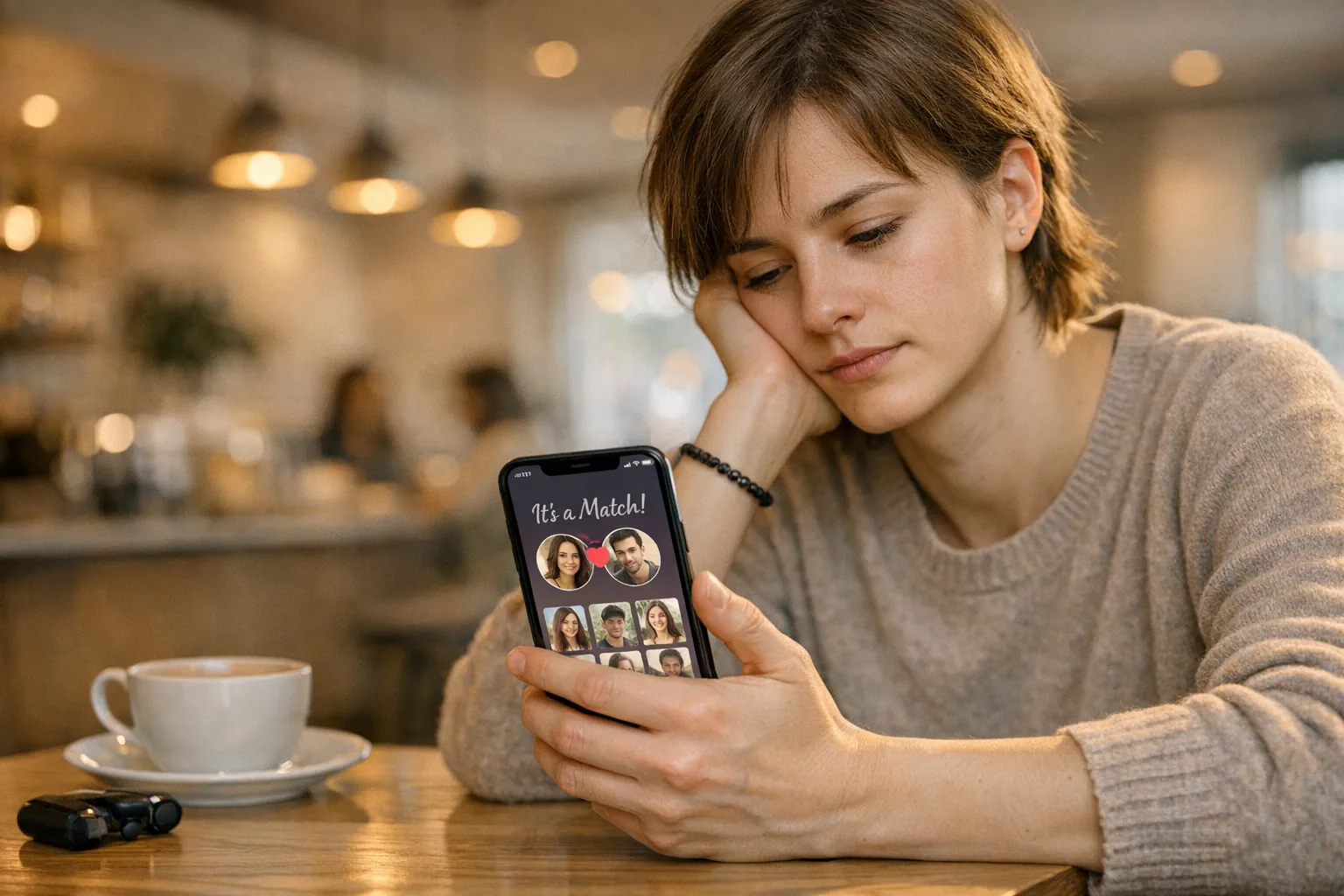
The Data on Dating Apps: Are They Engineered for Love or for Profit?
Dating apps promise connection but often prioritize profit over meaningful relationships. While algorithms help users find matches, they’re designed to maximize engagement and revenue, not necessarily compatibility. Features like paywalls, limited swipes, and addictive swiping mechanics can lead to frustration and burnout. Despite these challenges, about 10% of partnered adults in the U.S. met their significant other through these platforms, showing they can work for some.
Key Points:
- Algorithms: Match preferences based on user behavior but also promote profiles to keep users engaged.
- Business Models: Freemium structures push users toward paid features, generating billions in revenue.
- User Experience: Many feel fatigued and dissatisfied, with 54% wanting better compatibility features.
- Success Rates: 1 in 10 partnered adults met through apps, but most long-term relationships still start offline.
To make dating apps work for you, limit app time, focus on meaningful interactions, and transition to offline connections quickly. Apps are tools for introductions - not guarantees for lasting relationships.
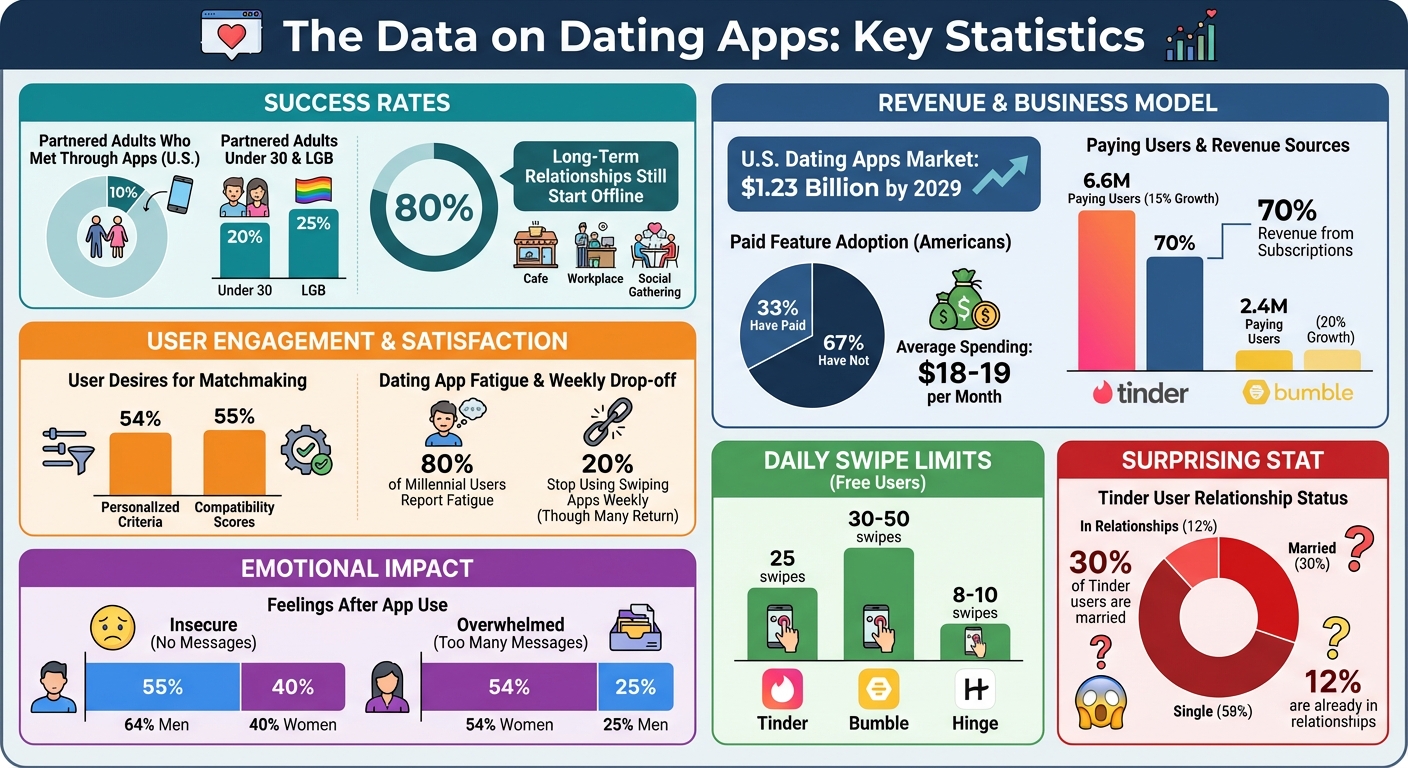
Dating Apps Statistics: Success Rates, User Behavior, and Revenue Models
How Dating App Algorithms Work
Matching Algorithms Explained
Dating app algorithms don’t just rely on the information you provide in your profile - they also track your behavior. Every swipe, click, or even pause helps the system figure out what you like using a method called collaborative filtering [2]. Think of it like how Netflix suggests shows: it looks at what you’ve enjoyed and compares it to the habits of similar users. For example, if you often swipe right on profiles mentioning hiking or featuring graduate degrees, the app will start prioritizing profiles with those traits, even if you didn’t explicitly say you’re into hikers or academics. In 2021, economist Alex Entz found that even small changes to your profile - like updating your photos or tweaking your bio - can significantly influence the types of matches the algorithm suggests [2]. This adaptability also ties into how popularity metrics shape visibility.
Popularity and Attractiveness Bias
Profiles that get a lot of attention tend to stay in the spotlight [2]. It’s a feedback loop: the more people engage with a profile, the more visible it becomes, while less popular profiles fade into the background.
The data paints a clear picture. For instance, people with similar education levels are three times more likely to match, and profile photos remain the biggest factor in attracting attention [3]. Interestingly, universally attractive profiles might not perform as well as more polarizing ones [3]. A striking example comes from Leanne Brady, who noticed a sharp drop in matches and dates after adding that she was a Christian to her profile. This shows how specific details can drastically impact how often the algorithm shows your profile [2].
Engagement vs. Compatibility
Dating apps face a tricky balancing act: should they aim for quick matches to keep users engaged, or focus on fostering meaningful connections that might lead users to leave the platform altogether? According to OFCOM's post-2024 Online Nation Report, many users are growing frustrated. There’s been a noticeable decline in both user numbers and the time people spend on some dating apps [5]. Users often cycle through four emotional stages: boredom, disappointment, suspicion, and fatigue [5].
Every week, up to 20% of users stop using swiping apps, though many eventually come back [6]. This pattern suggests that many apps prioritize engagement metrics - like how often you swipe or how long you stay on the app - over helping users find lasting connections. This approach has a direct impact on satisfaction. Surveys show that 54% of users want matches based on personalized criteria, and 55% would appreciate compatibility scores for different aspects of a potential relationship [4]. Despite this, most apps still emphasize rapid swiping over more in-depth compatibility features. This focus on keeping users engaged, rather than helping them form meaningful relationships, raises questions about whether these platforms are truly designed with users’ long-term goals in mind.
Business Models: How Dating Apps Make Money
Freemium Models and Paid Features
Most dating apps operate on a freemium model, offering basic functionality for free while charging for premium features that claim to improve users' chances of success [1][7]. Interestingly, about one-third of Americans who have used dating apps have paid for these extras, spending an average of $18 to $19 per month on subscriptions or one-time purchases [1][9]. While these individual fees may not seem steep, they collectively generate substantial revenue for the platforms. For example, Tinder’s Chief Financial Officer revealed that 70% of the app’s revenue comes from subscription services [8]. Similarly, Bumble increased its average revenue per paying user from $15 in 2019 to $18 by September 2020, achieving a 20% rise in paid users to 2.4 million. During the same period, Tinder saw its paying user base grow by 15%, reaching 6.6 million [8].
The freemium model thrives by limiting the free experience, nudging users to upgrade. Non-paying users face daily swipe limits - 25 on Tinder, 30–50 on Bumble, and 8–10 on Hinge [8]. Premium features like seeing who has liked your profile, boosting your visibility, or sending unlimited messages are locked behind paywalls. These strategies not only drive revenue but also shape how users interact with the platform.
Revenue-Focused Design Choices
While these monetization strategies are lucrative, they sometimes come at the expense of user satisfaction. Essential features such as knowing who has liked your profile or improving your profile’s visibility are often restricted to paying users, leaving free users with a diminished experience.
This dynamic also ties into a unique challenge for dating apps: every successful match means two users potentially leave the platform [1]. To counter this, some apps prioritize revenue generation over user satisfaction, often compromising the free experience to encourage subscriptions. This approach has tangible effects on user sentiment. For instance, 55% of current or recent dating app users reported feeling insecure when they didn’t receive messages (64% of men and 40% of women), while 36% felt overwhelmed by too many messages (54% of women versus 25% of men) [9]. These mixed emotions reveal the delicate balance between fostering meaningful connections and maximizing profits.
Revenue Strategies and Their Effects
| Revenue Method | How It Works | Platform Incentive | Impact on Users |
|---|---|---|---|
| Subscriptions | Monthly fees averaging $18–$19 for perks like unlimited swipes and advanced filters [1][9] | Provides a consistent income stream (70% of revenue for some apps [8]) | Creates a two-tiered system where free users face limitations |
| Visibility Boosts | One-time payments to temporarily increase profile visibility | Generates additional revenue through quick purchases | Offers short-term advantages but no long-term guarantees |
| Feature Paywalls | Charges for features like seeing who liked your profile or sending priority messages | Encourages upgrades by withholding key features | Can lead to frustration as essential tools are locked away |
Interestingly, 30% of Tinder users are married, and another 12% are already in relationships [10]. This suggests that many people continue using the app even after achieving their initial dating goals, further fueling revenue. These design choices and financial incentives raise questions about how they might influence the quality of relationships formed on these platforms.
Do Dating Apps Lead to Lasting Relationships?
Long-Term Relationship Success Rates
In the U.S., 10% of partnered adults - those who are married, living with a partner, or in a committed relationship - say they met their significant other through a dating app or website [9]. For partnered adults under 30, this figure jumps to 20%. Among LGB partnered adults, it climbs even higher, reaching about 25% [9]. While these numbers show that dating apps can lead to meaningful relationships for some, the majority of long-term partnerships still begin outside the digital realm. This sets the stage for exploring how dating apps, and the algorithms they use, influence the durability of relationships.
Algorithms and Relationship Compatibility
Dating app algorithms are designed to keep users engaged, often prioritizing profits over fostering meaningful, lasting connections [11]. Features like swiping mimic the addictive mechanics of slot machines, encouraging quick decisions rather than thoughtful interactions. Some apps even place the most desirable matches behind paywalls - a practice often referred to as "match restriction" - which can limit users from connecting with suitable partners [7]. These algorithmic strategies not only affect the quality of matches but also create a tension between the app's business goals and its users' desires for genuine, long-term relationships. This raises questions about whether the system itself is working against the very outcomes many users hope to achieve.
User Burnout and Addictive Design
The gamified nature of dating apps - think infinite scrolling, swiping, and constant notifications - can overwhelm users, leading to fatigue and burnout [11][12]. Paradoxically, the abundance of options often makes it harder to commit, as users get trapped in an endless cycle of swiping. This design, while great for keeping people engaged, doesn't necessarily help them build lasting relationships. Instead, it highlights the ongoing tension between apps' focus on engagement metrics and their users' goals of finding meaningful connections.
sbb-itb-069f7a3
How to Use Dating Apps More Effectively
Understanding Algorithm Recommendations
Dating app algorithms are not impartial matchmakers; they’re built to prioritize monetization. This means the matches you see might be influenced by paid features rather than pure compatibility. For instance, some apps place highly sought-after profiles behind paywalls, making them accessible only through premium features [7]. Being aware of this can help you manage your expectations. In fact, in 2024, women on Hinge went viral for finding ways to "hack" the app's "rose jail", a feature that limits certain matches [7]. While these tricks might not work for every platform, understanding how algorithms are designed to keep you engaged can help you make smarter choices - like focusing on meaningful interactions instead of endlessly swiping. And remember, the ultimate goal is to take those connections beyond the app.
Building Relationships Offline
Real connections happen offline. While dating apps are great for introductions, meaningful relationships grow through shared experiences and face-to-face conversations. Interestingly, 80% of millennial dating app users report feeling "dating app fatigue" [11], which often stems from spending too much time on apps without transitioning to real-life interactions. To avoid this, set clear boundaries for your app usage and prioritize meeting in person when a connection feels right. Once you take the step to meet offline, the focus shifts to strengthening that bond.
Roma Llama: Deepening Intimacy Through Storytelling

Once a connection has been established, building intimacy is the natural next step. Roma Llama offers a creative way to do just that. For $4.99, it creates personalized romance stories tailored to couples, helping them explore shared fantasies and deepen their emotional connection. These stories can even be shared as e-cards, adding a thoughtful touch to the journey from digital chats to meaningful offline relationships. It’s a fun and unique way to keep the spark alive after that initial match.
Dating Apps Have A Problem
Conclusion: Balancing Love and Profit
Based on the insights shared earlier, dating apps face a tricky dilemma: their success depends on keeping users engaged, even if that means delaying or complicating the path to lasting love [1]. With the U.S. dating apps market expected to hit $1.23 billion by 2029 [7], it's clear these platforms are lucrative - but their profitability doesn't necessarily stem from helping users find meaningful, long-term relationships.
This dynamic highlights the importance of setting realistic expectations. It's worth remembering that many app features are designed to boost engagement rather than foster genuine connections. This might explain why 80% of millennials report feeling burned out by dating apps [11].
Think of dating apps as a way to meet people - not as tools for building relationships. To nurture deeper connections, focus on offline interactions. Set boundaries, limit your time on apps, and invest in meaningful conversations.
Building stronger bonds goes beyond swiping. Shared experiences and open communication are key. For instance, tools like Roma Llama offer a creative twist - personalized romance stories for just $4.99 can help couples strengthen intimacy beyond the surface-level culture of dating apps.
Ultimately, dating apps are profit-driven platforms designed to spark introductions, not guarantee love stories. Recognizing their limitations and taking charge of how you use them is essential. Don’t let algorithms steer your romantic journey - make intentional choices that lead to meaningful connections.
FAQs
Do dating app algorithms focus more on keeping users engaged than finding compatible matches?
Dating app algorithms are built with one main goal in mind: keeping users hooked. Instead of prioritizing genuine compatibility, many platforms focus on boosting engagement. They highlight profiles that are likely to generate quick swipes, messages, or matches - actions that fuel ad revenue and encourage in-app purchases. This often means compatibility, like shared values or long-term relationship potential, takes a back seat.
To keep users coming back, these apps rely on features like endless scrolling, push notifications, and paid tools such as boosts or super-likes. These elements are designed to trigger dopamine hits, creating a cycle that feels addictive - even when the matches themselves might lack depth. At the end of the day, many dating apps are more invested in keeping users engaged and spending than in fostering meaningful, lasting connections.
How do dating apps make money from their users?
Dating apps make their money primarily through subscription plans and premium memberships, offering perks like unlimited swipes or advanced matching tools. On top of that, they sell in-app upgrades such as boosts to make profiles more visible, super-likes to stand out, and other paid features aimed at improving the overall experience.
These strategies are crafted to nudge users into spending while still using the app. Whether it’s about speeding up matches or getting more attention, this approach helps dating platforms maintain free access for users while ensuring they stay profitable.
Why do dating apps often leave users feeling burned out?
Dating apps often rely on swipe-based features designed to keep users glued to their screens, prioritizing engagement over fostering meaningful connections. This endless cycle of swiping and scrolling can feel like an emotional rollercoaster, leaving users drained as they sift through profile after profile without finding what they truly want.
On top of that, the addictive design of these apps, paired with the pressure to curate a flawless version of oneself, can lead to feelings of frustration and disappointment. Over time, this repetitive process can turn dating apps into a tiresome chore rather than a helpful way to build real connections.
Key Takeaways
- 1
Dating app algorithms don’t just rely on the information you provide in your profile - they also track your behavior.
- 2
Dating app algorithms are not impartial matchmakers; they’re built to prioritize monetization.
- 3
Based on the insights shared earlier, dating apps face a tricky dilemma: their success depends on keeping users engaged, even if that means delaying or complicating the path to lasting love [1].

Written By
Dr. Julian ChenCognitive Scientist
Dr. Julian Chen is a researcher studying the neurobiology of love and the impact of advanced technology on human emotional connection. His work explores how expertly-crafted personalized content can serve as a catalyst for real-world intimacy and self-expansion.
View Expert Profile →Keep Reading
Explore Related Stories

The Rival Chefs
Chef {NAME1} and rival {NAME2} are forced to share a tiny kitchen for a charity event. As they fight over counter space and ingredients, their professional bickering turns into an intense physical hunger.

The Slice of Life Arrangement
{NAME1} and her reclusive neighbor {NAME2} enter into a fake relationship to solve their social problems. As they navigate family events and quiet dinners, their 'arrangement' turns into a real, heartwarming passion.
Reference Sources
This article was developed using research and insights from the following clinical and narrative authorities: