Expert Summary
Learn how to spot a relationship slump, improve communication, rebuild intimacy with love languages and rituals, and when to seek professional help.

Decoding the 'Relationship Slump' and How to Pull Yours Out of It
When relationships feel stagnant or disconnected, it’s often due to a "relationship slump." This quiet drift happens when emotional and physical bonds weaken over time. Common triggers include poor communication, unresolved issues, or external stressors like work and family demands. Key signs include boredom, lack of intimacy, shallow conversations, or feeling like you’re living separate lives.
How to Reconnect:
- Self-Reflection: Identify your feelings and behaviors without assigning blame.
- Address Communication Issues: Use "I" statements, practice active listening, and avoid harmful patterns like criticism or stonewalling.
- Rebuild Intimacy: Try personalized storytelling tools like Roma Llama to spark passion.
- Understand Love Languages: Learn and act on your partner’s love language (e.g., words of affirmation, quality time).
- Create Rituals: Establish daily habits like check-ins or regular date nights for consistent connection.
- Seek Help When Needed: If challenges persist, consider professional counseling.
Small, intentional actions can reignite connection and strengthen your bond over time.
How to Identify Your Relationship Problems
Self-Assessment: Finding Problem Areas
Pinpointing issues in your relationship starts with a bit of self-reflection - without assigning blame. A good question to ask yourself is: "What can I change?"[6].
Take time to examine your own feelings, behaviors, and how you contribute to the dynamic between you and your partner. Pay attention to your emotions before reacting, and notice how your body responds - like a tight chest or a racing heart - as these signals can reveal a lot about your inner state[8]. After a conflict, write down what happened, how you felt, and what you could do differently next time[8].
Think about key areas like emotional connection, communication, intimacy, trust, shared values, and external stressors[2][7]. Are there differing opinions on sensitive topics like finances, parenting, or intimacy[3]? When discussing these issues, try using "I" statements instead of pointing fingers. For instance, say, "I feel unheard when we don't discuss things together," rather than, "You never listen to me"[5][2][7].
Often, relationships struggle not because of the problems themselves but because of how those problems are handled. Avoiding conflict, losing control of emotions, or failing to resolve disagreements are common pitfalls[3]. Instead, approach challenges as a team and focus on active listening. This means making an effort to truly understand your partner’s perspective and validating their feelings, even if you don’t see eye to eye[5][2].
Recognizing these patterns is a crucial first step toward restoring connection and intimacy. If self-reflection doesn’t help address recurring issues, it might be time to seek professional help.
When to Get Professional Help
Some relationship challenges are too complex to tackle alone. If you’re stuck in a cycle of constant, unresolved arguments that leave both of you drained, it’s a sign that expert guidance could help[9][11][12]. Another red flag is communication breakdown - when conversations end in frustration or important feelings are avoided altogether[9][10][11][12].
Trust issues, whether caused by infidelity, secrecy, or dishonesty, often require professional intervention to uncover the root causes and rebuild transparency[9][10][11][12][13][14]. Emotional distance is another warning sign. If you feel more like roommates than romantic partners or if one of you has emotionally withdrawn, it’s worth seeking help[9][10][11][12][13][14]. As Talkspace therapist Minkyung Chung, MS, LMHC, explains:
"Sometimes, personal or combined past issues hinder the positive movement of a relationship. We often call it 'baggage' when it's an individual issue that prohibits the growth of a relationship. However, it could also mean that sometime during the life of the relationship, some unresolved negative situation/emotion occurred that makes it difficult to move forward." [10]
Other serious issues, such as infidelity, addiction, or abuse, demand immediate attention[13]. Watch for signs like contempt (eye-rolls, sarcasm, or mocking), defensiveness (refusing to accept your partner’s perspective or apologize), or even fantasizing about living apart or being with someone else[13][14]. Don’t wait until the situation feels unbearable. Research shows that unhappy couples often wait an average of six years before seeking counseling, even though early intervention can lead to faster progress[13]. In fact, about 70% of couples report that therapy has been effective for them[10].
Taking these steps can pave the way for rebuilding trust and reigniting the connection in your relationship.
The #1 Relationship Repair Moment 99% Screw Up
Improving Connection Through Better Communication
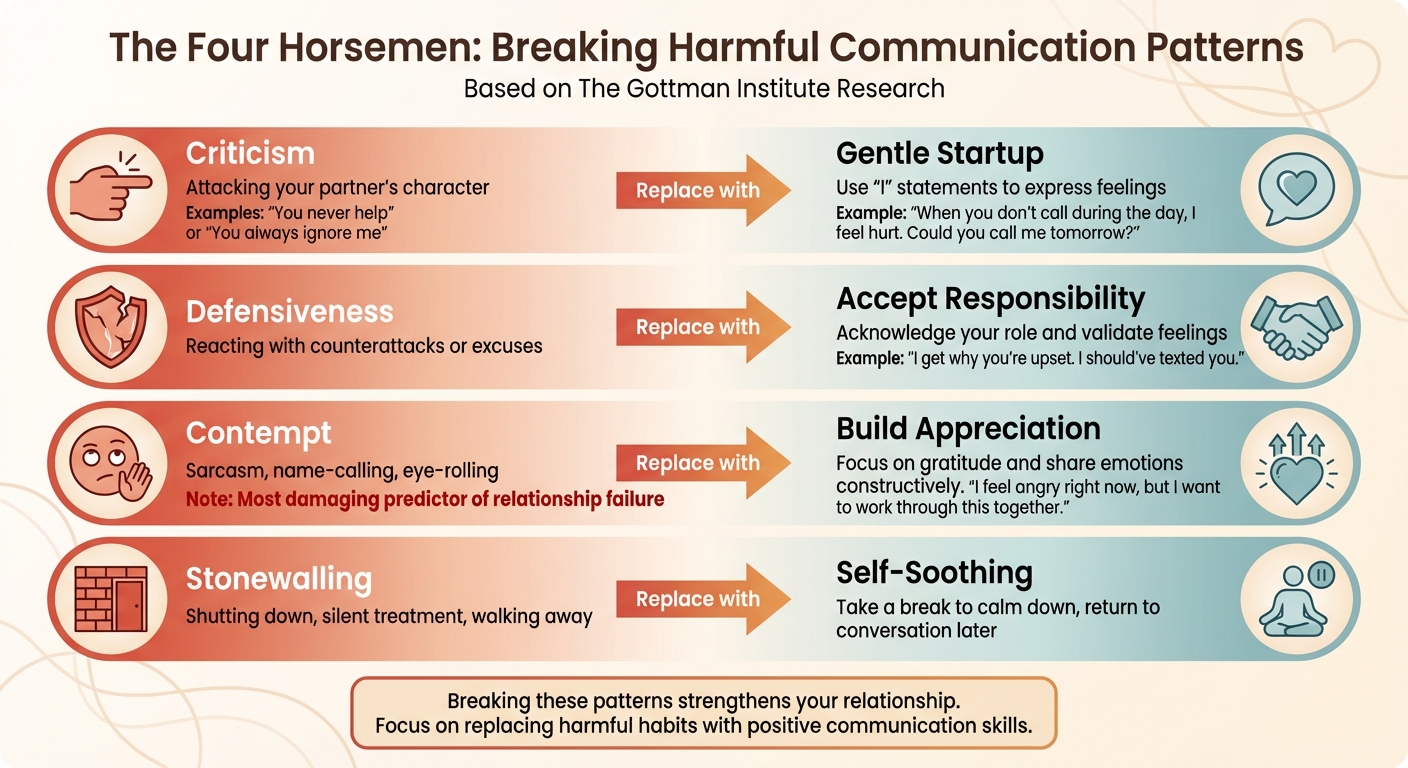
The Four Horsemen of Communication: Harmful Patterns vs Healthy Alternatives
Communication Strategies That Work
Good communication is the foundation of a strong relationship, but it's not just about talking more - it's about communicating better. One of the first steps is creating an environment where both people feel emotionally safe enough to share openly.
Timing matters, too. Plan important conversations when you're both rested and free from distractions. Put your phone away, take a few deep breaths, and approach the discussion with a clear mind.
Active listening can make a world of difference. This means not just hearing but truly understanding your partner. Reflective listening is a great tool - paraphrase what your partner says to confirm you're on the same page. For instance, you might say, "So, you're saying that when I check my phone during dinner, it feels like I'm not interested in your day. Is that right?" This approach shows your partner that you're genuinely trying to understand, even if you don't fully agree [16].
If criticism comes up, resist the urge to defend yourself immediately. Instead, ask open-ended questions like, "Can you tell me more about how that feels?" Then, validate their emotions with statements like, "I can see you're really upset" [16].
Regular check-ins - whether weekly or bi-weekly - can help you address small issues before they grow into bigger problems. Plus, they're a great opportunity to celebrate what's going well. As Meaghan Rice, PsyD, LPC, a therapist with Talkspace, explains:
"Most couples see me for help with communication. It is really challenging to stay connected, still feel aligned, and intimate while also walking away from a conversation feeling as though we worked through an issue. Setting up, typically two very different people, with this idea that they're on the same team can be the switch that gets them to this place." [15]
Using these strategies can help you break unhealthy communication habits, which we'll explore next.
Stopping Harmful Communication Patterns
Breaking destructive communication patterns is just as important as building healthier ones. The Gottman Institute has identified four harmful behaviors - referred to as "The Four Horsemen" - that can predict relationship failure if ignored. Thankfully, each has a better alternative you can use instead.
| Harmful Communication Pattern | Healthier Alternative |
|---|---|
| Criticism: Attacking your partner's character with sweeping statements like "You never help" or "You always ignore me" [17] | Gentle Startup: Use "I" statements to express your feelings and needs without blame (e.g., "When you don't call during the day, I feel hurt and worry that you don't care. Could you call me tomorrow?") [17] |
| Defensiveness: Reacting to feedback with counterattacks or excuses [17] | Accept Responsibility: Acknowledge your role, even if it's small, and validate your partner's feelings (e.g., "I get why you're upset. I should've texted to let you know I was swamped today.") [17] |
| Contempt: Behaviors like sarcasm, name-calling, or eye-rolling that show disrespect [17] | Build Appreciation & Narrate Feelings: Focus on gratitude and share your emotions constructively (e.g., "I feel so angry right now, but I want to work through this together.") [17] |
| Stonewalling: Shutting down, giving the silent treatment, or walking away [17] | Physiological Self-Soothing: Recognize when you're overwhelmed, take a break to calm down, and return to the conversation later [17] |
Of these, contempt is the most damaging - it’s often a strong predictor of relationship failure [17]. If you catch yourself rolling your eyes, using sarcasm to hurt, or speaking with disdain, it's crucial to stop and redirect your behavior.
Clinical Psychologist Lisa Morse highlights a common reason behind communication breakdowns:
"The single biggest reason ruts occur is a lack of communication. Typically, when a rut occurs people are experiencing disappointment and unmet or failed expectations, which are often out of their awareness. They're either not communicating them or communicating them aggressively so that the other person shuts down." [1]
When negativity spirals into defensiveness or withdrawal, it’s essential to interrupt the cycle. This could mean taking a short break, using an agreed-upon code word, or setting clear ground rules for discussions. For example, avoid interrupting, name-calling, or rehashing old arguments. If emotions run too high, agree to a 20-minute timeout and commit to revisiting the conversation. The goal is to replace harmful habits with positive communication skills that strengthen your connection [16] [17].
sbb-itb-069f7a3
Using Personalized Erotic Storytelling to Reignite Passion
How Storytelling Brings Back Desire
When intimacy starts to feel monotonous, erotic storytelling can breathe life back into your connection. Sharing intimate stories with your partner has the power to rekindle desire and deepen your bond [18]. It’s a form of foreplay that builds anticipation without the immediate pressure of physical intimacy, creating a safe and exciting space to explore.
Storytelling also serves as a bridge for addressing differences in desire. It allows both partners to express fantasies, preferences, or kinks in a way that feels less vulnerable. Openly discussing what excites each of you - whether it’s a specific scenario, a playful role, or a shared fantasy - can strengthen your emotional and physical connection. This creative process naturally ties into the communication strategies discussed earlier, enhancing both understanding and intimacy [19].
How Roma Llama Helps Build Intimacy

To take this storytelling experience to the next level, Roma Llama offers a user-friendly way to create personalized erotic stories. For just $4.99, you can craft a romance narrative tailored to your unique relationship, making it an accessible tool to address emotional disconnection during relationship slumps.
The platform lets you customize every detail, from the spice level - ranging from tender and romantic to boldly passionate - to the characters’ roles, personalities, and physical traits. You can even set the scene in a meaningful location, like a dreamy beach getaway or a cozy cabin retreat, adding a personal touch that resonates with your shared experiences.
One of Roma Llama’s standout features is the "Roll The Dice" option, perfect for those who want to explore new ideas but aren’t sure where to begin. This feature randomly generates sexual actions, offering a playful way to spark creativity. You can also include elements like BDSM or focus on specific actions such as foreplay or intercourse, tailoring the story to your preferences. Once your story is ready, you can share it with your partner as an e-card, allowing them to enjoy it privately - no subscriptions or logins required.
Building Stronger Bonds with Love Languages and Rituals
Using the 5 Love Languages
Understanding your partner's love language can breathe new life into your relationship. Dr. Gary Chapman introduced the concept of five love languages: Words of Affirmation, Quality Time, Receiving Gifts, Physical Touch, and Acts of Service [21]. The catch? Most couples don’t naturally share the same primary love language. This means that even well-meaning gestures might not strike the right chord if they don’t align with what makes your partner feel loved [22].
The first step is to figure out both your own and your partner’s love languages. You can do this through self-reflection or by taking a simple quiz [20]. Once you know what resonates most with your partner, make an effort to express love in that way. For instance, if their love language is Words of Affirmation, try leaving heartfelt notes or complimenting their efforts throughout the day. If Acts of Service is their way of feeling loved, consider taking on some of their responsibilities or surprising them with their favorite meal.
The magic lies in being genuine and consistent. Love languages aren’t about grand, over-the-top gestures - they’re about small, thoughtful actions that show you truly understand what makes your partner feel appreciated [20]. When both partners actively "speak" each other’s love language, the relationship becomes a safe, nurturing space where both individuals feel deeply valued [20] [22].
Creating Rituals of Connection
Once you’ve rekindled the spark, grounding your relationship in meaningful daily rituals can help keep the connection strong. Rituals act as anchors, offering reliable moments of intimacy and togetherness. For example, you might spend 10 focused, distraction-free minutes every evening sharing your thoughts and expressing one thing you appreciate about each other [1][2][7][16]. A simple question like, "How are you feeling about us today?" can open the door to honest and heartfelt conversations.
Regular date nights are another way to nurture intimacy and break free from the monotony of daily routines [4][15][2]. These don’t need to be extravagant - sometimes, small, playful touches, like incorporating a shared joke or story into your evening, can make all the difference. For instance, adding a lighthearted "Roma Llama" story to your date night could turn an ordinary outing into a cherished tradition. Additionally, setting aside screen-free time for shared activities can help you connect without the distractions of modern technology [1].
The Gottman Institute emphasizes the importance of making these rituals specific and actionable. Instead of vague promises like "We’ll spend more time together", commit to concrete plans, like a weekly date night or a nightly check-in. These small but intentional efforts can go a long way in strengthening your bond [16].
Conclusion: Moving Forward Together
The first step toward improving any relationship is recognizing the issues and committing to open, honest communication. Creating a safe space for genuine conversations is essential for addressing challenges and rebuilding trust [16]. Once this foundation is set, focus on specific strategies to restore intimacy. This might involve improving how you communicate, rekindling physical passion through tools like personalized erotic storytelling, or strengthening emotional bonds with love languages and meaningful daily rituals.
Studies show that couples who actively seek solutions and embrace new approaches often experience noticeable improvements [16]. However, as Dr. Neal Swartz, a psychiatrist, wisely points out:
"Fixing relationship problems takes effort, patience, and a commitment to growth from both partners." [2]
While the process takes time and dedication, consistent and deliberate actions can lead to meaningful changes. Small, steady efforts - like scheduling regular check-ins to evaluate progress and refine your approach - can make a big difference [7][16].
As you apply these communication and intimacy strategies, take ownership of your role in the relationship. Focus on progress rather than perfection, and celebrate small wins, whether it’s a heartfelt conversation or a moment of renewed connection. Taking personal responsibility empowers growth and strengthens your partnership [1]. Each step - whether it’s through better communication, shared rituals, or exploring new ways to connect - reinforces your bond. When both partners approach the journey with intention and commitment, transformation becomes not just possible, but achievable, one step at a time.
FAQs
How can I recognize and overcome a relationship slump?
A relationship slump often feels like emotional distance, monotonous routines, or a noticeable dip in intimacy with your partner. To move past it, focus on better communication - express your thoughts, feelings, and needs openly and honestly. Shake things up by planning new and engaging activities that help you both step out of the routine and reconnect on a deeper level. Being emotionally vulnerable is crucial; share your true self and create a safe space for your partner to do the same. Lastly, make time for each other - just 20 minutes of undistracted quality time daily can work wonders in rebuilding your bond and reigniting closeness.
How can learning about love languages strengthen my relationship?
Understanding love languages can change how you connect with your partner by showing you how to meet their emotional needs more effectively. People experience love differently - some feel it most through words of affirmation, others through acts of service, receiving gifts, quality time, or physical touch.
By identifying your partner’s primary love language, you can express affection in a way that truly speaks to them. This not only strengthens emotional connections but also improves communication and deepens intimacy, leading to a more meaningful and rewarding relationship.
When is it time for couples to seek professional help for their relationship?
When couples find themselves grappling with persistent emotional distance, unresolved arguments, difficulties with intimacy, or a sense of being stuck despite their best efforts, it might be time to consider professional help.
Therapists or counselors can provide new insights, practical tools, and strategies to tackle these challenges head-on. They can help you rebuild trust, deepen understanding, and restore connection. If these struggles start to feel overwhelming or begin to take a toll on your well-being, reaching out to a professional could be a meaningful step toward revitalizing your relationship.
Key Takeaways
- 1
Pinpointing issues in your relationship starts with a bit of self-reflection - without assigning blame.
- 2
When intimacy starts to feel monotonous, erotic storytelling can breathe life back into your connection.
- 3
The first step toward improving any relationship is recognizing the issues and committing to open, honest communication.

Written By
Marcus ThorneLicensed Marriage and Family Therapist (LMFT)
Marcus Thorne specializes in transforming high-conflict relationships into resilient partnerships. With a background in behavioral therapy, Marcus focuses on practical communication frameworks that help couples move from "fighting" to "connection." He has led over 200 workshops on the Gottman Method.
View Expert Profile →Keep Reading
The #1 Thing Couples Fight About (And It's Not What You Think)
Read Article →Is Your Relationship Too Comfortable? The Subtle Signs Boredom is Creeping In
Read Article →From Roommates to Lovers Again: Escaping the Relationship Rut
Read Article →10 Tips for Rebuilding Intimacy in Sexless Relationships
Read Article →Explore Related Stories

The Rival Chefs
Chef {NAME1} and rival {NAME2} are forced to share a tiny kitchen for a charity event. As they fight over counter space and ingredients, their professional bickering turns into an intense physical hunger.

The Slice of Life Arrangement
{NAME1} and her reclusive neighbor {NAME2} enter into a fake relationship to solve their social problems. As they navigate family events and quiet dinners, their 'arrangement' turns into a real, heartwarming passion.
Reference Sources
This article was developed using research and insights from the following clinical and narrative authorities: