Expert Summary
How VR boosts presence and shared experiences for long-distance couples, the privacy and tech risks, and practical tips to use VR as a supplement—not a substitute.
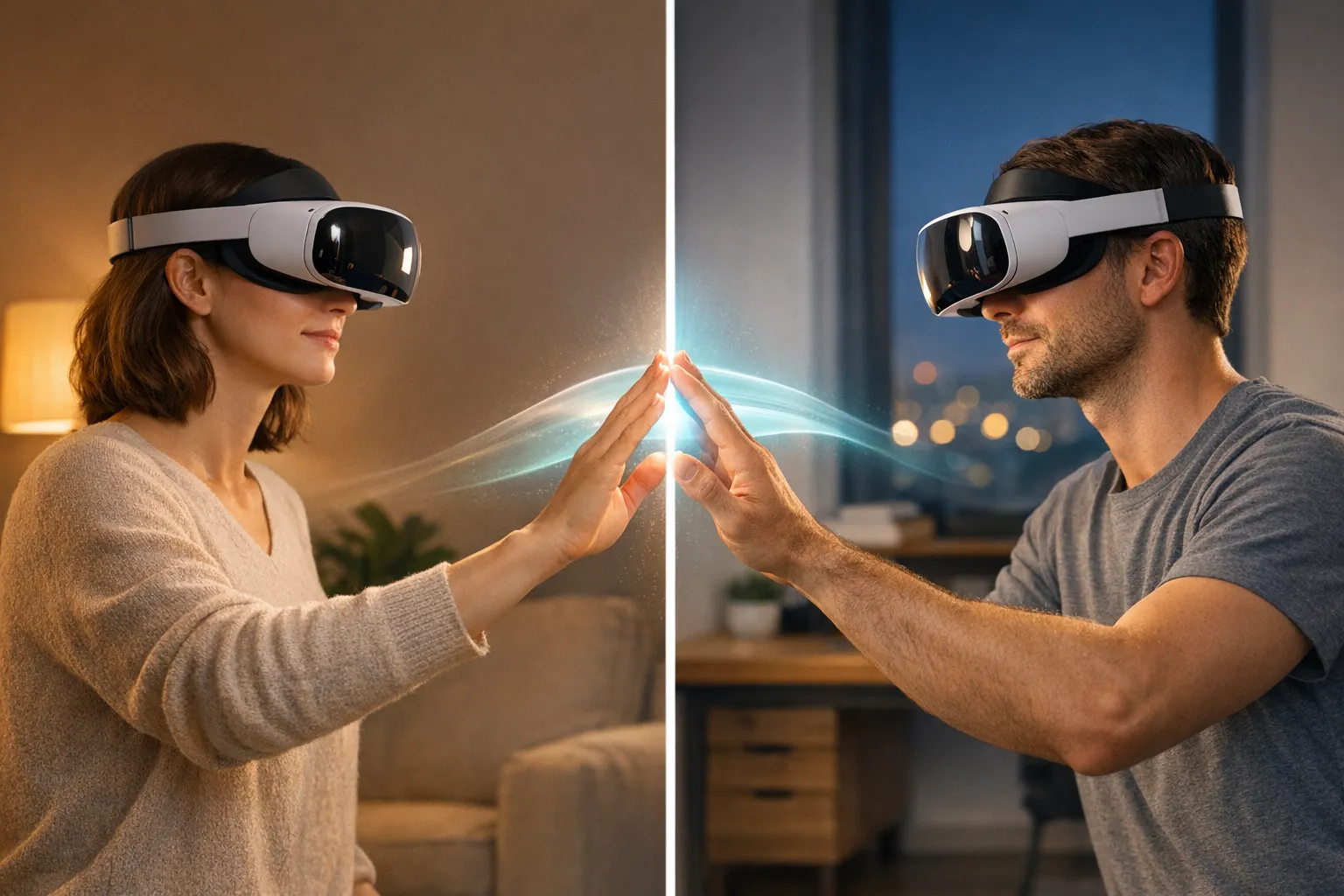
Digital Intimacy: Is Virtual Reality Saving or Replacing Long-Distance Relationships?
Virtual reality (VR) is transforming how long-distance couples connect. Unlike video calls, VR offers immersive experiences that make it feel like you're sharing the same space. Couples can explore virtual safaris, attend concerts, or even simulate touch through haptic devices. Studies show that VR increases feelings of presence and reduces boredom, making it a promising tool for maintaining relationships. However, it can't replace physical connection, and over-reliance on VR may create emotional gaps. Privacy concerns and technical challenges also remain. The key is balance - using VR as a supplement, not a substitute, for meaningful connection.
Key Takeaways:
- Benefits: Higher presence scores (M = 5.74 vs. 5.31 for video calls), shared virtual activities, and tools like haptic devices simulate touch.
- Challenges: Lack of physical touch, potential over-reliance, privacy risks, and technical issues.
- Best Practices: Use VR for variety, not as a replacement for phone calls or in-person visits. Plan virtual date nights that feel engaging and interactive.
VR is reshaping long-distance relationships by bridging gaps, but it works best when paired with other forms of communication and real-life meetups.
10 Best VR Date Ideas!
sbb-itb-069f7a3
Problems Long-Distance Couples Face
Distance does more than just separate people physically - it can create emotional divides that are tough to bridge. Even with constant texting and video calls, many long-distance couples describe a sense of profound loneliness, as though they’re living separate lives. The inability to physically comfort a partner during tough times only adds to the stress, creating a void that digital communication often fails to fill. Let’s dive into some of the deeper issues that emerge from this separation.
Physical Distance Creates Emotional Gaps
When partners are physically apart, emotional closeness can feel harder to maintain, even with frequent communication. A video call might bring faces to a screen, but it can’t replicate the feeling of being truly present.
"It is true that one can never compare what it is like to have their loved one sitting next to them, or feeling the warmth of their embrace, the connection while holding hands or the magic of a kiss." - Paula Lopez, University of Rochester [6]
Everyday moments - like sharing a morning coffee, walking the dog, or simply being together during quiet evenings - are often missed. These small, seemingly mundane experiences are the glue of daily life, and their absence can leave partners feeling disconnected. On top of that, the distance sometimes allows for selective sharing, where each partner might withhold certain aspects of their lives. This can create what some experts describe as a "false sense of a fantasy world", making the relationship feel less grounded in reality [9].
Difficulty Keeping Intimacy Alive
For couples who value physical touch as a primary expression of love, the absence of hugs, hand-holding, and spontaneous affection can make intimacy feel like a distant memory. Without these physical connections, love can start to feel abstract, almost theoretical.
Research shows that couples relying on standard video chats often experience greater boredom compared to those who engage in more immersive shared experiences. This boredom is tied to what psychologists call a "self-expansion deficit", referring to the lack of opportunities to grow together through new experiences [3]. Over time, the monotony of repetitive digital routines can erode relationship satisfaction, leaving couples feeling stuck in an emotional rut. Without shared physical activities to break the cycle, maintaining a sense of closeness becomes increasingly difficult.
These challenges highlight just how hard it can be to keep the spark alive across the miles, emphasizing the importance of finding creative ways to bridge the gap and nurture intimacy.
VR Tools That Help Long-Distance Couples Stay Close
Virtual reality (VR) is making it easier for long-distance couples to feel connected, offering a sense of presence that standard video chats simply can't match. Research shows that people using VR report feeling closer to their partners, with presence levels significantly higher (M = 5.74) compared to video chat users (M = 5.31) [3]. Here's how VR is helping bridge the physical gap through shared experiences, intimate storytelling, and even simulated touch.
Virtual Spaces for Shared Experiences
VR platforms let couples step into immersive, 3D environments where they can do more than just talk - they can experience things together. Apps like Wander, for instance, use Google Maps data to let partners explore real-world locations virtually. Whether it’s walking down a familiar street or visiting a bucket-list destination, these shared adventures feel incredibly real. Studies show that couples who try novel VR experiences, like hot air balloon rides over Kenya or gondola trips in the Swiss Alps, report feeling closer and more satisfied in their relationships [3].
"We found that shared novel experiences in VR, as opposed to a video chat, enhanced presence, or the sense that your partner was there with you, and this, in turn, was associated with greater self‐expansion and boosts in relationship satisfaction." – Rhonda Balzarini, Ph.D., Assistant Professor of Psychology, Texas State University [4]
Beyond travel, VR opens the door to joint activities like fitness classes, museum tours, live concerts, and gaming. In September 2023, researcher Xian Wang introduced a prototype VR app designed for Loving-Kindness Meditation, tailored specifically for long-distance couples. Compared to traditional video calls, couples found the VR meditation more effective at fostering intimacy and favored it for long-term use [5].
Personalized Erotic Stories Through VR
When physical connection isn’t possible, VR offers couples an intimate alternative through personalized erotic storytelling. Platforms like Roma Llama let users create custom romance stories for just $4.99. Couples can tailor the narrative to their preferences, adjusting the intensity and choosing from various romantic scenarios, including foreplay, intercourse, and even BDSM elements.
This kind of storytelling creates a safe space for exploring fantasies and improving sexual communication [11]. It also taps into the idea of self-expansion - introducing fresh, exciting elements to the relationship, which research shows can help combat boredom and strengthen bonds [2].
Devices That Simulate Physical Touch
VR doesn’t stop at visuals and storytelling - it’s also tackling the challenge of touch. Haptic technology is closing the "haptic gap" by letting couples experience simulated physical contact, even from miles away. Devices like the Hey Bracelet let partners send a gentle squeeze that feels like real touch, while Kissenger, a smartphone attachment from Lovotics, mimics the sensation of a partner’s kiss. For a more intimate connection, Kiiroo's Couple Set 2 uses touch-sensitive tech to mirror one partner’s movements in real time.
While these devices bring a new level of closeness, it’s important to review privacy settings, as some collect sensitive biometric data [10].
Pros and Cons of Using VR in Relationships
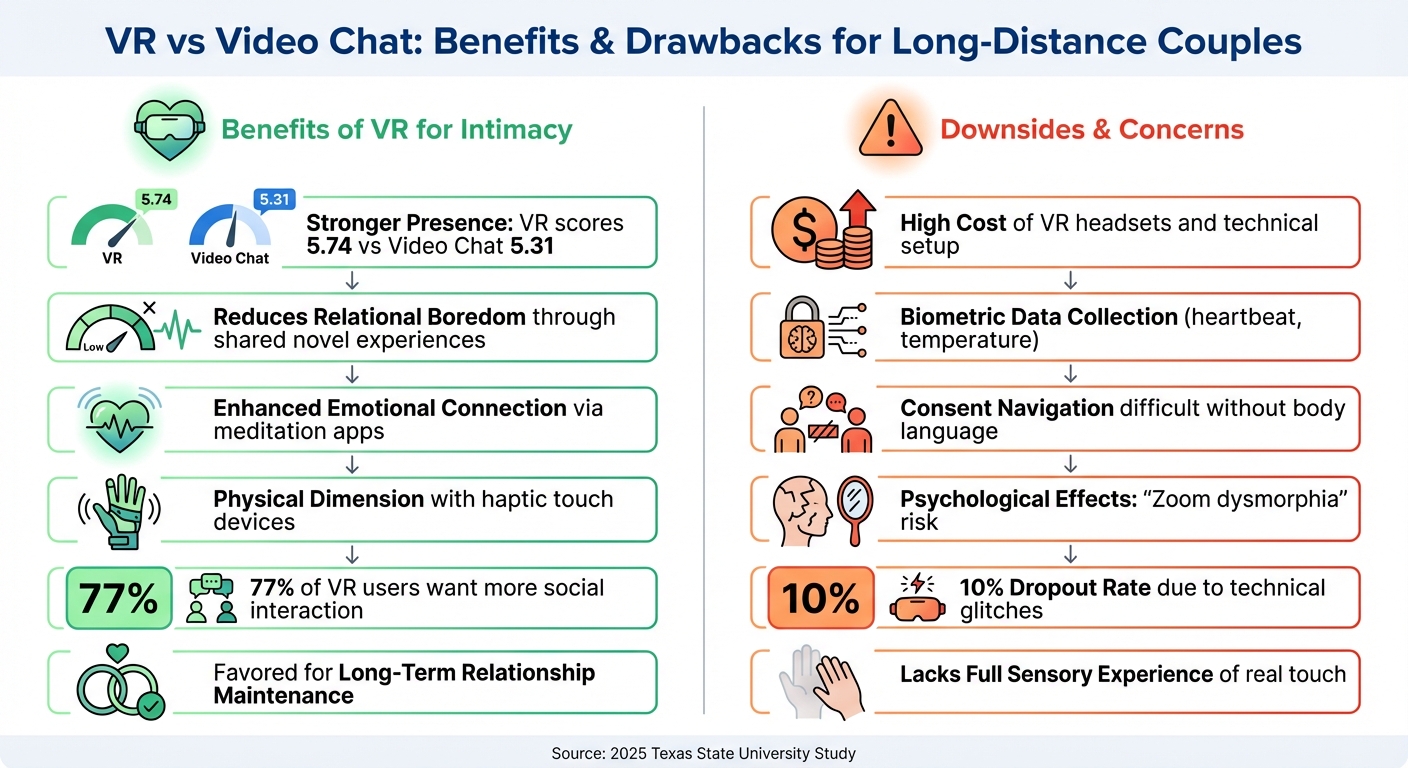
VR vs Video Chat for Long-Distance Relationships: Benefits and Drawbacks Comparison
VR can bring both exciting opportunities and significant challenges for couples navigating long-distance relationships.
Benefits of VR for Intimacy
Research shows that VR creates a stronger sense of presence compared to video chatting, with VR users reporting higher scores (M = 5.74) than video chat users (M = 5.31) [3]. This heightened feeling of "being together" can help couples combat boredom, as those who share new VR experiences often report feeling more satisfied in their relationship [3].
Specialized VR apps and haptic devices take things a step further by adding a physical element to virtual connections. These tools can simulate touch, heartbeats, or even kisses, making interactions feel more tangible [5][10]. For instance, apps designed for Loving-Kindness Meditation have been found to strengthen intimacy even more effectively than video calls, with many couples favoring them for ongoing use [5].
While these advantages are compelling, there are also notable downsides.
Downsides and Concerns
One major concern is privacy and data security. Devices that enable haptic feedback and VR interactions often collect sensitive biometric data, like body temperature, heartbeat rhythms, and vibration settings. A notable example occurred in 2017 when Standard Innovation faced a $5 million settlement after its We-Vibe device was found to be collecting intimate user data without proper consent [10]. Additionally, with pornography sites making up 30% of web traffic, the risk of leaks involving private sexual data is a persistent worry [10].
Technical and psychological hurdles also complicate VR's role in relationships. VR headsets are expensive, and a 2025 study revealed that 10% of couples dropped out due to technical issues or difficulty following instructions [3]. There's also a psychological toll - spending too much time interacting as virtual avatars can lead to dissatisfaction with one's real-world appearance, a phenomenon sometimes called "Zoom dysmorphia" [12]. Another challenge is navigating consent in virtual spaces. Without body language cues, it becomes harder to establish or withdraw boundaries during intimate moments [10].
Side-by-Side Comparison of VR Benefits and Drawbacks
Here's a quick look at how the benefits and drawbacks stack up:
| Benefits | Drawbacks |
|---|---|
| Creates a stronger sense of presence than video chat (M = 5.74 vs. 5.31) [3] | High cost of headsets and technical setup [3] |
| Reduces relational boredom with shared VR experiences [3] | Sensitive biometric data collection (e.g., heartbeat, temperature) [10] |
| Enhances emotional connection through apps like meditation [5] | Difficulty navigating consent without body language cues [10] |
| Adds a physical dimension with haptic devices [10] | Potential for psychological effects like "Zoom dysmorphia" [12] |
| 77% of VR users want more social interaction in virtual spaces [3] | Technical glitches can disrupt intimate moments (10% dropout rate) [3] |
| Favored for long-term relationship maintenance [5] | Lacks the full sensory experience of real touch [10] |
How VR Has Affected Actual Couples
Real-life stories reveal how VR has reshaped long-distance relationships, offering both opportunities to deepen bonds and challenges that can strain them.
Couples Who Strengthened Their Bond with VR
A January 2025 study highlighted VR's ability to create a stronger sense of presence and reduce boredom compared to video chats [3]. These findings are echoed in the experiences of couples who’ve embraced VR as part of their relationships.
Take journalist Nathan Grayson, for example. Between April and July 2016, he used AltSpace VR and HTC Vive headsets to stay connected with his girlfriend, who lived in England. Together, they explored virtual medieval taverns, solved an Indiana Jones–style maze, and played disc golf. Grayson described how interlocking their Vive controllers to "hold hands" felt surprisingly intimate. Sharing these virtual adventures brought them closer than traditional video calls ever could [13].
"While other people were talking, we got close, held hands, and looked into each other's soulless virtual eyes. My brain filled in the gaps, and for the briefest of moments, it felt like she was there." - Nathan Grayson [13]
In another example, researchers Xian Wang and Lik-Hang Lee developed a VR prototype in September 2023 specifically for Loving-Kindness Meditation in long-distance relationships. After conducting workshops and interviews with couples, they found that VR fostered greater intimacy than video conferencing and emerged as a preferred tool for maintaining long-term connections [5].
While many couples have benefited from VR's ability to enhance closeness, some have encountered challenges when virtual interactions overshadow real-world connections.
When VR Replaces Real Connection
Grayson's story also revealed potential pitfalls. He experienced "virtual jealousy" when his girlfriend's avatar interacted with others, a surprisingly visceral reaction. Technical glitches, like an avatar falling through the virtual floor, added to the frustrations, often making these issues feel more disruptive than problems encountered in traditional communication methods [13].
"You are left with the ghostly feeling that things are not so real. Impalpable objects are not convincing." - Professor Ophelia Deroy [6]
Research from Texas State University uncovered further limitations. While VR improved the feeling of presence, it didn’t significantly enhance self-expansion or overall relationship satisfaction compared to video chats [3]. Another study involving 141 couples found that virtual interactions lacked the same potential as in-person ones to promote identity growth, a key factor for sustaining long-term relationships. Additionally, requests to alter avatars to look less like real-life appearances sometimes triggered body image concerns, and the absence of physical touch left some couples feeling more disconnected [6].
These stories underline an important point: VR can enrich relationships when used thoughtfully, but over-reliance risks turning it into a substitute for genuine, real-world connection. The next section will explore practical ways to maintain this balance.
How to Use VR to Improve Your Long-Distance Relationship
The trick to making VR work in a long-distance relationship is to see it as an add-on, not a replacement, for genuine connection.
Selecting the Right VR Tools
To make the most of VR, both partners should use compatible systems so you can fully share experiences [2]. You don’t need to splurge on high-end equipment, but the system should support multiplayer environments where you can interact. Look for platforms offering activities that match your relationship goals - like strolling through virtual museums, enjoying digital meals together, or even doing yoga or meditation side by side [7].
For couples seeking a more intimate connection, Roma Llama offers a unique option: personalized erotic storytelling at $4.99 per story. You can customize everything - spice levels, settings, and character details - to create a narrative that reflects your relationship’s personality. These stories can be sent as e-cards, with no logins or subscriptions required, making it easy to surprise your partner with something private and special.
Once you’ve chosen the right tools, remember to balance your VR time with regular, real-world check-ins.
Using VR Without Replacing Real Communication
VR can fill the gaps in your communication routine, but it shouldn’t replace traditional methods like texts, phone calls, or video chats [8]. Think of VR dates as a way to add variety, not as your main form of connection. Keep up with daily conversations through other channels, and watch out for signs of VR fatigue or overuse, which could take away from planning in-person reunions [8].
Planning Virtual Date Nights
Once you’ve set up your VR tools and boundaries, get creative with virtual date nights to keep your bond strong.
Focus on activities that feel new and exciting. For instance, a February 2025 study by Texas State University found that couples who went on a virtual hot air balloon ride over a Kenyan safari reported feeling more connected and less bored compared to couples who watched the same experience via video chat [3].
"We found that shared novel experiences in VR, as opposed to a video chat, enhanced presence, or the sense that your partner was there with you, and this, in turn, was associated with greater self-expansion and boosts in relationship satisfaction." - Rhonda Balzarini, Ph.D., Assistant Professor of Psychology at Texas State University [4][1]
You can also make VR dates feel more authentic by syncing your physical actions with the virtual experience. For example, if you’re having a virtual dinner, prepare the same recipe in your own kitchens and eat together in VR. Small gestures - like toasting with glasses or cooking the same dish - help bridge the gap between the digital and real worlds.
Conclusion: What's Next for VR and Long-Distance Love
As VR continues to reshape how we connect, it's adding a whole new layer to long-distance relationships. Unlike video calls, VR gives couples a sense of presence - the feeling that your partner is right there with you. Recent studies highlight VR's growing role in helping couples combat the challenges of distance, offering immersive experiences that can strengthen emotional bonds [3].
That said, VR works best as an addition, not a replacement. It’s a tool to bridge the physical gap when meeting in person isn’t possible, but it shouldn’t take the place of planning real-life reunions. Couples see the most benefit when they integrate VR into their usual routines - like texting, calling, or video chatting - rather than relying on it exclusively [2].
Looking ahead, the potential for VR to deepen emotional connections is only expanding. Researchers are diving into how spatial interactions and embodied experiences in social VR can foster even stronger bonds [14]. As the technology evolves, the line between digital and physical intimacy could blur even further, making it crucial to stay rooted in authentic human connection.
Still, privacy concerns can’t be ignored. Devices like haptic wearables and VR platforms often collect sensitive data, such as heart rates or intimate movements. For instance, the 2017 lawsuit against Standard Innovation (We-Vibe), which ended in a $5 million settlement over unauthorized data collection, underscores the risks involved [10]. Always review data policies to protect your privacy.
Use VR to enhance your connection, but let it complement - not replace - the real, human moments that matter most.
FAQs
Do VR dates actually make couples feel closer?
Virtual reality (VR) dates have the potential to bring couples closer by creating a heightened sense of presence. It can feel like your partner is right there with you, even if you're miles apart. This immersive experience can boost emotional bonds, foster personal growth within the relationship, and increase overall satisfaction - especially for those exploring VR for the first time. For long-distance couples, these shared moments can be a powerful way to maintain intimacy and connection.
How can we use VR without replacing real connection?
To enjoy VR without losing the essence of real-world connections, focus on creating shared, meaningful experiences that bring people closer. For example, exploring virtual landscapes together or teaming up on collaborative activities can strengthen emotional bonds. VR should act as a supplement to traditional ways of connecting - like face-to-face conversations or in-person meetups - not a substitute.
Adding tools like haptic devices can make virtual interactions feel more intimate, but it’s important to approach these with care, especially regarding consent and ethical boundaries. The goal is to use VR to enhance relationships and make them richer, not to replace the irreplaceable value of real-life interaction.
What privacy risks come with VR and haptic devices?
Virtual reality (VR) and haptic devices gather highly sensitive data, including involuntary body signals and emotional responses. This information, if mishandled, could be exploited for purposes users never agreed to - like targeted advertising or other intrusive activities.
The immersive experience these technologies offer also comes with its own set of challenges. For instance, users may face risks like harassment or the misuse of mediated touch, which can lead to uncomfortable or harmful interactions.
To address these issues, it's crucial to focus on a few key areas: implementing robust data security measures, establishing clear ethical guidelines, and educating users about potential risks and how to protect themselves in these digital spaces. These steps can help ensure a safer and more respectful virtual experience.
Key Takeaways
- 1
sbb-itb-069f7a3
- 2
VR vs Video Chat for Long-Distance Relationships: Benefits and Drawbacks Comparison
- 3
As VR continues to reshape how we connect, it's adding a whole new layer to long-distance relationships.

Written By
Dr. Julian ChenCognitive Scientist
Dr. Julian Chen is a researcher studying the neurobiology of love and the impact of advanced technology on human emotional connection. His work explores how expertly-crafted personalized content can serve as a catalyst for real-world intimacy and self-expansion.
View Expert Profile →Keep Reading
Long-Distance Romance: Digital Story Sharing Guide
Read Article →Beyond the Bedroom: 7 Unexpected Ways to Boost Eroticism in Your Daily Life
Read Article →How to Keep Romance Alive in a Long-Distance Relationship
Read Article →A Survival Guide for Long-Distance Relationships: 7 Ways to Maintain Intimacy
Read Article →Explore Related Stories

The Rival Chefs
Chef {NAME1} and rival {NAME2} are forced to share a tiny kitchen for a charity event. As they fight over counter space and ingredients, their professional bickering turns into an intense physical hunger.

The Slice of Life Arrangement
{NAME1} and her reclusive neighbor {NAME2} enter into a fake relationship to solve their social problems. As they navigate family events and quiet dinners, their 'arrangement' turns into a real, heartwarming passion.
Reference Sources
This article was developed using research and insights from the following clinical and narrative authorities: