Expert Summary
The science behind unforgettable kisses—how brain chemicals, pheromones, timing, and emotional connection shape attraction and compatibility.

The Mechanical Breakdown of a Perfect Kiss: What the Data Says
Kissing isn’t just romantic - it’s a sensory and chemical experience that helps you assess attraction, deepen emotional bonds, and even gauge compatibility. Here’s what you need to know:
- First impressions matter: 59% of men and 66% of women have ended relationships over a bad first kiss.
- Biology at work: Kissing triggers a chemical cocktail - dopamine for pleasure, oxytocin for bonding, and serotonin for mood stability.
- Pheromones and compatibility: Kisses help you subconsciously evaluate genetic compatibility through scent and taste.
- Emotional connection rules: Technique matters, but being emotionally present leaves a lasting impact.
Whether it’s your first kiss or a daily ritual, understanding the science behind it can help make every kiss unforgettable.
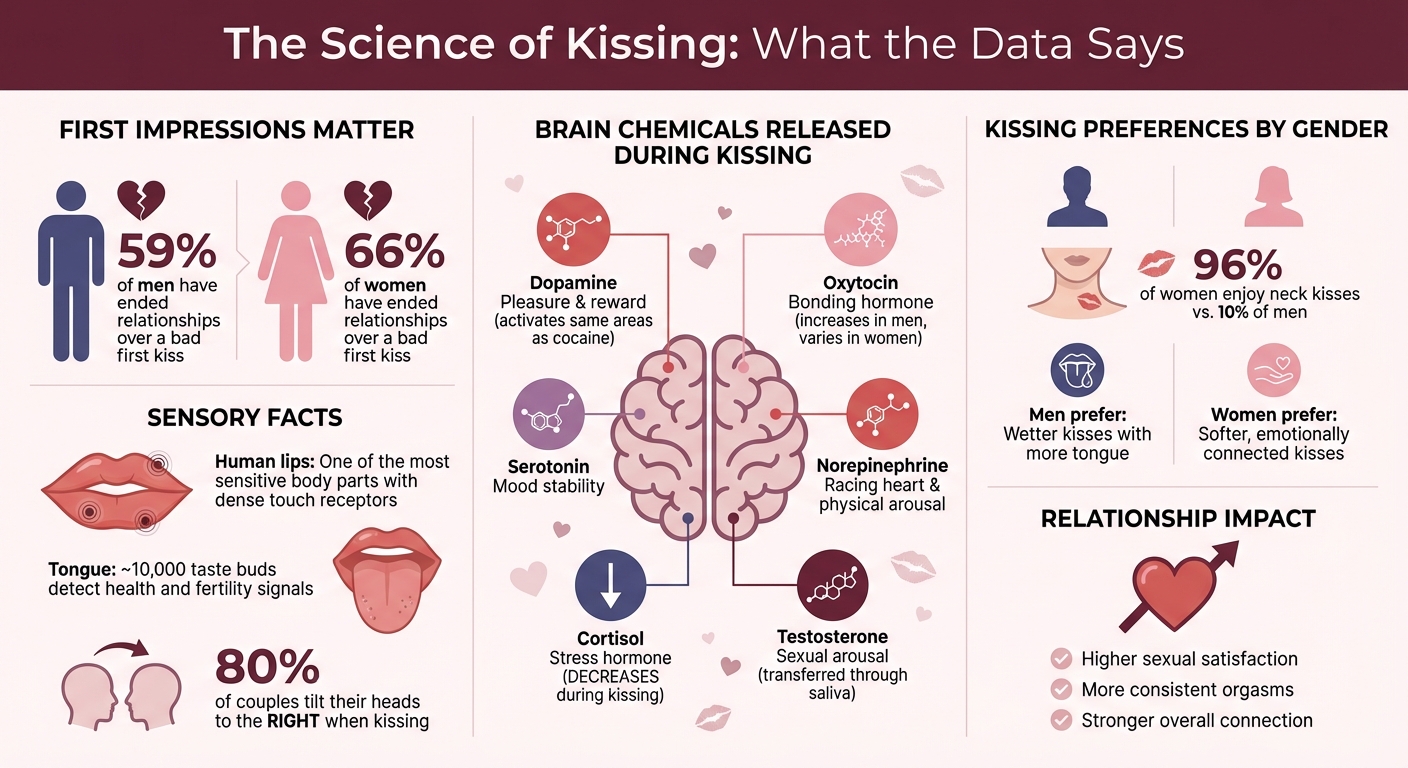
The Science of Kissing: Key Statistics and Brain Chemistry
The Science of Kissing
sbb-itb-069f7a3
The Biology of Kissing
Your lips are packed with sensory neurons, making them highly sensitive to touch. When you kiss, these nerve endings send signals to the brain's sensory centers, which process sensations like temperature, taste, smell, and movement. Researchers describe this as a "chemical ballet" of neurotransmitters and hormones [7]. This intricate sensory input triggers a cascade of chemical reactions in your body.
How Sensory Stimulation Works
Human lips are one of the most sensitive parts of the body, with a thin layer of skin and a dense concentration of touch receptors [7]. Even the lightest touch can evoke a strong sensory reaction. Meanwhile, your tongue, equipped with about 10,000 taste buds, picks up subtle signals about your partner's health and fertility [10].
When you kiss, blood vessels dilate, increasing oxygen flow and quickening your heartbeat. This creates a feedback loop where chemical signals and tactile sensations interact, amplifying the experience.
Brain Chemicals Released During Kissing
The sensory stimulation of kissing prompts your brain to release a specific mix of chemicals that enhance the experience. Dopamine floods the brain's reward centers - the same areas activated by addictive substances like cocaine - leading to feelings of euphoria and craving [7]. A study conducted in November 2007 by Wendy L. Hill and Carey A. Wilson at Lafayette College observed 15 heterosexual couples kissing for 15 minutes. They found that cortisol levels, a stress indicator, dropped for both men and women. Interestingly, oxytocin, often called the "bonding hormone", increased in men but decreased in women, suggesting that emotional context and environmental factors play a role [2][8].
"A passionate kiss acts like a drug, causing us to crave the other person thanks to a neurotransmitter called dopamine."
- Sheril Kirshenbaum, Author of "The Science of Kissing" [7]
Serotonin helps stabilize your mood during a kiss, while norepinephrine triggers physical reactions like a racing heart and sweaty palms [8]. Saliva exchange during kissing also transfers small amounts of testosterone, which may gradually heighten sexual arousal [8][9]. This intricate neurochemical response not only makes kissing feel addictive but also strengthens emotional bonds, blending biology with romance.
Pheromones and Genetic Compatibility
Kissing does more than ignite short-term chemical reactions - it also plays a role in assessing long-term compatibility. When two people kiss, they exchange subtle pheromonal cues that help gauge genetic compatibility. These signals are tied to the Major Histocompatibility Complex (MHC), a set of genes that influence immune system strength [2][10]. Studies show that women tend to prefer the scent of men with MHC genes different from their own, potentially leading to offspring with stronger immune systems [11][10][12].
"Kissing involves a very complicated exchange of information - olfactory information, tactile information and postural types of adjustments that may tap into underlying evolved and unconscious mechanisms that enable people to make determinations … about the degree to which they are genetically incompatible."
- Gordon G. Gallup, Jr., Evolutionary Psychologist, University at Albany [2]
This natural "screening process" has a practical side: research reveals that 59% of men and 66% of women have ended relationships after experiencing a bad first kiss [2][7][10]. It’s a powerful reminder of how biology and instinct shape human connection.
Psychology of a Memorable Kiss
Taking a closer look at the psychological side, let’s explore what makes certain kisses unforgettable while others fade quickly from memory.
Why Emotional Connection Matters
While the biology of kissing explains the physical reactions, the psychology uncovers why some kisses stay with you. Emotional connection takes a simple physical act and turns it into something deeply meaningful. Think of a kiss as a mirror for your relationship - it reflects the emotional bond you share with your partner [2][5].
The effects of a meaningful kiss go beyond the moment itself. When you kiss someone you feel strongly connected to, your brain releases oxytocin, also known as the "bonding hormone", which strengthens your attachment [5][6]. For women, kissing often serves as a way to gauge a partner’s commitment and potential for a lasting relationship [2][6]. This is why understanding your partner’s needs and reactions is more important than focusing solely on technique [1][5]. The best kissers aren’t necessarily the most technically skilled - they’re the ones who are emotionally tuned in. Ultimately, the emotional depth of a kiss carries more weight than the mechanics.
Technique vs. Emotion: What Matters More
When it comes to the age-old debate of technique versus emotion, the research points to a clear winner. Dr. Cortney Warren, a psychologist, emphasizes that "the feelings, circumstances, and connection to the romantic partner were more important to how wonderful the kiss was than the physical mechanics" [3]. That doesn’t mean technique doesn’t matter - poor hygiene or clumsy movements can still ruin the moment. But once the basics are covered, emotional presence takes center stage.
Interestingly, men and women often approach kissing differently. Men are generally more drawn to passionate, open-mouth kisses as a lead-up to sexual activity, while women often value kissing as a way to build emotional intimacy and assess the relationship’s strength [6][13]. Couples who kiss more frequently in long-term relationships also report higher levels of sexual satisfaction, more consistent orgasms, and stronger overall connection [3]. The key takeaway? Focus on being emotionally present and connected - it’s far more impactful than obsessing over flawless technique.
Of course, the setting and timing of a kiss also play major roles in how memorable it becomes.
How Timing and Context Affect a Kiss
Beyond emotions and technique, the timing and context of a kiss can make or break its impact. The same kiss can feel magical in one moment and forgettable in another, depending on the setting. Research suggests that women, in particular, are more likely to feel connected in romantic environments, as neutral or sterile settings may hinder the release of oxytocin [2]. For example, a spontaneous kiss under the stars on vacation can feel worlds apart from a hurried goodbye kiss before heading to work.
Timing is especially important during key moments in a relationship. A first kiss should happen when mutual interest is clear - confidence is appealing, while hesitation can make things awkward [6]. In established relationships, even small, everyday kisses - like a quick peck during a quiet moment or after intimacy - can reinforce feelings of love and attention [6]. Simple gestures like fresh breath, a soft touch on the face, or brushing a strand of hair aside can elevate even a casual kiss into something meaningful.
| Kiss Type | Purpose | Timing/Context |
|---|---|---|
| Testing Kiss | Mate assessment | When mutual interest is evident; confidence is key [6] |
| Bonding Kiss | Connection & attachment | Spontaneous moments; after intimacy; a gentle peck [6] |
| Arousal Kiss | Seduction | Builds in intensity; involves open-mouth kissing [6] |
Research-Based Tips for Better Kissing
Now that you’ve got a grasp on the psychology behind unforgettable kisses, let’s dive into how to put that knowledge into action. These tips, rooted in research, can help you enhance your kissing game.
Learning Your Partner's Preferences
Great kissing starts with understanding your partner, and that means paying attention to their preferences - even if much of that communication is non-verbal. Kevin Bennett, Ph.D., a Teaching Professor of Social-Personality Psychology at Penn State University, highlights this perfectly: "Being a good kisser is not just about technique; it's also about being attuned to your partner's desires and responses" [1]. In other words, the magic lies in reading the moment and adjusting to your partner’s cues.
Watch for subtle signals like breathing changes or body language. If they pull you closer, they’re into it. If they seem hesitant or pull back, it’s time to ease up. Gentle touches, like brushing their arm or cheek, can help gauge their comfort level - positive reactions mean you’re on the right track.
Gender preferences also play a role. Studies show that 96% of women enjoy neck kisses, compared to only 10% of men [4]. Men tend to prefer wetter kisses with more tongue, while women often favor softer, emotionally connected kisses [4][6]. Letting your partner lead occasionally can also provide valuable insight into their unique style and rhythm [6].
Once you’ve tuned into their preferences, you can fine-tune your approach with some proven techniques.
Improving Your Technique with Data
While emotional connection is key, bad technique can ruin even the most heartfelt moment. Science offers some clear dos and don’ts to keep in mind. First up: hygiene. Fresh breath, clean teeth, and soft, moisturized lips are non-negotiable. Lip balm can work wonders here. Poor hygiene is one of the top reasons first kisses fail to leave a lasting impression [1][4][6][13].
Good kissing follows a natural flow. Start slow with closed-mouth kisses and minimal saliva, then increase intensity as things heat up [6]. Don’t forget to involve your hands - hold their face, run your fingers through their hair, or pull them closer for a more intimate experience [6]. Interestingly, 80% of couples naturally tilt their heads to the right when kissing, a habit tied to motor preferences developed in infancy [2][13]. So, don’t overthink the angle - just go with it.
Avoid being overly repetitive. Mix it up by alternating between soft and firm pressure, switching from their upper lip to their lower lip, or exploring other areas like the neck or ears [4]. For men, resist the urge to be overly aggressive with tongue use - pay attention to your partner’s breathing and match their pace [4]. For women, research suggests that being a bit more assertive and occasionally initiating the kiss can be a major turn-on for both partners [4][6].
Setting the Right Mood
The setting can make or break a kiss. Women, in particular, often need a romantic atmosphere to feel more connected [2]. One study even found that while oxytocin levels rose in men after a kiss, they decreased in women - suggesting that women might need a more emotionally charged environment to fully enjoy the experience [2][14]. A thoughtful setting can amplify both the emotional and biochemical aspects of a kiss.
Choose your moments wisely. A spontaneous kiss during an intimate, quiet moment will always feel more meaningful than a rushed peck in a busy or distracting environment. Dim lighting, a cozy setting, and minimal interruptions can all work in your favor. After the kiss, maintain the connection with lingering touches or eye contact [6].
If it’s a first kiss, timing matters. Jeremy Nicholson, M.S.W., Ph.D., also known as The Attraction Doctor, advises: "A first kiss isn't the time for a heavy 'make-out' session... Only kiss for a few moments (be sure to leave them wanting more)" [6]. Confidence is key - commit to the moment rather than holding back. A relaxed environment also helps, as kissing naturally lowers cortisol levels and acts as a stress reliever [1][2].
Conclusion: Combining Science and Romance
Key Takeaways
A perfect kiss isn't just about mastering technique - it’s a blend of biology, psychology, and emotional connection. When you kiss, your body releases a cocktail of chemicals: dopamine sparks craving and reward, oxytocin strengthens bonds, and serotonin lifts your mood. At the same time, cortisol, the stress hormone, decreases, helping both partners feel more at ease [11]. But there’s more to it than just chemistry. Kissing also acts as a kind of sensory test, letting you evaluate genetic compatibility through taste, touch, and even smell [2]. All of this highlights why that first kiss can feel so high-stakes. Yet, when done right, the rewards - a deeper connection and intimacy - are well worth it.
Final Thoughts on Building Intimacy
Science doesn’t diminish romance - it enhances it. As Sheril Kirshenbaum, author of The Science of Kissing, explains:
"The chemicals in our bodies are responsible for the so-called symptoms we associate with falling in love. I don't think it takes the romance out of the equation, but it gives us a better scientific understanding of how our bodies are behaving" [11].
Armed with this knowledge, it’s clear that small, intentional actions can help nurture lasting connections. Pay attention to your partner’s cues and make those shared moments count. As Gordon Gallup, an evolutionary psychologist, points out:
"In long-term relationships, the frequency of kissing is a good barometer of the health and well-being of that particular bond" [11].
Use these insights to deepen your connection and make every kiss more meaningful.
FAQs
Why can a first kiss feel like a dealbreaker?
A first kiss carries a lot of weight because it often hints at connection and attraction, leaving a memory that sticks. Research even suggests people remember their first kiss more clearly than their first sexual experience. Why? It tends to reveal both emotional and physical chemistry. If the kiss feels off, it might suggest a lack of compatibility, which can lead to waning interest. Essentially, that initial kiss sets the stage for how intimacy and emotional bonds might unfold in the relationship.
How can I tell if a kiss is emotionally connecting for my partner?
A kiss can reveal a lot about emotional connection, and your partner's response is key. Look for signs like mutual engagement, relaxed body language, and a sense of warmth or security that lingers afterward. A kiss that feels meaningful often lasts at least six seconds, creating intimacy through the release of bonding chemicals like oxytocin. If your partner displays tenderness, holds eye contact, or seems eager to stay close, it’s a good indicator that the kiss carries emotional depth.
What are the biggest kissing mistakes to avoid?
Kissing mistakes that can spoil the moment include:
- Bad breath: Nothing kills the mood faster than unpleasant breath.
- Being too sloppy or overly aggressive, which can make the experience uncomfortable.
- Accidentally clashing teeth, an awkward and avoidable mishap.
- Overdoing or underdoing tongue movement, which can feel awkward if not balanced.
- Skipping the emotional connection: Technique matters less than genuine passion and a sense of intimacy.
Steering clear of these pitfalls can help make the moment more enjoyable and unforgettable.
Key Takeaways
- 1
Taking a closer look at the psychological side, let’s explore what makes certain kisses unforgettable while others fade quickly from memory.
- 2
A perfect kiss isn't just about mastering technique - it’s a blend of biology, psychology, and emotional connection.

Written By
Dr. Julian ChenCognitive Scientist
Dr. Julian Chen is a researcher studying the neurobiology of love and the impact of advanced technology on human emotional connection. His work explores how expertly-crafted personalized content can serve as a catalyst for real-world intimacy and self-expansion.
View Expert Profile →Keep Reading
Explore Related Stories

The Rival Chefs
Chef {NAME1} and rival {NAME2} are forced to share a tiny kitchen for a charity event. As they fight over counter space and ingredients, their professional bickering turns into an intense physical hunger.

The Slice of Life Arrangement
{NAME1} and her reclusive neighbor {NAME2} enter into a fake relationship to solve their social problems. As they navigate family events and quiet dinners, their 'arrangement' turns into a real, heartwarming passion.
Reference Sources
This article was developed using research and insights from the following clinical and narrative authorities: