Expert Summary
Sleeping in separate bedrooms can improve sleep, reduce stress, and rebuild desire—boosting mood, communication, and sexual satisfaction.

Can Separate Bedrooms Actually Improve Your Sex Life?
Sleeping in separate bedrooms might seem counterintuitive for a healthy relationship, but for many couples, it’s a game-changer. Here’s why: better sleep leads to better mood, more energy, and even a stronger sex drive. Studies show that couples who prioritize sleep - whether together or apart - experience fewer arguments, improved communication, and more satisfying intimacy.
If snoring, tossing, or temperature battles are robbing you of rest, sleeping apart could be the solution. It’s not about growing distant; it’s about creating space for better sleep and rekindling desire. Couples who try this often report feeling more connected and intentional about their time together.
Key takeaways:
- 53% of couples sleeping separately report better rest and gain 37 extra minutes of sleep per night.
- Poor sleep doubles the risk of sexual dysfunction and strains emotional connection.
- Separate bedrooms can build anticipation, reduce stress, and improve intimacy.
If sleep issues are impacting your relationship, consider giving this approach a try. It’s not about separation - it’s about prioritizing rest so you can bring your best self to your partnership.
The case for separate bedrooms
Sleep Problems That Hurt Intimacy
Sharing a bed can come with its challenges - snoring, tossing, and turning are just the beginning. In fact, a whopping 78% of couples who have questioned their relationship due to sleep issues point to snoring as the main culprit, with conflicting schedules close behind at 71% [11]. These disturbances can rob you of the deep, restorative sleep your body needs.
Temperature disagreements are another common battleground, affecting 58% of couples. The ideal sleep temperature sits between 60°F and 67°F [12], but when one partner feels too hot while the other shivers, nobody wins. Throw in restless leg syndrome, teeth grinding, or even the classic cover-stealing dilemma, and it's no wonder sleep deprivation becomes a chronic issue.
In fact, sharing a bed increases sleep disturbances by 50% [12]. This lack of quality sleep often leads to irritability, emotional instability, and, for 44% of couples, even doubts about the relationship [11]. Over time, these disruptions can chip away at communication and deepen emotional distance.
How Bad Sleep Damages Relationships and Sex
Sleep deprivation doesn’t just make you tired - it can unravel the fabric of your relationship. When you're running on empty, your patience wears thin, and it's all too easy to take out your frustrations on the person closest to you.
"When you're sleep-deprived, your frustration tolerance is lower. And who are we most likely to project our frustrations on? Not our bosses or our coworkers but our closest partners", says Wendy Troxel, Senior Behavioral Scientist at RAND Corp [7].
Sleep loss also dulls your ability to empathize, making it harder to pick up on your partner’s emotions and further straining your connection.
And let’s not forget how sleep affects your sex life. Sleep disorders double the risk of sexual dysfunction across all genders [10], while chronic fatigue saps the energy needed for intimacy. Stress from poor sleep has a way of killing desire, something certified sex counselor Eric Marlowe Garrison refers to as "sex's Kryptonite" [5]. On the flip side, studies show that getting just one extra hour of sleep increases the likelihood of intimacy the next day [10]. But when exhaustion and resentment over lost sleep take hold, physical closeness often falls by the wayside.
The Connection Between Sleep and Sexual Satisfaction
The relationship between quality sleep and a fulfilling sex life isn’t just a matter of personal experience - it’s supported by scientific evidence. When you’re well-rested, your body feels recharged, and your mood is lifted, creating a better environment for intimacy. On the flip side, sleep deprivation can leave you feeling drained and less interested in physical connection. In fact, studies have shown that getting enough rest not only boosts your energy and mood but also enhances communication and empathy, which are key ingredients for deeper intimacy. These findings have led researchers to dive deeper into how sleep impacts sexual satisfaction.
What Research Shows
Science backs up these observations in meaningful ways. For example, research from the RAND Corporation highlights that couples who prioritize sleep tend to enjoy more frequent and satisfying sexual experiences. Better sleep quality translates to a stronger sexual connection. Wendy Troxel, a Senior Behavioral Scientist at RAND Corp, explains:
"When we're well-rested, we enjoy sex more, our sexual frequency goes up, the sex drive goes up. So there are lots of relationship benefits to be had from prioritizing sleep." [7]
Interestingly, how and where couples sleep also plays a role. A January 2023 survey revealed that 52.9% of adults who opted for separate bedrooms reported improved sleep, gaining an average of 37 extra minutes of rest per night [9][13]. Additionally, about one-third of Americans now occasionally or regularly sleep in separate rooms [8]. This trend highlights a growing awareness that prioritizing individual sleep quality can have a positive ripple effect on both relationship satisfaction and sexual well-being.
How Separate Bedrooms Can Improve Your Sex Life
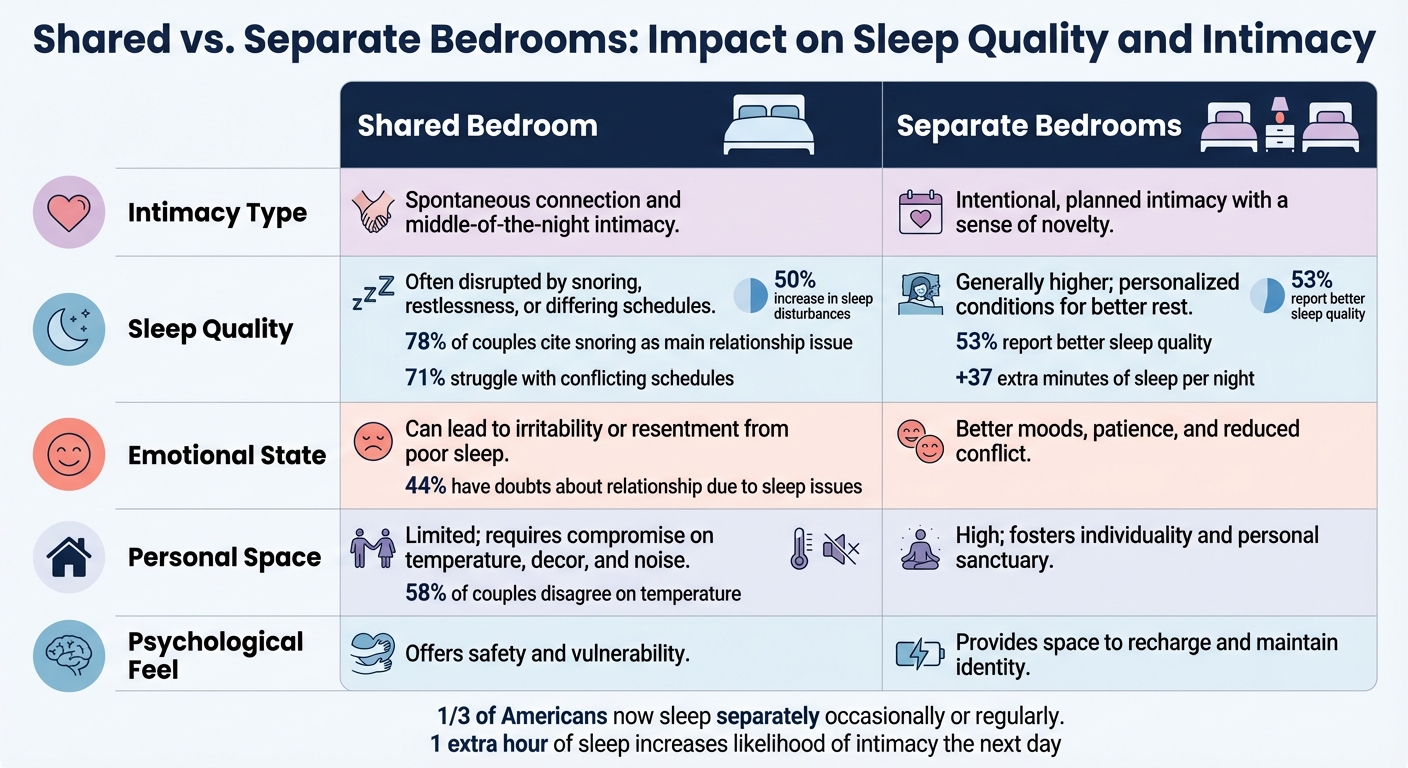
Shared vs Separate Bedrooms: Impact on Sleep Quality and Intimacy
It might seem surprising, but sleeping in separate bedrooms can actually enhance intimacy. This approach creates an environment that nurtures desire, builds anticipation, and supports personal well-being - all of which are crucial for a fulfilling sex life.
Building Anticipation and Rekindling Excitement
Having your own bedroom transforms intimacy into a deliberate choice rather than a habitual expectation. This shift can reignite the spark of early dating, where every encounter feels intentional and exciting. Instead of default togetherness, you’re inviting your partner into your space, creating a sense of novelty.
Sharon Bober, Associate Professor of Psychology at Harvard Medical School, highlights the importance of rest in maintaining desire:
"Getting restful sleep is essential for good health and a good sex life... this might allow for both partners to have more energy, better mood, and consequently more desire for sex." [4]
Wendy Troxel, Senior Behavioral and Social Scientist at RAND Corp, adds:
"It's like taking a sleep vacation from each other, then reuniting. That can be refreshing for a relationship." [5]
This temporary separation fosters a natural longing. While you might have fewer spur-of-the-moment encounters, the planned moments can feel more deliberate and thrilling. Scheduling time together becomes an act of anticipation, which can be a powerful driver of desire.
Preserving Personal Space and Identity
Separate bedrooms also allow you to maintain personal space, which is key to both individual well-being and relationship satisfaction.
Your bedroom becomes a sanctuary tailored to your preferences - whether it’s controlling the temperature, adjusting the lighting, or sticking to your own sleep schedule. This sense of autonomy strengthens your identity within the relationship.
Take Lindsay and James Gardner from Boston, for example. After James caught a cold in 2018, they decided to sleep apart. Lindsay, a therapist, noted:
"We spend a lot of other time together, so it doesn't feel that important to be unconscious next to each other." [3]
When you eliminate frustrations like snoring or conflicting routines, it’s easier to maintain a positive view of your partner. Better-rested individuals are naturally more empathetic, communicative, and - let’s face it - more attractive to their partners. As sex counselor Eric Marlowe Garrison puts it:
"Stress is sex's Kryptonite." [5]
By reducing the stress caused by poor sleep, separate bedrooms can indirectly enhance your libido.
Similarly, Tonia Farmer and Casey Pitts from Ohio started sleeping separately in 2022 due to Casey’s heavy snoring. Tonia, an ENT doctor, observed that the change made them more intentional about staying connected - whether through shared TV time or meaningful conversations. Their sex life thrived because they prioritized conscious connection over simply sharing a bed. [3]
Shared vs. Separate Bedrooms: A Side-by-Side Look
Here’s a quick comparison of how shared and separate bedrooms impact intimacy, sleep, and personal space:
| Feature | Shared Bedroom | Separate Bedrooms |
|---|---|---|
| Intimacy Type | Spontaneous connection and middle-of-the-night intimacy [1] | Intentional, planned intimacy with a sense of novelty [4][6] |
| Sleep Quality | Often disrupted by snoring, restlessness, or differing schedules [3][1] | Generally higher; personalized conditions for better rest [2][4] |
| Emotional State | Can lead to irritability or resentment from poor sleep [1][7] | Better moods, patience, and reduced conflict [3][5] |
| Personal Space | Limited; requires compromise on temperature, decor, and noise [4][7] | High; fosters individuality and personal sanctuary [3] |
| Psychological Feel | Offers safety and vulnerability [1][7] | Provides space to recharge and maintain identity [3][6] |
The numbers back this up: about 53% of people who tried sleeping separately reported better sleep quality, gaining an average of 37 extra minutes of rest per night [8]. And as better rest boosts energy and mood, it creates a positive cycle that can enhance intimacy.
sbb-itb-069f7a3
When Separate Bedrooms Make Sense
Sometimes, separate bedrooms can be the key to a healthier and happier relationship, especially when certain challenges arise. Here’s how to know if this arrangement might work for you.
Couples with Medical or Sleep Disorders
Health issues are one of the most common reasons couples decide to sleep apart. Conditions like sleep apnea, restless leg syndrome, or parasomnias can steal precious hours of rest - up to an hour of sleep per night, in fact [1].
Take Michael Solender from Charlotte, North Carolina, for example. He and his wife have been sleeping in separate bedrooms for 32 of their 42 years together. It all started because of his chronic snoring and sleep apnea. Even after a CPAP machine helped reduce his snoring, they stuck with separate rooms due to differing temperature preferences - he likes it warm, while she prefers it cooler [2].
Sometimes, medical treatments make separate bedrooms a practical choice. Taryn Hillin and Max Gamble from Los Angeles transitioned to separate sleeping arrangements after Hillin was diagnosed with a rare form of cancer in 2017. Chemotherapy made it difficult for her to sleep comfortably, so when they bought a new house in 2019, they opted for two bedrooms. Despite sleeping apart, Hillin shared that their "electric chemistry" and sex life stayed as strong as ever [3].
Dr. Seema Khosla, a pulmonologist and spokesperson for the American Academy of Sleep Medicine, puts it succinctly:
"It's not about avoiding intimacy. It's about recognizing that you can have intimacy, you can have that time together, but then you just sleep apart." [2]
While medical or sleep-related challenges may lead to separate bedrooms, staying emotionally and physically connected requires intentional effort.
Staying Close While Sleeping Apart
Once health concerns are addressed, the next step is ensuring your relationship stays strong. Couples who sleep separately can maintain their connection by creating meaningful rituals and moments of intimacy.
One popular method is the "snuggle and split" approach. Spend 30 to 60 minutes together in one bed before sleeping apart - use the time to cuddle, talk, or be intimate [4]. Another idea is to reconnect in the morning by sharing coffee or conversation in bed to start the day together [4].
Other couples embrace a "tuck-in" routine, where they share a kiss or a quick moment of connection before heading to their separate rooms [2]. Some also opt for part-time arrangements, sharing a bed on weekends or holidays while sleeping apart during the workweek [4].
Separate bedrooms can work beautifully when both partners are well-rested, communicate openly, and make a conscious effort to nurture their bond. In fact, about one-third of Americans occasionally or regularly sleep in separate bedrooms, and the trend is especially growing among millennials [4]. If sleepless nights are causing tension in your relationship, this arrangement might be worth considering.
How to Keep Intimacy Strong While Sleeping Apart
Getting a good night’s sleep can work wonders for your mood and energy, but what happens when you and your partner sleep in separate bedrooms? It doesn’t have to mean losing that spark. In fact, with a little planning, you can keep the connection alive - and even strengthen it. Let’s dive into some practical ways to maintain intimacy while prioritizing rest.
Planning Time for Intimacy and Romance
When it comes to keeping the romance alive, a little planning goes a long way. Knowing you’ve set aside time for intimacy can build anticipation and excitement. Sharon Bober, Associate Professor of Psychology at Harvard Medical School, puts it perfectly: scheduling intimacy "can create a sense of excitement and allow for anticipation" [4].
One idea is to plan a “sleepover” night where you share a bed for some quality time before heading back to your own rooms. Some couples prefer a hybrid approach - sleeping together on weekends while sticking to separate rooms during the workweek. To keep things playful, you could even send each other flirty texts or cheeky “hook-up invitations” from across the house. It’s all about keeping the energy fun and intentional.
Using Roma Llama to Build Anticipation

Sometimes, a little creativity can reignite the spark. That’s where tools like Roma Llama come in. For $4.99, this platform offers personalized romance stories with adjustable “spice levels” and a fun “Roll The Dice” feature to explore new scenarios.
You could send one of these stories as a digital love note before your planned intimate time or read through a randomly selected scenario together. Think of it as a modern twist on love letters - a playful way to share fantasies and keep the connection alive, even when you’re in separate rooms.
Building Shared Rituals Outside the Bedroom
While digital tools can add some spice, shared routines in real life are just as important for keeping your bond strong. Spending 30 minutes a day on simple activities - like enjoying a morning coffee together or taking an evening walk - can do wonders for your relationship.
Some couples also find joy in low-pressure moments, like taking a weekend nap together. Regular check-ins are another great way to ensure your separate sleeping arrangement is working for both of you. As Sharon Bober reminds us, "Just because you don't always sleep in the same bed doesn't mean that you feel separated as a couple" [4].
With a little effort and creativity, sleeping apart doesn’t have to mean growing apart. Instead, it can help you both feel rested, happy, and even more excited to connect.
Conclusion
Choosing to sleep separately can actually strengthen relationships by ensuring both partners get the rest they need to be their best selves. When you're well-rested, you're less irritable, more understanding, and have the energy to genuinely enjoy time with your partner.
This approach has gained traction among couples who see it as a thoughtful and practical choice. It shifts the focus from routine togetherness to intentional moments of connection. As Sharon Bober from Harvard Medical School explains, "Just because you don't always sleep in the same bed doesn't mean that you feel separated as a couple" [4]. Separate bedrooms can foster a sense of novelty and anticipation, replacing habit with meaningful interactions.
Interestingly, this trend is particularly popular among younger couples who view it as a way to prioritize their well-being without compromising their bond. Better sleep can improve mood, enhance intimacy, and boost overall relationship satisfaction. For couples dealing with issues like snoring or differing sleep schedules, this arrangement might be a game-changer.
If you're curious, consider trying it out for a short period. You might find that uninterrupted sleep leads to fewer arguments and a deeper emotional connection. Plus, maintaining closeness is easy with small, consistent efforts - whether it's sharing a morning coffee, planning regular date nights, or creating other meaningful routines. Separate bedrooms don't have to mean growing apart; they can be a step toward a healthier, happier partnership.
FAQs
Can sleeping in separate bedrooms improve communication in a relationship?
Yes, having separate bedrooms can actually improve communication in a relationship. When both partners enjoy uninterrupted, quality sleep, they’re less likely to wake up feeling cranky or on edge. This naturally reduces tension, making it easier to have calm and constructive conversations. A well-rested couple is more likely to approach discussions with patience and understanding.
Separate bedrooms can also encourage more intentional connection. With their own spaces, couples often make a conscious effort to spend quality time together, which can lead to deeper and more meaningful interactions. In this way, physical separation at night can actually help strengthen emotional and communicative bonds during the day.
How can couples stay emotionally and physically connected while sleeping in separate bedrooms?
Staying connected while sleeping apart requires thoughtful effort and attention. Start by making communication a priority. Whether it's a nightly check-in, a quick morning coffee chat, or a weekly date night, carve out time to share your thoughts and stay emotionally aligned.
You can also build a sense of togetherness through shared rituals. Try reading the same book, exchanging a favorite pillow, or listening to the same playlist before bed. Even small gestures can create a feeling of closeness. Physical touch remains important too - schedule moments for cuddling, share a goodnight kiss, or set aside time for intimacy during the week. Many couples find that planning these moments can build anticipation and strengthen their connection.
Lastly, honor each other's sleep preferences, like room temperature, lighting, or noise levels. A restful night’s sleep leaves you both feeling refreshed, which can boost your mood and make the time you spend together even more enjoyable.
Can separate bedrooms help if one partner has a sleep disorder?
Sharing a bed can become tricky when sleep disorders like chronic snoring, insomnia, restless leg syndrome, or even differing sleep schedules come into play. Opting for separate bedrooms can be a game-changer, giving each partner the uninterrupted rest they need. Better sleep often leads to improved mood, higher energy levels, and even a stronger, more satisfying relationship.
When couples prioritize quality sleep, they tend to feel more connected and emotionally present. This can have a positive ripple effect on intimacy and their overall bond. At the end of the day, it’s about finding a setup that keeps both partners happy and well-rested.
Key Takeaways
- 1
Shared vs Separate Bedrooms: Impact on Sleep Quality and Intimacy
- 2
Getting a good night’s sleep can work wonders for your mood and energy, but what happens when you and your partner sleep in separate bedrooms?

Written By
Dr. Elena VancePh.D. in Clinical Psychology
Dr. Elena Vance is a clinical psychologist with over 12 years of experience helping couples navigate the complexities of long-term partnership. Her research focuses on how attachment styles influence digital communication and intimacy in the modern age. She is the author of "The Secure Heart: Navigating Love in a Digital World."
View Expert Profile →Keep Reading
Explore Related Stories

The Rival Chefs
Chef {NAME1} and rival {NAME2} are forced to share a tiny kitchen for a charity event. As they fight over counter space and ingredients, their professional bickering turns into an intense physical hunger.

The Slice of Life Arrangement
{NAME1} and her reclusive neighbor {NAME2} enter into a fake relationship to solve their social problems. As they navigate family events and quiet dinners, their 'arrangement' turns into a real, heartwarming passion.
Reference Sources
This article was developed using research and insights from the following clinical and narrative authorities: