Expert Summary
Clear Sexual SOPs replace guesswork with consent, specific preferences, and regular check-ins to deepen intimacy and boost sexual satisfaction.

Sexual "Standard Operating Procedures": Using Clear Communication to Optimize Pleasure
Talking openly about sex improves relationships, increases satisfaction, and reduces misunderstandings. Yet, many couples avoid these discussions due to discomfort, shame, or fear. Research shows that clear sexual communication leads to more frequent orgasms and higher satisfaction.
A practical way to enhance intimacy is by creating Sexual Standard Operating Procedures (SOPs). These are personalized guidelines that outline preferences, boundaries, and desires. Tools like Yes/No/Maybe lists help partners identify mutual interests while addressing consent and emotional needs. Regular check-ins ensure these SOPs evolve with the relationship.
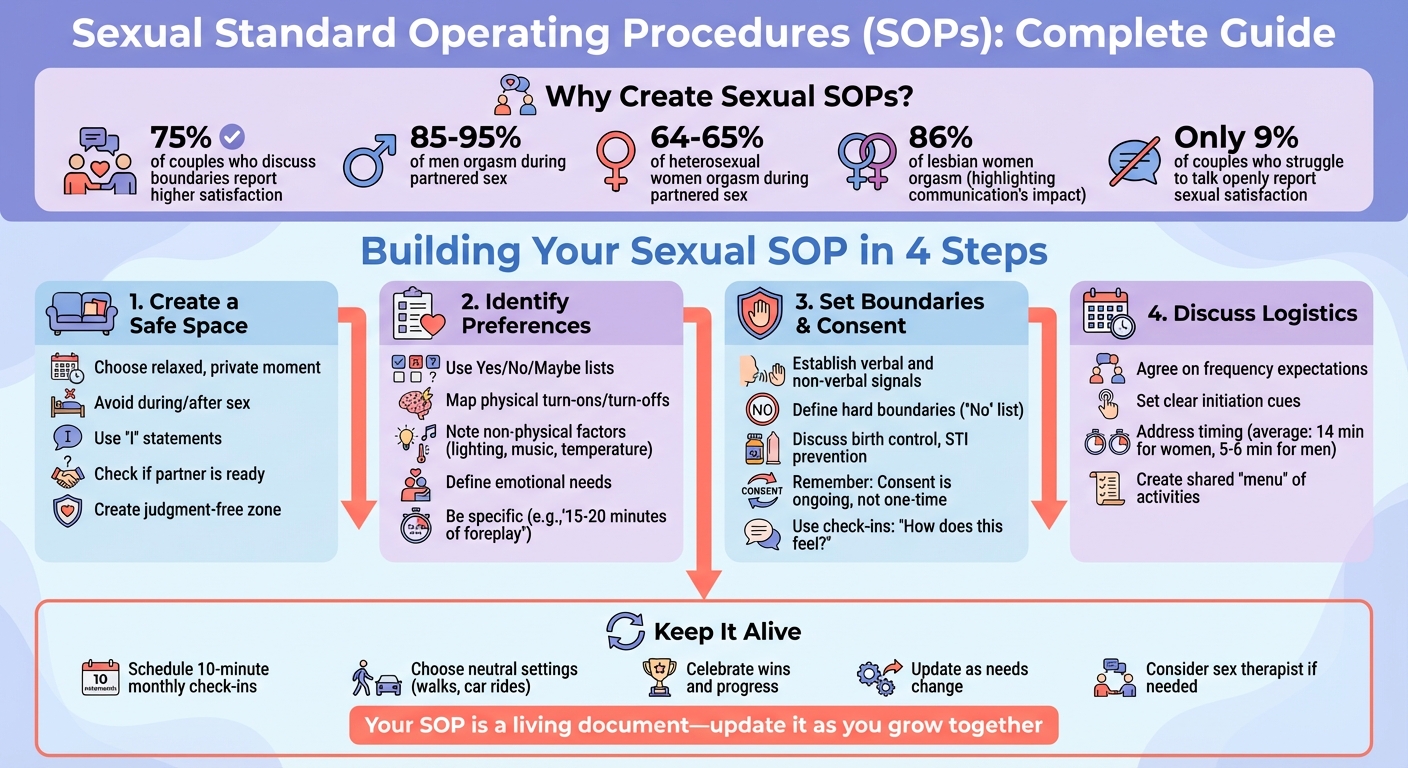
How to Create Your Sexual Standard Operating Procedures: A Step-by-Step Guide
What Are Sexual Standard Operating Procedures?
Defining Sexual SOPs
Sexual Standard Operating Procedures (SOPs) are personalized guidelines that outline your preferences, boundaries, and protocols - a sort of "how-to guide" for your intimate life that removes the need for guesswork [7].
Unlike vague advice, sexual SOPs are practical and specific. They break down intimacy into clear, actionable steps, covering roles, responsibilities, and preferences. As Stanley E. Althof, Ph.D., Professor of Psychology at Case Western Reserve University School of Medicine, explains:
The SOP presented in this article offers... a brief, structured, and uniform method for obtaining a sexual history from men or women seeking health care services [6].
One common tool in these SOPs is the Yes/No/Maybe list, which categorizes activities into three groups: things you’re excited about (Yes), things you’re not open to (No), and activities you might consider under the right circumstances (Maybe) [7]. This structured approach fosters what Dr. Yamicia Connor describes:
This isn't about having awkward conversations that kill spontaneity. It's about building a shared vocabulary for pleasure that enhances intimacy and creates the foundation for consistently satisfying sexual experiences [2].
By replacing ambiguity with clarity, sexual SOPs pave the way for a deeper, more fulfilling connection, as explored further below.
Why Sexual SOPs Work
Sexual SOPs address common communication gaps by formalizing preferences and expectations. They remove the unrealistic assumption that partners should instinctively know each other's desires. As psychosexual and relationship psychotherapist Silva Neves notes:
Being 'good at sex' is a learned behavior, not something we just instinctively know how to do [8].
These guidelines act as a learning framework to build that knowledge.
Research backs this up: 75% of couples who regularly discuss their sexual boundaries and desires report higher satisfaction and intimacy in their relationships [9]. Sexual SOPs also play a role in addressing the orgasm gap. For example, while 85–95% of men report orgasming during partnered sex, only 64–65% of heterosexual women do. However, lesbian women report an 86% orgasm rate, highlighting how communication and understanding are key drivers of sexual satisfaction [2].
sbb-itb-069f7a3
How to Start the Sexual SOP Conversation
Setting Up a Safe Space for Discussion
The first step in opening up about sexual preferences is choosing the right moment and setting. Timing matters - avoid bringing up these topics during or right after sex, as it can come across as criticism of the experience you just shared [10]. Instead, aim for a relaxed, private moment when both of you are calm and fully dressed. Casual settings, like a walk or a car ride, can make the discussion feel less intimidating.
Before starting, check in with your partner to see if they feel ready to talk about intimacy [11]. If either of you feels stressed or distracted, it’s okay to reschedule. Dr. Sarah Schewitz, psychologist and founder of Couples Learn, emphasizes:
Talking about sex is helpful and essential in any relationship. [11]
Acknowledge that the conversation might feel awkward - sometimes just saying it out loud can help break the tension. Then, steer the focus from problems to possibilities. What do you want to create together? Starting with appreciation, like mentioning something you already enjoy about your intimacy, can set a positive and encouraging tone.
Use "I" statements, such as "I feel more connected when we…" to express your feelings without sounding accusatory. Pair this with active listening techniques, like summarizing what your partner shares to show you’re fully engaged. Sex therapist Nan Wise, Ph.D., suggests creating a judgment-free zone - what’s shared in the conversation should stay private and safe from future criticism [3].
Dealing with Discomfort and Vulnerability
Even with a safe space, it’s natural to feel uneasy discussing sex. Society doesn’t often provide us with the tools or language to navigate these conversations comfortably [3]. Still, leaning into that discomfort is key to building deeper intimacy. Studies show that only 9% of couples who struggle to talk openly about sex report feeling sexually satisfied [1]. Pushing through the awkwardness can lead to a more fulfilling connection.
If the topic feels overwhelming, start small. Share your general feelings about sex or reflect on how your upbringing shaped your views on intimacy. This softer approach shifts the focus from performance to the enjoyment of sensuality.
One practical tool is the "Amorous Scale." Rate your current level of arousal on a scale from 1 ("not interested") to 9 ("absolutely yes!"). This method acknowledges that desire naturally ebbs and flows depending on factors like stress [1]. As couples therapist Kyle Benson explains:
The less direct you are about what you want, the less likely you are to get it. [1]
What to Include in Your Sexual SOP
Turn-Ons and Turn-Offs
A solid sexual SOP starts with understanding what excites and what doesn’t. Being specific eliminates guesswork and helps create a clear path to mutual enjoyment.
For physical preferences, go beyond vague statements. Instead of saying, "I like touching", you might say, "I enjoy slow, circular motions on my lower back", or "I need about 15–20 minutes of kissing before moving on." As psychosexual therapist Silva Neves puts it:
"It is your responsibility to own your sexuality and express it clearly: 'I like my feet massaged to get me in the mood,' 'I like deep kissing throughout sex,' 'I prefer not to make eye contact during penetration,' etc." [8]
Non-physical factors matter just as much. Things like lighting, music, or even room temperature can set the tone. Emotional needs, such as feeling desired or chosen, also play a huge role. Using a desire mapping approach can help outline these specific conditions for intimacy.
A helpful tool for organizing preferences is the "Yes–No–Maybe" framework. This method lets you and your partner identify activities you’re enthusiastic about, unsure of, or completely against. Anything on the "No" list should stay there to avoid pressure or misunderstandings.
Once preferences are clear, the focus shifts to ensuring ongoing consent and setting boundaries.
Consent Signals and Boundaries
After identifying what works for you physically and emotionally, it’s time to agree on how to communicate consent and define boundaries. As Dr. Yamicia Connor explains, "Consent isn't a one-time agreement but an ongoing conversation that continues throughout sexual experiences" [2]. This means incorporating signals that make sense for both partners. These could be verbal cues, like specific words, or non-verbal ones, such as a hand squeeze, to pause or stop immediately.
Boundaries should be explicit and cover more than just physical acts. They might include preferences for birth control, STI prevention, or even rules about mixing intimacy with alcohol. Using "I" statements - like "I feel uncomfortable when…" - can make these discussions less confrontational.
During intimate moments, verbal check-ins like "How does this feel?" or "Do you want me to continue?" are simple ways to ensure everyone is comfortable. Research even shows that clear sexual communication is linked to higher satisfaction and more frequent orgasms [2].
Frequency, Initiation, and Specific Preferences
Now that you’ve outlined preferences and boundaries, it’s important to address how often and in what ways intimacy will happen. Mismatched levels of desire are common, so discussing frequency openly is key. Whether it’s weekly, several times a month, or another rhythm, having a plan can help avoid misunderstandings.
Initiation cues are just as important. These can be verbal, like saying, "I’d love to be close to you tonight", or non-verbal, such as a specific touch or look. Defining these signals helps eliminate uncertainty or anxiety around initiating intimacy.
When discussing preferences, specifics make all the difference. Instead of saying, "I need more foreplay", try something like, "I usually need 15–20 minutes of touching before penetration." Timing can also be a factor. For example, studies show the average partnered orgasm for women takes about 14 minutes, while men typically reach ejaculation in 5–6 minutes [2]. If timing is an issue, options like manual stimulation, toys, or alternating focus can help bridge the gap.
| SOP Element | Action Steps |
|---|---|
| Frequency | Discuss how often intimacy is desired and create a plan to address mismatched levels of desire. |
| Initiation | Set clear verbal or non-verbal "green light" signals to indicate readiness for intimacy. |
| Specific Acts | Use a Yes–No–Maybe list to identify mutual interests and build a shared "menu" of enjoyable activities. |
| Boundaries | Clearly outline non-negotiable items, whether they involve specific acts or other factors like alcohol use. |
Tools and Questions for Building Your Sexual SOP
Questions to Explore Preferences
Starting a conversation about intimacy doesn’t have to be uncomfortable. The right prompts can make it feel natural - even enjoyable. As Vanessa Marin, MA, MFT, explains:
Most couples only ever talk about sex when they're fighting, so a prompt that invites partners to offer genuine compliments or share a favorite memory can be a refreshing change of pace [13].
You can try prompts like, “I feel the most desired by you when…” or “My favorite memories of being intimate with you include…” to keep the discussion positive. Other helpful questions include, “One thing I would like to explore with you is…” or “How do you want to feel during sex?” These focus on emotions and experiences rather than just physical actions. For a deeper dive, you might ask, “What language do you want to use (or avoid) during play?” or “I love when you initiate sex in this way…”
It’s important to create a safe space for these conversations. Allow your partner to skip any questions that feel too intense, and choose a time when you’re both relaxed and free from distractions.
To take things further, structured tools like the Yes/No/Maybe list can help clarify mutual interests.
Using Yes/No/Maybe Lists
The Yes/No/Maybe list is a practical way to identify shared interests. Each partner completes the list privately before comparing answers. A "Shared Yes" only happens when both partners mark an activity as "Yes." If even one partner marks it as "No", it becomes a "Shared No."
There are various versions of these lists tailored to different needs:
- The Scarleteen Checklist: Designed by Heather Corinna and CJ Turett, this version is great for younger or less experienced individuals. It includes topics like body boundaries and safer sex practices [12].
- Bex Caputo's Comprehensive List: This version allows you to differentiate between activities you’re personally excited about and those you’re willing to try for your partner. It also covers feelings and specific language preferences [12].
- Autostraddle Worksheets: Created by A.E. Osworth, these worksheets delve into topics like lube and toy materials, dirty talk, and general turn-ons.
One key rule: if your partner marks something as a "No", it’s off the table. Nicole Kammerlocher emphasizes:
A No does not mean that your partner is rejecting you or judging you... they are expressing that they are not interested in it or do not think they would enjoy it [14].
These lists are a foundation for building your Sexual SOP, helping to spark deeper discussions and create agreements that work for both partners.
Using Roma Llama Stories to Explore Fantasies

If structured lists feel limiting, creative exploration can open new doors. Roma Llama offers personalized romance stories that let couples explore fantasies together. This platform acts as a psychological "Third Space", where partners can step outside everyday constraints and dive into imaginative scenarios.
Couples can co-create stories by selecting subgenres, romance tropes, and character archetypes, building a shared erotic language. Sex therapist Olivia A. describes it as:
Roma Llama is a breakthrough in digital intimacy. It provides a safe, imaginative space for couples to rediscover one another through shared creative exploration [15].
The fictional nature of these stories offers a buffer, making it easier to explore fantasies without the pressures of real-life expectations.
You can customize settings, spice levels, and character details to reflect your relationship. The platform respects your privacy - no logins or tracking are required. Premium stories are available for $4.99, and they can serve as conversation starters, helping you identify preferences to incorporate into your Yes/No/Maybe list or Sexual SOP.
How to Talk About Sex With Your Partner (Without Shame or Rejection)
Putting Your Sexual SOP into Practice
Once you've created your Sexual SOP, the next step is to bring it to life. Its real value lies in how you use it to stay in sync with your partner's changing needs and desires. Think of it as a living document that evolves alongside your relationship.
Scheduling Regular Check-Ins
Your Sexual SOP isn't something you set and forget - it requires regular attention. A short monthly check-in is a great way to keep it updated and relevant [16]. Aim for about 10 minutes to keep things low-pressure and focused [16].
Timing and setting are key. Choose a neutral, relaxed environment, like a quiet walk or a car ride, rather than the bedroom. Avoid discussing updates during or right after sex, as that can feel like a critique rather than a constructive conversation [10][16]. Always check in with your partner beforehand to make sure you're both in the right mindset for the discussion [8].
Start these conversations on a positive note. Highlight what’s working by saying things like, "I’ve really enjoyed when we..." or "I feel incredible when..." Using "I" statements helps express your needs without sounding critical [10][8]. If emotions start to run high, take a break and revisit the topic when you’re both feeling calmer [8].
Making these check-ins a regular habit helps normalize the discussions. It can become as routine as planning a weekend getaway [16]. Sex educator Emily Morse describes it as:
You're planting the seeds for the sex life to come [16].
These regular conversations create space for updates and keep your SOP relevant.
Tracking Progress and Making Updates
Sexual preferences and boundaries change over time, so it’s important to update your SOP to reflect those shifts [10][16]. Before each check-in, take a moment to reflect on your own needs and boundaries [10]. Use the conversation to celebrate wins - like trying something new or respecting a boundary - which reinforces the importance of your SOP [10][16].
If a discussion doesn’t go as planned, try a "do-over" by role-playing the conversation again. This allows you to practice expressing your needs more clearly and compassionately [5].
Respect previously set boundaries. If your partner has said "No" to something, avoid bringing it up repeatedly, as it can feel coercive. When new preferences are shared, approach them with an open mind. Dr. Yamicia Connor suggests:
Try to hear them as gifts of intimate information rather than criticisms of your performance [2].
If your check-ins often lead to tension or misunderstandings, consider working with a sex therapist for additional guidance [10][8]. As psychotherapist Vanessa Marin explains:
One of the best things you can do for your relationship is think of you and your partner as teammates, working together against whatever is getting in the way of having the sex life of your wildest dreams [4].
Conclusion: Building Better Intimacy Through Communication
A Sexual SOP isn’t about turning intimacy into a rigid checklist - it’s about creating a space for trust, honesty, and teamwork that allows great sex to flourish. When you treat sexual satisfaction as a shared journey instead of a solo mission, your relationship becomes a true partnership.
Poor communication often stands in the way of sexual fulfillment. Being open about your desires not only increases the chances of getting what you want but also eliminates the guessing games that can lead to frustration. A Sexual SOP equips you to be direct, vulnerable, and sincere with your partner. It clears up confusion, prevents resentment from festering, and fosters a safe environment where both partners feel understood and appreciated. This clarity strengthens trust and lays the groundwork for ongoing, meaningful conversations.
When your partner knows your boundaries, respects your needs, and works with you rather than against you, emotional intimacy deepens naturally. As your relationship evolves, so will your desires and limits.
Think of your SOP as a living guide. Your needs and preferences will change over time, and the couples who thrive are those who keep the dialogue alive. Whether it’s using Yes/No/Maybe lists, exploring fantasies with Roma Llama stories, or scheduling monthly check-ins over coffee, you’re building a sex life that improves over time - not one that stagnates.
Even if it feels awkward at first, the long-term rewards are worth it.
FAQs
How do we write a sexual SOP without it feeling awkward?
To create a sexual Standard Operating Procedure (SOP) without feeling awkward, prioritize open and clear communication. Begin by having a conversation about boundaries, desires, and preferences in a relaxed and judgment-free environment. Using tools like a "Yes-No-Maybe" list can add a playful element, making the discussion feel less daunting. Take your time, use encouraging language, and focus on mutual enjoyment to ensure both partners feel safe and comfortable throughout the process.
What if my partner’s “No” conflicts with something I really want?
When your partner says “No,” it’s important to respect it as a boundary. Take the time to communicate openly, aiming to understand each other’s feelings and viewpoints without applying pressure. If the disagreement continues, consider finding compromises that address both of your needs - like exploring alternative ways to connect or agreeing to revisit the conversation later with mutual consent. Building trust, maintaining respect, and fostering clear communication are essential for working through these moments together.
How can we safely talk about fantasies without feeling pressured?
To have a meaningful and safe conversation about fantasies, start by creating a calm, private environment where both of you feel comfortable. Avoid initiating this discussion during or immediately after sex, as that might make the situation feel rushed or emotionally charged.
Acknowledge that fantasies are a normal part of human nature - this helps remove any stigma or awkwardness. Approach the topic with empathy and a sense of trust, making it clear that the conversation is about openness, not judgment. Share your own thoughts honestly and encourage your partner to do the same, ensuring they feel safe to express themselves without fear of criticism.
The focus here should be on building mutual understanding and strengthening intimacy, rather than placing any kind of expectation or pressure on each other.
Key Takeaways
- 1
Sexual Standard Operating Procedures (SOPs) are personalized guidelines that outline your preferences, boundaries, and protocols - a sort of "how-to guide" for your intimate life that removes the need for guesswork [7].
- 2
Starting a conversation about intimacy doesn’t have to be uncomfortable.
- 3
A Sexual SOP isn’t about turning intimacy into a rigid checklist - it’s about creating a space for trust, honesty, and teamwork that allows great sex to flourish.

Written By
Marcus ThorneLicensed Marriage and Family Therapist (LMFT)
Marcus Thorne specializes in transforming high-conflict relationships into resilient partnerships. With a background in behavioral therapy, Marcus focuses on practical communication frameworks that help couples move from "fighting" to "connection." He has led over 200 workshops on the Gottman Method.
View Expert Profile →Keep Reading
5 Common Oral Sex Mistakes You Might Be Making (And How to Fix Them)
Read Article →The Formula for Breaking Your Sexual Routine Without the Awkwardness
Read Article →How to Create an Erotic "Yes, No, Maybe" List (and Why Every Couple Needs One)
Read Article →How to Set Sexual Boundaries Without Harming Your Relationship
Read Article →Explore Related Stories

The Vendetta
As the heirs to warring crime syndicates, {NAME1} and {NAME2} are forced to share a bulletproof villa during a mandatory truce summit. In the silence of the Sicilian night, their mutual hatred transforms into a violent, high-heat passion. They must navigate their loyalty to their families while surrendering to a physical connection that threatens to burn both their empires to the ground.

The Safehouse Shadow
{NAME1} is a key witness in a federal trial, sequestered in a remote, one-bedroom mountain cabin with {NAME2}, a reclusive enforcer whose methods are as dark as the men hunting her. As a record-breaking blizzard cuts them off from the world, the high-tension atmosphere of the safehouse transforms from a prison into a space of intense, obsessive surrender.
Reference Sources
This article was developed using research and insights from the following clinical and narrative authorities: