Expert Summary
Soft-launching ethical non‑monogamy preserves trust by prioritizing honest motives, clear boundaries, and regular check‑ins.

Soft Launching Non-Monogamy: How to Explore ENM Without Blowing Up Your Life
Opening up your relationship to ethical non-monogamy (ENM) can feel like a big step, but starting slowly can help you avoid unnecessary stress. ENM includes relationship styles like polyamory, open relationships, swinging, and monogamish arrangements. What sets ENM apart is consent, clear communication, and honesty among all involved.
Here’s how to approach ENM in a way that keeps your relationship stable:
- Start slow: Gradual steps allow time to adjust and maintain trust.
- Clarify your reasons: Understand your motivations - personal growth works better than using ENM as a way to fix issues.
- Check relationship health: Strong communication and mutual willingness are key.
- Have open conversations: Use calm, respectful dialogue to explore the idea with your partner.
- Set boundaries: Create agreements on time, health, and privacy to ensure everyone feels secure.
ENM is about intentional choices, not quick fixes. With patience, regular check-ins, and mutual respect, you can navigate this shift without jeopardizing your relationship.
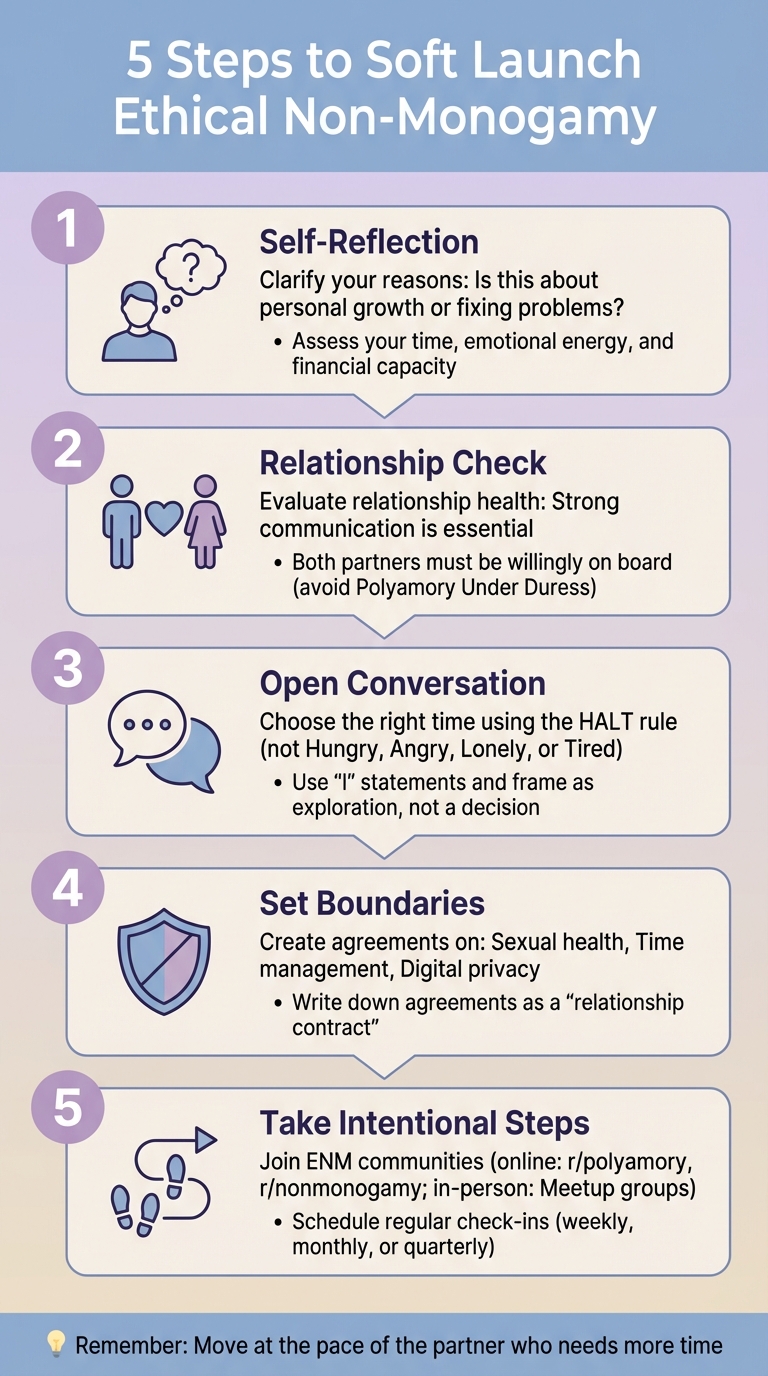
5-Step Guide to Exploring Ethical Non-Monogamy Safely
A Beginner’s Guide to Non-Monogamy with Emma and Fin | Sleeping Around
sbb-itb-069f7a3
Checking If You're Ready for ENM
Before discussing ENM (Ethical Non-Monogamy) with your partner, it's worth taking a step back to examine your own motivations. This isn't about passing some kind of test - it's about understanding why you're drawn to this shift and whether your relationship has the stability to navigate it.
Clarifying Your Reasons
Why do you want to explore ENM? Be honest with yourself: Is it about expanding your life, or are you looking for a way to escape issues in your current relationship? ENM tends to work best when it's rooted in a desire for personal growth, not as a quick fix for dissatisfaction [3][5].
People are often motivated by a variety of reasons, such as the desire for deeper emotional connections with multiple partners, seeking sexual variety, or exploring different aspects of their identity through new relationship dynamics [2][3]. Others value the freedom to move beyond traditional expectations or believe that love isn't something that needs to be confined to one person [6]. A 2022 study in Sexologies identified eight key motivations for polyamory, including meeting needs that monogamy doesn't fulfill and expressing certain political or personal values [5].
But here's the practical side: Do you actually have the time and emotional energy for additional relationships? Registered Clinical Counselor Meg Wilson puts it succinctly:
"Love is not a limited resource but we might have limited time or emotional bandwidth" [1].
Take a hard look at your schedule, finances, and commitments. Can you afford the extra time and costs that come with dating or arranging childcare for additional date nights? [4] Are you seeking more love, more sex, or both? Answering these questions can help you figure out which ENM structure might suit you best [5].
Once you've thought through your motivations, shift focus to your current relationship. Is it in a good place to support this kind of change?
Reviewing Your Current Relationship
ENM doesn't fix existing relationship problems - it magnifies them [4][7]. Both partners need to be on board willingly. If one partner feels pressured into agreeing, often referred to as "Polyamory Under Duress", the chances of success drop significantly [7][1].
Take a moment to evaluate your ability to handle conflict. Do you and your partner address issues openly, or do you tend to avoid them? [7] Strong communication and conflict resolution skills are critical, as ENM will require frequent, honest conversations. As sex and relationship therapist Leah Carey points out:
"What being non-monogamous actually means is that you have tons of conversations" [7].
Here's a helpful thought experiment: Picture your partner at a social event, clearly enjoying themselves with someone who fits their "type." How does that make you feel? Do you feel threatened, or can you genuinely share in their happiness? [7] Your gut reaction can reveal a lot about your emotional readiness.
Interestingly, research suggests that relationship satisfaction levels are similar between monogamous and non-monogamous couples [6]. However, this only holds true when both partners willingly embrace ENM and the relationship is already built on a healthy foundation.
How to Talk to Your Partner About ENM
Opening up a conversation about ENM (Ethical Non-Monogamy) with your partner can feel daunting, but it all starts with thoughtful communication. The goal is to create a space where both of you feel safe to explore the idea together.
Picking the Right Time and Place
Timing is everything. Choose a calm, distraction-free moment when you’re both relaxed. Avoid times when either of you might be Hungry, Angry, Lonely, or Tired - also known as the HALT rule [11][12]. Think of moments like a peaceful Sunday afternoon, a leisurely breakfast on the weekend, or a cozy evening at home. Steer clear of bringing it up during stressful periods, right before bed, or when your partner is rushing out the door [12].
A small but thoughtful gesture, like sharing a snack beforehand, can help set a relaxed tone. And before diving in, ask for their consent to have the conversation. Something simple like, "I’ve been thinking about something important - are you in a good headspace to talk about it?" can show respect and build trust right from the start [10].
If jumping straight into the topic feels overwhelming, consider starting with a broader discussion about ENM as a concept. You could watch a show like Sense8 or Wanderlust together or share an article about non-monogamy to gauge their initial thoughts [12].
Once the timing feels right, focus on framing the conversation in a way that invites collaboration.
Framing the Discussion Positively
How you approach this conversation matters. Instead of presenting ENM as a decision you’ve already made, frame it as something to explore together. For example, rather than saying, "I want an open relationship", you might say, "I’ve been curious about what non-monogamy could look like for us - can we explore this idea together?" [9].
Using "I" statements can help keep the focus on your own feelings rather than implying any shortcomings in your partner or relationship [8]. Licensed Marriage and Family Therapist Allison Marx emphasizes the importance of vulnerability in these discussions:
"being honest about yourself and your desires is a very vulnerable thing to do, and requires a lot of trust in your partner and your relationship" [12].
Make it clear that your interest in ENM isn’t about dissatisfaction but about growth and exploring new possibilities together [13]. You can also explain how ENM might help ease the pressure on one partner to fulfill every emotional or sexual need [1].
Don’t expect an immediate response. As Allison Marx advises:
"approach the conversation with curiosity rather than a goal" [12].
Give your partner time to process - it’s normal for this to take days or even weeks [12]. A three-phase approach can be helpful. Start with an "Elevator Pitch" to introduce the topic, follow up with a brief Q&A to address initial concerns, and then move toward an "Exploratory Committee" phase where you both research and plan together [10].
Throughout the conversation, active listening is key. Reflect your partner’s concerns back to them by saying things like, "What I’m hearing is that you’re worried about..." This ensures they feel heard and valued [12]. As Counselor Adrian Matthews puts it:
"Consensual non-monogamy shouldn’t feel like something that’s being done to you, or your partner; it should feel like something that’s being done with" [10].
Creating Boundaries and Agreements
After having an open conversation about ENM, the next step is to establish clear agreements that maintain trust and create a sense of safety for everyone involved. This stage is all about working together to build a framework that respects each person’s needs while allowing room for exploration. Think of it as a collaborative effort to ensure everyone feels secure and valued, rather than a way to impose control.
Setting Practical Boundaries
It’s crucial to distinguish between personal boundaries and shared agreements. As therapist Prentis Hemphill explains:
"Boundaries are the distance at which I can love you and me simultaneously." [14]
Personal boundaries are about protecting your emotional space, while agreements are shared understandings that help create a foundation of trust. These agreements act as bridges, ensuring everyone feels safe while still allowing room for individual freedom.
When setting these agreements, consider addressing key areas like:
- Sexual health: Decide on testing frequency (experts recommend every three months for those with multiple regular partners [14]), use of barriers, and which activities require prior discussion.
- Time management: Plan how to schedule dates, manage weekends versus weekdays, navigate holidays, and decide whether shared spaces should remain exclusive.
- Digital privacy: Discuss what details are appropriate to share on social media and how to handle communication during dates.
Dr. Sara Al-Khedairy captures the essence of this process perfectly:
"Boundaries are an act of love and sustainability - allowing us to connect with others without abandoning ourselves." [14]
To ensure clarity, consider writing down your agreements in a "relationship contract" or "shared map." This isn't about legalities but about having a clear reference point during emotionally charged situations. And remember, move at the pace of the person who needs more time to feel comfortable - it’s about mutual respect.
Planning Regular Check-Ins
Boundaries aren’t static; they shift as relationships evolve. Make it a habit to schedule regular check-ins - weekly, monthly, or quarterly - to revisit what’s working and what might need tweaking. These conversations can help you address "what-if" scenarios, process emotions after significant events, and ensure everyone remains on the same page.
Relationship coach Marcus Lee emphasizes this ongoing process:
"Effective boundary-setting is an ongoing process that requires self-awareness, honest dialogue, and the willingness to adapt." [15]
Early boundaries often provide a sense of security but may feel less necessary as trust deepens. It’s normal for something that feels essential now to seem less critical in six months. These regular, open discussions are key to building a strong and flexible ENM relationship.
Taking Safe and Intentional Steps
Once you've established your boundaries, it's time to take careful and deliberate steps forward. These actions ensure that your journey remains thoughtful and secure, building on the foundation of trust and communication you've already set.
Joining ENM Communities
Connecting with others who share similar experiences can provide a sense of reassurance and guidance. Online spaces like Reddit's r/polyamory and r/nonmonogamy host daily discussions where you can learn from others' journeys while maintaining your anonymity. For those exploring diverse relationship models, apps such as Feeld and #open offer welcoming environments. Additionally, platforms like Discord feature active support groups where you can ask questions and receive real-time advice.
If you're looking for in-person connections, consider checking out Meetup.com for local ENM-focused social events. You might also find workshops and discussion groups at sex-positive cafes, independent bookstores, or LGBTQ+ centers. Organizations like OPEN (Organization for Polyamory and Ethical Non-monogamy) facilitate peer support circles, while the National Coalition for Sexual Freedom (NCSF) provides resources on topics like consent and legal rights. Before attending any in-person event, it’s a good idea to establish a safety signal with your partner to ensure you both feel secure.
Using Personalized Stories to Explore Fantasies
In addition to community engagement, digital tools can help you safely explore fantasies and potential scenarios. For example, Roma Llama offers a unique platform where you and your partner can create intimate, tailored stories. For $4.99, you can craft narratives that align with your specific desires, power dynamics, or ENM-related situations. The platform allows you to adjust spice levels, customize details, and explore scenarios - all without the need for logins or subscriptions.
This storytelling approach can help simulate situations and uncover potential challenges. As relationship psychologist Caitlin Schmidt, Ph.D., explains:
"Ethical storytelling invites readers into a conversation not a performance. It invites empathy not judgment. It builds trust rather than eroding it" [16].
These stories encourage emotional preparation by prompting discussions about handling jealousy, planning aftercare, and ensuring you're both aligned in your expectations - essentially confirming that you're "reading from the same script" [16][17]. By addressing "what if" scenarios in a controlled way, you can identify possible issues before they arise in real-life situations. This practice strengthens trust and sets the stage for deeper, more meaningful interactions.
Conclusion
Ethical non-monogamy doesn’t have to completely upend your life. The key is to approach it with clear communication, mutual respect, and a sense of purpose. Start by understanding your reasons for exploring this path, and always move at a pace that feels comfortable for the partner who needs more time.
By focusing on open and honest conversations, you can shift from unspoken assumptions to clear agreements about boundaries, schedules, and sexual health. This kind of clarity helps build trust. And when jealousy arises, treat it as a signal to explore unmet needs rather than as a sign of failure.
Interestingly, research indicates that people practicing ENM experience levels of relationship and sexual satisfaction similar to those in monogamous relationships, showing that intentional connection is at the heart of both [19]. Joining this path means becoming part of a community that values deliberate, thoughtful relationships over automatic routines.
As discussed earlier, breaking the process into smaller, manageable steps is essential. Leaning on community support and scheduling regular check-ins can make the transition smoother. Dr. Tammy Nelson puts it this way:
"Integrating a more open agreement into your monogamy does not have to mean you are breaking up... In fact, it should be a sign that you are on solid ground and you want to bring more excitement and energy into the partnership" [18].
Your relationship can grow and adapt while keeping trust, honesty, and care at its core.
FAQs
How do I know if my relationship is strong enough to open up?
Before considering non-monogamy, take a close look at the state of your relationship. Is it built on trust, open communication, and a solid emotional bond? These elements are essential. If you and your partner can navigate conflicts in a healthy way and feel secure in your connection, it might be a sign that you're ready to explore this path. On the other hand, introducing non-monogamy into a relationship that's already facing challenges can often make things worse. It's important to ensure both of you are emotionally prepared and have thought through the practical aspects before taking this step.
What’s the safest first step to try ENM without dating yet?
The best way to start is by having an open and honest conversation with your partner. Share your curiosity and motivations while focusing on understanding each other's perspectives and establishing boundaries. Take time to reflect on why you're considering ENM (Ethical Non-Monogamy), and introduce the idea in a way that emphasizes trust and working together. Clear communication and giving your partner the space to express their feelings are key to ensuring you're both on the same page before moving forward.
How do we handle jealousy when it shows up?
Jealousy is a common emotion that often stems from feelings of insecurity or fear. To address it effectively, start by identifying its root causes. Open communication with your partner can help clarify misunderstandings and foster trust. Take time for self-reflection to better understand your emotions, needs, and personal boundaries. Feeling jealous doesn’t mean you’ve failed - it’s a chance to grow, both individually and within your relationship.
Key Takeaways
- 1
sbb-itb-069f7a3
- 2
Opening up a conversation about ENM (Ethical Non-Monogamy) with your partner can feel daunting, but it all starts with thoughtful communication.
- 3
Once you've established your boundaries, it's time to take careful and deliberate steps forward.

Written By
Marcus ThorneLicensed Marriage and Family Therapist (LMFT)
Marcus Thorne specializes in transforming high-conflict relationships into resilient partnerships. With a background in behavioral therapy, Marcus focuses on practical communication frameworks that help couples move from "fighting" to "connection." He has led over 200 workshops on the Gottman Method.
View Expert Profile →Keep Reading
Explore Related Stories

The Rival Chefs
Chef {NAME1} and rival {NAME2} are forced to share a tiny kitchen for a charity event. As they fight over counter space and ingredients, their professional bickering turns into an intense physical hunger.

The Slice of Life Arrangement
{NAME1} and her reclusive neighbor {NAME2} enter into a fake relationship to solve their social problems. As they navigate family events and quiet dinners, their 'arrangement' turns into a real, heartwarming passion.
Reference Sources
This article was developed using research and insights from the following clinical and narrative authorities: