Expert Summary
The phrase "You complete me" fosters unrealistic expectations and codependency. Learn how emotional independence and self-completeness build healthier relationships.

Why "You Complete Me" Is the Worst Relationship Advice Ever Given
The phrase “You complete me” might sound romantic, but it sets up unrealistic expectations in relationships. This mindset assumes your partner should fill every emotional gap, which can lead to:
- Unrealistic expectations: No one person can meet all your needs.
- Codependency: Losing your sense of self by relying too much on your partner.
- Blocked personal growth: Depending on someone else can stop you from growing as an individual.
Instead, healthy relationships thrive when both individuals are emotionally independent. By focusing on self-completeness, you take pressure off your partner and create a stronger, balanced connection. The goal is to share happiness, not depend on someone else for it.
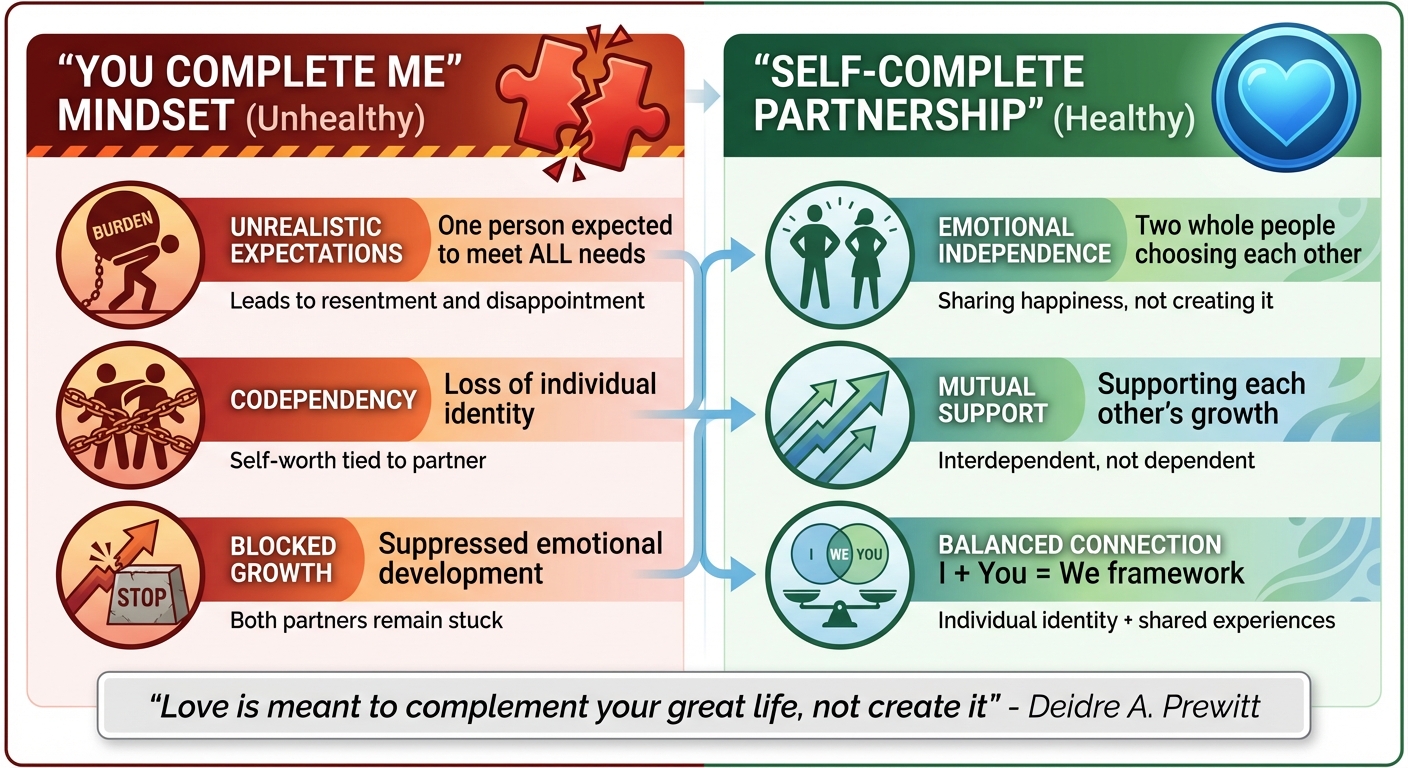
You Complete Me vs Self-Complete Relationships Comparison
Building Self LOVE = HEALTHY Relationships!
Why 'You Complete Me' Damages Relationships
The phrase "You complete me" might sound like the epitome of romance, but it can quietly undermine the foundation of a healthy relationship. Rooted in fear and unrealistic expectations, this mindset often leads to unnecessary strain between partners. Here's how it plays out.
Setting Unrealistic Expectations
Believing that one person can meet all your emotional and practical needs is simply asking too much. As Esther Perel points out, we now expect from a single partner what entire communities used to provide [5]. This can lead to a vicious cycle: one partner feels crushed under the weight of being "everything", and the other feels disappointed when their needs aren't fully met. Over time, these unmet expectations can breed resentment, insecurity, and constant arguments [4].
Creating Codependency
Beyond setting the bar too high, this mindset often fosters codependency. When your sense of self-worth becomes tied to your partner, you risk losing sight of who you are as an individual [6]. You might give up hobbies, suppress parts of your personality, or rely solely on your partner for emotional support. But this isn't true intimacy - it's self-erasure. As Barbara Markway, Ph.D., puts it:
If we're panicked at the thought of being alone, we're likely to become needy and desperate, and we don't learn how to be emotionally self-sufficient [1].
Blocking Personal Growth
Relying on your partner to fill in the gaps in your own development - whether it's emotional expression or decision-making - can stunt personal growth. Therapists call this "suppressed emotional development", where one partner becomes overly dependent while the other takes on a caretaker role [2]. This dynamic keeps both individuals stuck, unable to grow into their full potential. By focusing on personal growth, both partners can create a more balanced and fulfilling relationship [7].
How Self-Completeness Builds Better Relationships
Healthy relationships flourish when both individuals are secure and whole on their own. Instead of seeking another person to "complete" you, entering a relationship as a whole person changes the dynamic entirely - from one of dependency to one of mutual choice. As marriage counselor Deidre A. Prewitt explains:
Expecting one partner to be your entire solution is unrealistic. The reality is love is meant to complement your great life, not create it [2].
This mindset moves away from dependency and creates a foundation built on strength and shared growth.
Why Emotional Independence Matters
Being emotionally independent doesn’t mean shutting your partner out. It means you’re not emotionally lost without them. When you can manage your own emotions and find joy within yourself, you take the pressure off your partner to be everything - your therapist, best friend, entertainment, and life coach all rolled into one. This relieves the strain on a relationship, preventing one person from feeling overwhelmed by the weight of meeting every need [4][3].
Research backs this up. A 2016 study found that couples in interdependent relationships - where two self-sufficient individuals choose to be together - experience a stronger bond. These couples support each other’s personal growth while still pursuing their own goals [8]. The key difference? You’re sharing happiness you’ve already built, not relying on your partner to fill an emotional void [2]. Your partner becomes a source of comfort, not your sole provider of emotional stability.
How to Develop Self-Completeness
Becoming emotionally independent takes effort and deliberate action. Start by making time for yourself - whether it’s through hobbies, meditation, or solo activities. This not only reduces stress but also gives you fresh things to talk about with your partner [3]. Build friendships outside your relationship, so no single person is responsible for meeting all your emotional needs [3][8]. If needed, consider working with a therapist to process emotions and improve communication without relying solely on your partner [3][8].
Another strategy is to identify qualities you admire in your partner - such as their logical thinking or emotional openness - and work on developing those traits within yourself [2]. Pursue interests and goals that bring you joy independently of your relationship. The idea isn’t to isolate yourself but to become a whole person who chooses to share their life with someone, rather than needing someone to feel complete.
Example: A Couple That Maintains Individuality
David and Constantino Khalaf found their balance between independence and connection after years of effort. David, having lived alone for a decade, was used to handling everything himself, which left Constantino feeling unnecessary in their marriage. Over time, David practiced what The Gottman Institute calls "healthy dependence." He kept his independent hobbies but gradually allowed himself to lean on Constantino for specific support. It started small - asking Constantino to grab dinner - and eventually grew into sharing deeper concerns, like work-related fears.
sbb-itb-069f7a3
Building Balanced Partnerships
The 'I, You, We' Framework
The 'I, You, We' framework offers a practical way to achieve emotional independence while fostering mutual growth. A strong relationship brings together two complete individuals, creating a partnership that’s greater than the sum of its parts [2]. Here’s how it works:
- The "I" represents your personal identity - your unique qualities, passions, and values.
- The "You" acknowledges your partner as a whole person with their own dreams, needs, and boundaries.
- The "We" is the shared space you build together through experiences, trust, and growth.
This mindset shifts the focus from depending on a partner to "complete" you to choosing them because you’re fulfilled as individuals. As marriage and family therapist Hal Runkel explains:
I am a whole person. She is not powerful enough to complete me. I'm not powerful enough to complete her. She's a complete person. That's why I want her. Not because she's half; she's whole. [9]
By embracing this approach, both partners bring their own happiness and fulfillment into the relationship, sharing it rather than relying on one another to provide it. This sets the foundation for tools and practices that strengthen connection.
Using Roma Llama to Strengthen Connection

A creative way to embody this balance is by using tools that celebrate both individuality and togetherness. Roma Llama offers a unique service where couples can co-create personalized romance stories for just $4.99. These stories allow partners to adjust themes and tones to reflect their personalities, blending their identities into a shared narrative. Plus, the stories can be easily shared as e-cards, adding a thoughtful touch to the experience.
Practical Tips for Relationship Balance
Maintaining balance in a partnership takes consistent effort. Here are a few tips to help:
- Dedicate time to your own hobbies and interests to nurture your individual identity.
- Maintain friendships outside the relationship to ensure a well-rounded support system.
- Set clear boundaries for responsibilities to build trust and avoid misunderstandings.
- Gradually open up about small concerns to strengthen vulnerability and deepen trust over time.
These practices help create a partnership where individuality and unity coexist harmoniously, fostering a healthier, more fulfilling relationship.
Conclusion: Moving Beyond 'You Complete Me'
The idea behind the "You Complete Me" mindset paints a picture of people as incomplete halves searching for someone to make them whole. While it might sound romantic, this belief often leads to unhealthy codependency, unrealistic expectations, and barriers to genuine intimacy. Relationships flourish when both individuals come into them as whole, self-assured people.
Shifting from needing a partner to wanting one can profoundly change the dynamic. As marriage and family therapist Hal Runkel explains:
I don't need my wife, which frees me up to want her. I want her [9].
This shift fosters respect, attraction, and authentic connection - things that dependence alone cannot provide.
To embrace this healthier perspective, focus on steps that nurture your own sense of completeness. For a creative twist, you might explore something like Roma Llama's personalized romance stories for $4.99. These customizable e-cards allow you to celebrate both your individuality and your relationship in a fun, unique way.
Ultimately, your partner should enrich an already full life, not be the source of it. When you let go of the fantasy that someone else will "complete" you, you create space for a partnership built on mutual choice, respect, and love - one that grows stronger every day.
FAQs
How can I build emotional independence in my relationship?
Building emotional independence begins with understanding that you are already complete on your own. A healthy relationship should enhance your life, not fill an emptiness. Take a moment to consider if you often depend on your partner for validation, making decisions, or managing your emotions. If that sounds familiar, work on building your self-reliance. Set personal goals - like picking up a new hobby, sticking to a fitness routine, or learning a new skill - and accomplish them without needing someone else's approval.
Establishing clear communication and boundaries is just as important. Share with your partner the kind of emotional support you need, and be open to hearing their needs too. When conflicts arise, pause and reflect on your emotions instead of immediately turning to your partner for reassurance. Practices like journaling, mindfulness, or therapy can help you stay grounded and better understand your emotional tendencies.
It's also essential to strike a balance between personal growth and shared experiences. Make space for activities you enjoy on your own while also dedicating quality time to your relationship. When both partners prioritize their individual happiness, the relationship becomes more balanced, resilient, and genuinely supportive.
What are the signs of an unhealthy codependent relationship?
Codependency in relationships often shows up as an overwhelming reliance on your partner for emotional balance or a sense of self-worth. You might notice signs like feeling uneasy or "incomplete" when you're apart, constantly seeking their approval, or consistently putting their needs ahead of your own - even if it means sacrificing your health, hobbies, or friendships. Setting boundaries may feel challenging, and you could find yourself feeling guilty for expressing your own needs. Sometimes, you might even take on responsibility for their problems, even when it’s not your burden to carry.
Another warning sign is losing touch with your own identity. You might neglect personal goals or interests and start defining yourself entirely through the relationship. Communication can become skewed, with you holding back your thoughts to avoid potential conflict. Over time, this kind of pattern can lead to feelings of exhaustion, resentment, or even enabling behaviors that aren’t healthy. Recognizing these tendencies is a vital step toward creating a relationship where both partners can thrive - individually and together.
Why is it essential to maintain your individuality in a relationship?
Maintaining your sense of self in a relationship is essential for a healthy dynamic. When you rely on a partner to "complete" you, it can lead to unhealthy dependency, diminished self-confidence, and an uneven balance of power. Instead, bringing your own strengths and individuality into the relationship creates a partnership where both people enhance each other’s lives rather than trying to fill emotional voids.
Keeping your individuality also helps you avoid enmeshment - when personal boundaries blur, and your identity becomes too tied to your partner’s. By pursuing your own passions, setting clear boundaries, and embracing self-acceptance, you can nurture a relationship that fosters mutual respect and growth while allowing both people to flourish as independent individuals.
Key Takeaways
- 1
Healthy relationships flourish when both individuals are secure and whole on their own.
- 2
The idea behind the "You Complete Me" mindset paints a picture of people as incomplete halves searching for someone to make them whole.

Written By
Dr. Elena VancePh.D. in Clinical Psychology
Dr. Elena Vance is a clinical psychologist with over 12 years of experience helping couples navigate the complexities of long-term partnership. Her research focuses on how attachment styles influence digital communication and intimacy in the modern age. She is the author of "The Secure Heart: Navigating Love in a Digital World."
View Expert Profile →Keep Reading
Why "Happily Ever After" Is A Myth (And What's Actually Better)
Read Article →Is Your Relationship Too Comfortable? The Subtle Signs Boredom is Creeping In
Read Article →Attachment Theory and Relationship Commitment
Read Article →How to Compliment Your Partner in a Way That Actually Lands
Read Article →Explore Related Stories

The Rival Chefs
Chef {NAME1} and rival {NAME2} are forced to share a tiny kitchen for a charity event. As they fight over counter space and ingredients, their professional bickering turns into an intense physical hunger.

The Slice of Life Arrangement
{NAME1} and her reclusive neighbor {NAME2} enter into a fake relationship to solve their social problems. As they navigate family events and quiet dinners, their 'arrangement' turns into a real, heartwarming passion.
Reference Sources
This article was developed using research and insights from the following clinical and narrative authorities: