Expert Summary
How wearables use HRV, sleep, stress and cycle data to map libido patterns and create personalized intimacy experiences with storytelling.

The Bio-Hacker’s Guide to Libido: Can Wearable Tech Predict Your "Mood"?
Wearable devices like smartwatches and rings are now being used to track physiological signals linked to libido. By monitoring metrics such as heart rate variability (HRV), sleep quality, stress levels, and hormonal cycles, these devices provide insights into patterns of sexual desire. For example, higher HRV and better sleep often align with increased libido, while stress and poor sleep can lower it. Tools like the Oura Ring and apps like Clue combine this data to help users understand their body's natural rhythms and plan intimacy accordingly. Emerging AI-driven devices, such as TechRing and MYHIXEL, are also providing deeper insights into sexual health by measuring erection metrics and addressing issues like premature ejaculation. When paired with storytelling platforms like Roma Llama, wearable data can create personalized experiences tailored to your mood and readiness for intimacy.
Revolutionizing Men's Sexual Health with Wearable Tech with Dr Elliot Justin
sbb-itb-069f7a3
How Wearables Track Libido: Understanding the Data
Wearable devices don’t directly measure libido but instead track physiological signals that often correlate with it. Through sensors, these devices monitor metrics like heart rate variability (HRV), skin temperature, and electrodermal activity (EDA) to identify patterns that suggest when your body might be most receptive.
This technology works by detecting subtle changes in your autonomic nervous system, which governs involuntary functions like heart rate and stress responses. When your body is relaxed and well-recovered, certain biometric markers tend to align with heightened libido.
Biometric Data and Libido Patterns
One of the most revealing metrics for understanding sexual mood is heart rate variability (HRV). HRV measures the variation in time between heartbeats and reflects how well your autonomic nervous system can adapt to stress and relaxation. A higher HRV suggests your body is more balanced and better positioned for arousal.
Studies show that women with lower resting HRV often experience reduced sexual arousal, while higher HRV is linked to better responsiveness to sexual cues. Wearable devices track HRV throughout the menstrual cycle, revealing short-term increases during the early cycle and peaks in autonomic activity around ovulation [7][8].
Sleep quality also plays a major role in libido. Wearables monitor sleep stages, duration, and interruptions, all of which impact sexual drive. Interestingly, while higher sexual motivation is often linked to fatigue and insomnia, poor sleep consistently correlates with suppressed libido. If your device flags poor sleep alongside stress markers, it may explain dips in sexual desire [2].
Additionally, wearables assess stress levels using metrics like resting heart rate and EDA, which measures sweat gland activity. Elevated stress markers often align with lower libido, while periods of low stress and high recovery tend to coincide with increased sexual receptivity.
Building on these physiological markers, wearables also incorporate hormonal data to provide a more refined understanding of libido patterns.
Tracking Hormonal Cycles for Sexual Mood
For menstruating individuals, hormonal fluctuations create predictable changes in libido. Wearables use photoplethysmography (PPG) to monitor skin temperature, heart rate, and interbeat intervals, helping to identify key phases of the menstrual cycle: menstruation, ovulation, and the luteal phase.
In a 2025 study, researchers at the University of North Florida analyzed data from 18 participants across 65 menstrual cycles using Empatica E4 and EmbracePlus wristbands. By applying Random Forest machine learning models to metrics like skin temperature, EDA, and heart rate, they achieved 87% accuracy in identifying menstrual phases [9].
"Hormonal changes in the menstrual cycle are typically associated with physiological changes in a woman, and therefore, physiological signals recorded from the body can provide valuable insights into these hormonal fluctuations." - Nature [9]
Libido often peaks during the 5-7 day fertile window around ovulation, when conception is most likely. During this time, basal body temperature rises slightly due to increased progesterone, and HRV patterns shift. Research shows HRV is generally higher during the follicular phase at the start of the cycle, dropping by 3% to 9% during the luteal phase [8].
In 2024, Flo Health Inc. analyzed data from over 16,000 users across 10 months. They found that shorter and more regular cycles predicted higher sexual motivation both within the same month and the next. The study also noted that increased libido often coincided with feelings of fatigue and insomnia, suggesting that your body may trade rest for reproductive investment [2].
Wearables collect much of this data passively - primarily during sleep when movement is minimal - and use algorithms to map patterns over time. This creates a personalized view of libido fluctuations, based on objective physiological data rather than guesswork. By identifying these trends, wearables offer deeper insights into when intimacy might naturally align with your body’s rhythms.
Wearable Devices for Tracking Libido
Consumer technology is now capable of tracking physical markers tied to sexual mood, offering insights into intimate health and well-being.
Oura Ring: Monitoring Sleep and Hormones
The Oura Ring measures over 20 biometrics, including skin temperature, heart rate variability (HRV), and resting heart rate, to assess intimacy readiness and provide insights into menstrual phases. These metrics help reveal hormonal changes that influence mood and sexual desire [10][11].
Backed by research, Oura demonstrates impressive accuracy, with a near-perfect correlation to medical-grade ECG devices for resting heart rate (r² = 0.996) and a high correlation for HRV (r² = 0.980) [12]. Hannu Kinnunen, Oura's Chief Scientist, explained:
"This level of accuracy opens up new possibilities for understanding what state your body is in" [12].
Oura integrates seamlessly with popular apps like Clue, Natural Cycles, and Flo, offering personalized reproductive insights that go beyond basic biometric tracking [10]. Its Explore feature also provides guided meditations and breathing exercises, complete with biofeedback on metrics like HRV and skin temperature, helping users manage stress [13].
Oura's data reveals intriguing trends: on days marked "Sex", users experienced 11.7% more deep sleep and 10.8% more REM sleep, alongside a 4.2% higher average HRV compared to other days [14]. When paired with apps like Clue, Oura provides a deeper understanding of how hormonal shifts impact mood and libido.
Clue App: Tracking Periods and Libido
Clue, a period tracking app, works in tandem with wearables like the Oura Ring to monitor menstrual cycles, energy levels, and libido patterns. By blending self-reported data with biometric readings, Clue helps users identify connections between hormonal changes and sexual desire, particularly during the fertile window when libido often peaks [10].
While these tools are well-established, new AI-driven devices are taking sexual health tracking to the next level.
New Tools: Advanced AI-Driven Insights
Emerging technologies are using AI to provide more detailed sexual health insights. For example, the TechRing by FirmTech incorporates pressure sensors and strain gauges to measure erection metrics like firmness, duration, and nocturnal patterns, offering an objective view of erectile health [4].
MYHIXEL combines AI and behavioral therapy to address premature ejaculation. Its "Sphincter Control Training" program, personalized through machine learning, significantly improved ejaculatory latency times during a 2021 clinical trial, with no reported side effects [4].
The Lioness Smart Vibrator uses built-in sensors (pressure, temperature, and gyroscope) to track pelvic floor movements and orgasm metrics, syncing with an app for real-time feedback [4]. Another innovation, the HeHealth App, expanded its AI technology in 2022 to assist with rapid STI and Mpox screening. By analyzing over 10,000 images, the app provides quick feedback for penile lesion assessments, with physician reviews available within 24 hours [4].
These AI-powered tools are reshaping how we approach sexual wellness. For instance, a 2023 study from the University of Miami Miller School of Medicine used Fitbit Versa 3 devices to monitor five participants over six weeks, analyzing 32 sexual encounters. Participants rated their satisfaction at 4.45 ± 0.68 out of 5, demonstrating that wearables can effectively track physiological changes during intimacy [1][5].
These advancements highlight how technology can translate data into actionable insights for a more personalized approach to sexual health.
Using Wearable Data with Roma Llama for Better Intimacy
How to Match Wearable Biometric Data to Personalized Intimacy Settings
Your wearable device is constantly gathering information about your body - like heart rate variability, sleep quality, and stress levels. This data can be a game-changer when it comes to intimacy. By syncing these insights with Roma Llama's customizable storytelling features, you can tailor experiences to match your body's readiness, creating deeply personal and engaging moments through erotic storytelling.
Personalizing Stories Based on Biometric Data
Your body’s signals can reveal how ready you are for intimacy. For instance, a high heart rate variability (HRV) often means your stress is low, and your nervous system is relaxed - making it a great time to dive into adventurous or high-intensity stories. On the other hand, a low HRV suggests higher stress levels, which might call for slower-paced, comforting narratives set in a cozy cabin or a tranquil spa.
Sleep data adds another layer of customization. If your wearable shows a poor sleep score or signs of fatigue, shorter, simpler Roma Llama stories with a low spice level (Level 1-2) might be the way to go. But after a night of restorative REM sleep and solid recovery, your body is primed for longer, more intricate narratives with higher spice levels (Level 4-5). In fact, research from May 2021, led by Adela Timmons at Florida International University, found that wearable devices could predict relationship conflicts with 80% accuracy by identifying stress before it escalates [15]. The same principle applies here: recognizing your physiological cues early helps you adapt your approach to intimacy before the moment slips away.
Real-time heart rate tracking during intimate moments can create what experts call "a stimulation feedback loop between two beating hearts" [6]. If your heart rate rises, you can ramp up the tension in your Roma Llama story, aligning the narrative with your body’s natural arousal curve. But if stress markers, like electrodermal activity, spike unexpectedly, it’s worth shifting to a more calming or sensual story setting to ease tension before building intensity again.
These insights directly connect to the customization options Roma Llama offers, as detailed below.
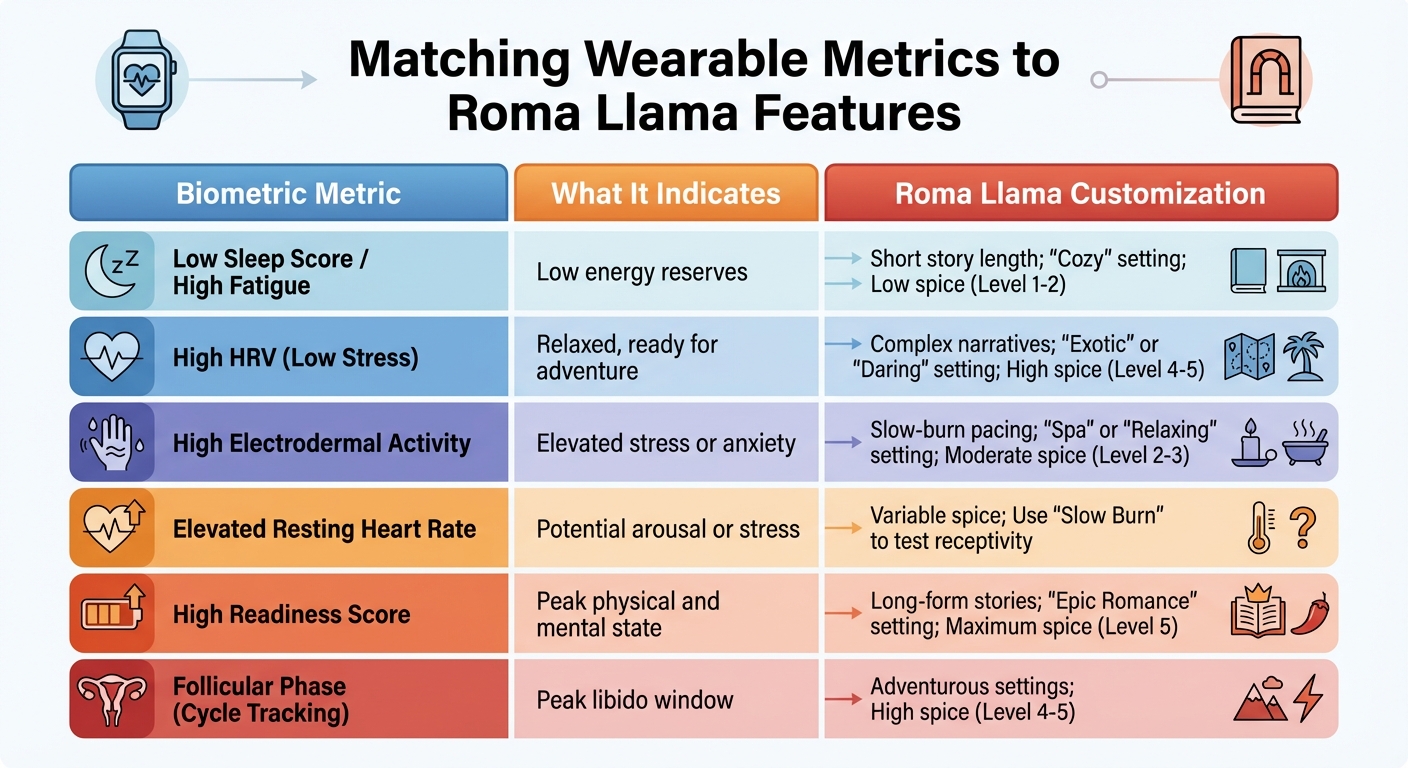
Matching Wearable Metrics to Roma Llama Features
Here’s a quick guide to how different biometric data can shape your Roma Llama experience, helping you turn raw numbers into meaningful decisions for intimacy:
| Biometric Metric | What It Indicates | Roma Llama Customization |
|---|---|---|
| Low Sleep Score / High Fatigue | Low energy reserves | Short story length; "Cozy" setting; Low spice (Level 1-2) |
| High HRV (Low Stress) | Relaxed, ready for adventure | Complex narratives; "Exotic" or "Daring" setting; High spice (Level 4-5) |
| High Electrodermal Activity | Elevated stress or anxiety | Slow-burn pacing; "Spa" or "Relaxing" setting; Moderate spice (Level 2-3) |
| Elevated Resting Heart Rate | Potential arousal or stress | Variable spice; Use "Slow Burn" to test receptivity |
| High Readiness Score | Peak physical and mental state | Long-form stories; "Epic Romance" setting; Maximum spice (Level 5) |
| Follicular Phase (Cycle Tracking) | Peak libido window | Adventurous settings; High spice (Level 4-5) |
How to Use Wearable Tech for Better Libido in Relationships
Tracking Libido Patterns Over Time
Wearable devices can help you understand your body's natural rhythms by building a detailed record of your physiological patterns. For example, a study in May 2024 involving 16,327 users of the Flo cycle tracking app over 10 months found that shorter, more regular menstrual cycles were linked to higher sexual motivation in both the current and following months (with standardized coefficients ranging from –0.10 to –0.06) [2].
By logging daily metrics like sleep scores, heart rate variability (HRV), resting heart rate, stress levels, and mood, you might notice trends - such as libido peaks during your fertile window or a drop in interest tied to poor sleep. Many sex therapists recommend keeping a journal to explore these patterns. Liz Klinger, Founder of Lioness, emphasizes:
"Many sex therapists often advise to keep a sex journal to help better understand their own sexuality, desire, and preferences" [3].
With these insights, you can plan moments of intimacy during periods when your body feels naturally more receptive.
Planning Intimacy Around Peak Mood Times
Once you’ve identified your personal patterns, you can use that knowledge to schedule intimacy during your natural high-readiness periods. Apps like HackHer simplify this process by allowing users to privately share "sex drive shifts" and "intimacy intel" with their partner through a "Host and Guest" model [16]. This eliminates guesswork and provides subtle reminders when libido is likely to be higher.
For example, if your wearable indicates high HRV, strong sleep recovery, and optimal hormonal timing, it could be the perfect time to plan a romantic evening. On the flip side, if your device shows elevated stress or poor sleep, you can adjust your expectations and focus on emotional connection without added pressure. Wearables can even help detect stress early, giving you the chance to address it before it impacts your relationship [15].
Combining Roma Llama Stories with Wearable Data
After identifying your peak physiological readiness, you can enhance intimacy further by pairing it with personalized Roma Llama stories that align with your mood and energy levels.
When your wearable data signals readiness - like low stress, good sleep, and balanced hormones - choose a high-energy Roma Llama story (Level 4-5) with adventurous themes such as "Exotic" or "Daring." These narratives can amplify your natural mood, making the experience feel effortless. On days when your data points to fatigue or stress, opt for a shorter, cozier story with moderate spice (Level 2-3) to nurture connection in a more relaxed way.
In April 2023, a pilot study using Fitbit Versa 3 devices tracked five individuals over 32 sexual encounters. Participants reported an average satisfaction score of 4.45 out of 5 [1][5]. This shows how wearable data can enhance the overall experience. By blending objective tracking with Roma Llama’s tailored stories, you create a feedback loop that turns raw data into meaningful, shared moments of connection.
Conclusion: Combining Wearable Tech and Roma Llama for Better Intimacy
Wearable tech is changing the way we understand our bodies, offering insights into sexual readiness by monitoring metrics like heart rate variability (HRV), sleep quality, stress levels, and hormonal patterns. Devices such as the Oura Ring and apps like Clue provide actionable data, helping users interpret their body’s signals. For example, a 2021 study involving 19 couples revealed that wearables analyzing both physiology and language could predict relationship conflicts with about 80% accuracy [15]. These findings open the door to using personalized tools to enhance intimacy.
When combined with a Roma Llama story, this data transforms into a tailored experience that matches your current state. If your wearable indicates low stress, solid sleep recovery, and optimal hormonal balance, you can choose a Roma Llama narrative that resonates with your energy - whether it’s an adventurous scenario or a calming, emotionally rich setting. Psychology Professor Adela Timmons from Florida International University highlights the importance of timing:
"If we could be in the context in which the problem is occurring, in the optimal moment… we could potentially do more and be more effective" [15].
This combination of data and storytelling fosters stronger emotional connections.
FAQs
How accurate are wearables at predicting libido?
Wearable devices can track certain physiological factors that may correlate with libido, such as heart rate or stress levels. However, their ability to precisely predict sexual desire or mood remains limited. The technology still requires more research and validation to ensure consistent accuracy. While these tools hold potential, they should be seen as just one piece of the puzzle in understanding your overall well-being.
Which biometrics matter most for sexual mood?
Understanding sexual mood involves tracking a few key physiological indicators: heart rate, hormonal cycles, and sleep patterns.
- Heart rate: This can signal emotional and physical arousal, offering a real-time glimpse into how the body reacts in intimate moments.
- Hormonal cycles: Particularly in women, fluctuations in hormones can significantly affect libido, making it an important factor to monitor.
- Sleep patterns: Quality sleep is essential for overall health and directly influences sexual well-being.
By analyzing these metrics, wearable technology can deliver tailored insights into sexual mood, fostering better self-awareness and improving communication in relationships.
How do I use wearable data with Roma Llama?
To integrate wearable data with Roma Llama, start by connecting your compatible device to the platform. Once synced, it can analyze biometric data like heart rate, sleep patterns, or even hormonal cycles. This information helps identify shifts in libido or sexual mood, offering insights that can improve communication and intimacy. Make sure your device is compatible, syncing is secure, and privacy settings are properly configured to ensure a smooth and secure experience.
Key Takeaways
- 1
sbb-itb-069f7a3
- 2
Wearable tech is changing the way we understand our bodies, offering insights into sexual readiness by monitoring metrics like heart rate variability (HRV), sleep quality, stress levels, and hormonal patterns.

Written By
Dr. Julian ChenCognitive Scientist
Dr. Julian Chen is a researcher studying the neurobiology of love and the impact of advanced technology on human emotional connection. His work explores how expertly-crafted personalized content can serve as a catalyst for real-world intimacy and self-expansion.
View Expert Profile →Keep Reading
Explore Related Stories

The Vendetta
As the heirs to warring crime syndicates, {NAME1} and {NAME2} are forced to share a bulletproof villa during a mandatory truce summit. In the silence of the Sicilian night, their mutual hatred transforms into a violent, high-heat passion. They must navigate their loyalty to their families while surrendering to a physical connection that threatens to burn both their empires to the ground.

The Safehouse Shadow
{NAME1} is a key witness in a federal trial, sequestered in a remote, one-bedroom mountain cabin with {NAME2}, a reclusive enforcer whose methods are as dark as the men hunting her. As a record-breaking blizzard cuts them off from the world, the high-tension atmosphere of the safehouse transforms from a prison into a space of intense, obsessive surrender.
Reference Sources
This article was developed using research and insights from the following clinical and narrative authorities: