Expert Summary
Practical guide to practicing radical honesty in relationships—tools, timing, and boundaries to deepen trust and intimacy while minimizing harm.

The Case for 'Radical Honesty' in Your Relationship
Radical honesty is about sharing your true thoughts, feelings, and needs without sugarcoating or hiding behind "white lies." This approach, introduced by psychotherapist Brad Blanton, aims to replace polite facades with open communication to build deeper connections. While it can strengthen trust and intimacy, practicing it requires care to avoid causing harm or defensiveness. Key strategies include using "I" statements, choosing the right timing, and creating a safe space for vulnerability. Though challenging, radical honesty can help relationships thrive by addressing issues early and fostering emotional closeness.
Core Principles and Boundaries
Key Principles
Radical honesty thrives on a few essential practices that keep it rooted in connection rather than conflict. Start with present-moment transparency - this means openly sharing what you're observing now, while carefully separating objective facts from emotional reactions or judgments [7][8]. Incorporate "I" statements to express your feelings and experiences without assigning blame. For instance, saying, "I feel sad when we don't talk at dinner", invites connection rather than defensiveness [8]. As psychologist Lindsey Hoskins, Ph.D., LCMFT, explains:
"Radical honesty is not simply saying out loud whatever you're thinking; rather, it is sharing authentically what you notice" [8].
When practiced thoughtfully, these principles naturally lead to boundaries that protect both partners' emotional well-being.
Setting Healthy Boundaries
Radical honesty doesn't give you a free pass to be hurtful. Clinical psychologist Sabrina Romanoff, PsyD, cautions:
"Sometimes, radical honesty can be an excuse to hurt or criticize the other person. We make the justification that we're 'just being honest' to accuse the other person or put them down" [6].
Before speaking, pause and ask yourself: Am I trying to strengthen intimacy, or am I just airing my frustrations? [6] Choose calm moments for candid conversations and clearly state your intention beforehand. This approach creates a safe environment for both you and your partner to share vulnerabilities [9][6]. The goal is to express truths that nurture the relationship, rather than serve your own ego [5].
U.S. Cultural Challenges
While these principles work well in personal relationships, American cultural norms often make open truth-telling more complicated. In the U.S., politeness often takes precedence over authenticity [2]. Counselor Taber Shadburne refers to this as the "adolescent model of love", where couples hide their genuine thoughts and emotions to avoid conflict, leading to emotional distance and loneliness [4].
Business psychologist Douglas LaBier, Ph.D., highlights this contradiction:
"Transparency is burgeoning all around us, but relationships seem to be stuck in a last-century time warp, untouched by the changing world" [4].
To overcome these cultural barriers, rely on "I" statements to reduce defensiveness and create a space where honesty is welcomed with curiosity rather than judgment [6][3]. By practicing these techniques, you not only protect honesty but also build deeper trust and intimacy in your relationship.
Radical Honesty Can Take Your Romance to the Next Level
Benefits and Risks
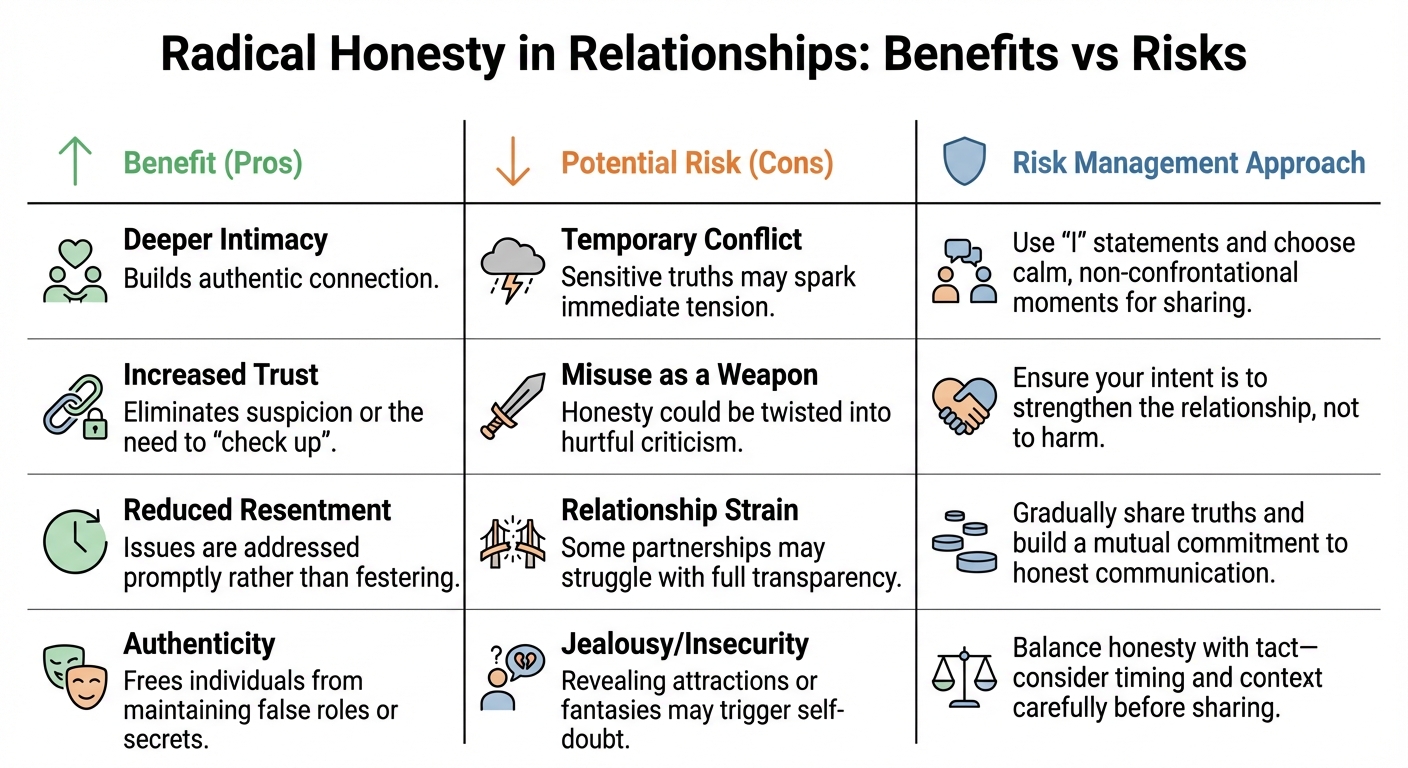
Benefits vs Risks of Radical Honesty in Relationships
Relationship Benefits
Radical honesty can reshape relationships by fostering deeper trust and connection. Studies suggest that sharing truthfully strengthens intimacy and enhances overall well-being [3][4]. It’s also been linked to greater satisfaction, both personally and within relationships [6].
By addressing issues as they arise, radical honesty helps prevent resentment from building up [3][4]. In fact, being transparent in close relationships has been shown to positively impact mental and physical health over the long term [4].
However, while the potential benefits are clear, navigating the risks of radical honesty requires a thoughtful approach.
Common Risks and How to Manage Them
Radical honesty isn’t without its challenges. One of the biggest risks is using honesty as a way to criticize or hurt a partner [6]. Temporary conflicts can also arise when sharing sensitive truths, such as attractions to others or personal fantasies. These disclosures may provoke feelings of jealousy or insecurity [1][2][5].
Timing plays a critical role. Sharing difficult truths when your partner is emotionally drained or unavailable can create unnecessary friction [5]. There’s also the danger of losing a sense of privacy or autonomy. Brad Blanton, a proponent of radical honesty, estimates that around 85% of relationships are "more phony than authentic" [2]. However, swinging too far toward complete transparency can risk creating co-dependence [5][10].
| Benefit (Pros) | Potential Risk (Cons) | Risk Management Approach |
|---|---|---|
| Deeper Intimacy: Builds authentic connection. | Temporary Conflict: Sensitive truths may spark immediate tension. | Use "I" statements and choose calm, non-confrontational moments for sharing. |
| Increased Trust: Eliminates suspicion or the need to "check up." | Misuse as a Weapon: Honesty could be twisted into hurtful criticism. | Ensure your intent is to strengthen the relationship, not to harm. |
| Reduced Resentment: Issues are addressed promptly rather than festering. | Relationship Strain: Some partnerships may struggle with full transparency. | Gradually share truths and build a mutual commitment to honest communication. |
| Authenticity: Frees individuals from maintaining false roles or secrets. | Jealousy/Insecurity: Revealing attractions or fantasies may trigger self-doubt. | Balance honesty with tact - consider timing and context carefully before sharing. |
To manage these risks, it’s important to distinguish between obligatory honesty (disclosures that are necessary, like financial or sexual health information) and discretionary honesty (sharing details that, while truthful, may not be essential and could cause harm) [10]. Before speaking, ask yourself whether your goal is to strengthen intimacy or simply to vent frustrations [6]. Practicing "wise speech" - choosing the right time and framing disclosures thoughtfully - can ensure honesty benefits your relationship rather than harming it [5].
The next section will explore practical communication techniques to help you navigate these challenges while deepening your connection.
Practical Communication Strategies
Effective communication is essential for nurturing both emotional and intimate connections. By applying specific techniques, you can express yourself clearly and thoughtfully, strengthening your relationships along the way.
Communication Tools That Work
One helpful method is the "I Notice, I Imagine, I Feel, I Need" framework[12]. This four-step process encourages separating your observations from your interpretations. For instance, you might say, "I notice you were quiet tonight" (an observation), followed by "I imagine you might be upset with me", then "I feel anxious", and finally, "I need you to talk to me." This approach keeps the focus on your experience without making assumptions about the other person.
Dr. Brad Blanton, psychotherapist and founder of Radical Honesty Enterprises, elaborates:
"Radical Honesty means that you describe what you notice. Whether it fits the model in your mind of what you should be attending to or not, you have a commitment to attending to and reporting what is so."
This emphasizes sticking to sensory observations, avoiding unnecessary interpretation.
Another tip is to replace "but" with "and" to allow multiple truths to coexist. For example, say, "I love you and I need space", instead of "I love you but I need space." Similarly, when expressing resentment, you might say, "I resent you for [specific action]" and remain engaged until the feeling passes.
Using Radical Honesty in Key Areas
Using ownership language is another essential strategy. Instead of saying, "You make me angry", try reframing it as, "I feel anger when I imagine you don't care about my day." This shift helps take responsibility for your emotions and reduces blame.
Start with low-stakes disclosures to build trust before diving into more sensitive topics. When you're ready for deeper conversations, ask for consent with something like, "I'd like to share something vulnerable with you. Is now a good time?"
For recurring conflicts, consider "Completion Conversations." These structured discussions allow unresolved issues to surface and be addressed, helping to release lingering shame and strengthen your bond. The key is for both partners to stay present and committed until the issue feels resolved, even if it gets uncomfortable.
These tools naturally lead to the importance of timing your disclosures.
Pacing and Timing Your Disclosures
Timing is just as important as the words you choose. Avoid sharing difficult truths when your partner is tired, distracted, or unwinding. Instead, check in first by asking, "Are you in a place to hear something important?" If not, postpone the conversation until both of you are emotionally ready.
Start with small, manageable disclosures, like sharing a quiet fear or a hope. Gradually building up to deeper truths helps create a safe space without overwhelming your partner. Meditation teacher Neil Morbey highlights the importance of self-awareness in this process:
"Owning that you are making yourself angry, sad, fearful and joyful via the thinking and story you've concocted... allows us to see the story"[11].
This perspective encourages thoughtful pacing, focusing on what truly matters rather than expressing every fleeting thought.
sbb-itb-069f7a3
Improving Erotic Connection Through Honesty
Opening up about your fantasies with radical honesty can do more than just build trust - it can spark a deeper sense of erotic intimacy. By practicing open communication and sharing your desires, you create a foundation for a stronger connection.
Sharing Desires and Boundaries
Sexual honesty begins with acknowledging that your partner can’t read your mind. Studies show that many people have fantasies about dominance, rough sex, or even intimacy with a friend[5]. These findings highlight how common it is to feel hesitant about sharing certain desires.
Creating a safe space where both "yes" and "no" are equally respected is essential. Psychologist Kate Balestrieri emphasizes this point, saying:
"If you want a safe place in your relationship, you have to be that safe place."[14]
Start by being vulnerable yourself. Instead of asking your partner to go first, share one of your own fantasies. Use "I" statements to express your feelings and desires, such as: "I’ve been curious about exploring [specific desire], and I’d love to hear your thoughts." This approach sets a collaborative tone and invites your partner into the conversation.
When addressing boundaries, clarity is key. Avoid vague statements like "I’m open to anything." Instead, be specific: "I’d like to try [specific activity], but it’s important we both feel comfortable enough to say no if something doesn’t feel right." This kind of openness fosters trust and ensures that both partners feel heard and respected. Together, you can build a foundation for exploring shared fantasies.
Building Fantasies Together
Exploring fantasies as a couple works best when approached as a shared creative process rather than a one-sided confession. A helpful strategy is using the "triangulation method", where you introduce sensitive topics through an external source like an article or podcast[16]. This takes some of the pressure off and allows both partners to engage with the content in a relaxed way.
A structured conversation framework, such as the "Sex Talks" approach, can also guide these discussions. This method focuses on five areas: Acknowledgement (understanding your current dynamic), Connection (what strengthens your bond), Desire (what excites you), Pleasure (what feels good), and Exploration (what you’d like to try next)[17].
When discussing fantasies, ask questions to explore rather than assume. For instance, if your partner mentions an interest in role-playing, you might say, "What about that excites you?" or "Can you share more about the scenario you have in mind?"[14] Showing genuine curiosity helps deepen your understanding and demonstrates that you value their inner thoughts. Once you’re ready to bring these ideas to life, consider using creative tools to spark dialogue.
Using Roma Llama for Erotic Storytelling

Finding the right words to express your desires can be tricky, but Roma Llama offers a fun and imaginative way to explore fantasies. For $4.99, you can create personalized romance stories with adjustable spice levels, detailed character options, and a variety of romantic scenarios - from gentle foreplay to more intense themes like BDSM.
The platform’s "Roll The Dice" feature adds an element of surprise by randomly suggesting sexual actions, which can inspire discussions about preferences you might not have considered. You can craft a story that reflects a fantasy you’re curious about, then share it with your partner as an e-card. This indirect approach gives both of you space to process and discuss the idea without the pressure of face-to-face vulnerability.
To introduce the story, you might say, "I created this, and I found it intriguing - what do you think about trying something like this together?" With customizable settings for character traits and scenarios, Roma Llama allows you to explore ideas in a playful, low-pressure way before deciding to incorporate them into your relationship. This method not only makes the conversation easier but also opens the door to deeper intimacy and shared exploration.
Emotional Safety and Long-Term Practice
Creating a sense of emotional safety is essential for sticking with radical honesty over the long haul. This approach isn't just a one-time effort - it's a continuous practice that grows and adapts as you and your relationship navigate life's challenges and confront difficult truths together.
Building Emotional Regulation Skills
The biggest obstacle to honest communication? Emotional dysregulation - those moments when your emotions run so high that you go into self-protection mode. Studies show that during these times, you're more likely to lash out or shut down entirely, which undermines the trust and safety needed for open conversations[14].
When you notice emotions spiraling out of control, take a step back. Feeling overwhelmed? Hit pause. Grounding techniques - like deep breathing, yoga, or meditation - can help you calm down and lower stress before diving back into the conversation[18]. These aren't ways to dodge the issue; they're tools to help you stay present and approach the dialogue constructively.
If needed, take a time-out to avoid reacting defensively. Step away, collect yourself, and return when you're ready to listen and engage with a clear head.
Repairing After Difficult Conversations
Honesty can sting, but what truly matters is how you handle the aftermath. Psychologist Margaret Paul puts it plainly:
"Relationships flourish when partners trust each other to be honest and open to resolving conflict."[15]
When your partner shares something hard to hear, fight the urge to get defensive or retaliate. Instead, ask elaboration questions like "Can you tell me more?" or "Help me understand your perspective." These questions show you're open to understanding, even if you don't agree, and they help reduce mistrust[14]. Acknowledging their vulnerability - even when the truth feels uncomfortable - strengthens trust and lays the groundwork for future conversations.
Small gestures can also help repair the emotional fallout. A gentle touch, a sincere acknowledgment of their feelings, or even a bit of humor can ease tension[13]. The goal isn't to make the discomfort disappear but to show that your bond is stronger than any single tough moment. When you handle these moments with care, you create a dynamic where openness feels safer than hiding.
Adjusting and Growing Together
Once the immediate emotional hurdles are addressed, it's important to let your honesty practices adapt as your relationship evolves. What felt risky to share years ago might feel routine now, while new stages of life - like becoming parents, switching careers, or aging - bring fresh challenges that call for renewed honesty.
Consider creating a relationship mission statement together. This statement should outline why you're together and the agreements that support your shared vision[14]. Make it a habit to revisit this statement regularly - perhaps annually or during major life changes - to ensure your honesty practices still align with your goals. Ask each other questions like, "Are there areas where we've stopped being fully honest?" or "What new boundaries do we need as our lives shift?"
This kind of reflection helps you avoid "dishonest harmony" - the tendency to keep quiet or placate each other just to avoid conflict, which can quietly build resentment over time[14]. By treating your relationship as something that grows and changes, you ensure that radical honesty stays a source of connection rather than a source of stress.
Conclusion
Radical honesty isn’t about blurting out every thought that crosses your mind - it’s about peeling back the layers and sharing your authentic self. This means opening up about your fears, desires, and dreams in a way that fosters understanding and connection. When done with care, this practice strengthens trust and clears the path for deeper intimacy by eliminating the hidden resentments that can quietly erode relationships.
The rewards are undeniable. Studies reveal that people who consistently share their true feelings enjoy higher levels of relationship closeness and overall happiness [4]. Honesty like this is closely tied to greater satisfaction in both personal and romantic relationships [6]. It’s also a way to reinvigorate relationships that may have fallen into predictable patterns. As counselor Taber Shadburne explains:
"Radical honesty is a way of repeatedly reintroducing the mystery and excitement, the edgy and unknown, the learning and growth, the love and intimacy back into your relationship." [2]
This isn’t just a feel-good concept - it’s a practical approach to connection. Whether it’s sharing your sexual preferences, voicing small irritations before they grow, or even admitting to feelings of attraction toward someone else, radical honesty prioritizes authenticity over comfort, creating space for relationships to thrive.
FAQs
How can I practice radical honesty in my relationship without causing harm?
Practicing radical honesty means communicating openly while being considerate of your partner’s emotions. Start by setting a clear purpose for the conversation - aim to build trust and strengthen your connection, not to criticize or assign blame. Pick a calm, private moment to talk, and use "I" statements to share how you feel without pointing fingers.
It’s helpful to begin with smaller, less sensitive topics to establish trust before moving on to deeper matters. Encourage an open dialogue by asking your partner how they feel about what you’ve shared and what they might need from you in response. Keep in mind, not every thought needs to be voiced - focus on sharing what nurtures your relationship. Wrap up the conversation by reaffirming your love and commitment, creating a safe and supportive space for honesty to thrive.
What cultural factors make practicing radical honesty challenging in the U.S.?
Practicing radical honesty in the U.S. isn't always straightforward, largely because of cultural habits that emphasize politeness, personal boundaries, and social tact. Many people shy away from sharing deeply personal thoughts or emotions out of fear - fear of sparking conflict, feeling exposed, or being judged. This is especially true when it comes to delicate subjects like past mistakes or uncomfortable emotions.
The strong focus on individualism and maintaining a polished self-image also plays a role. Couples often feel pressure to showcase an idealized version of themselves, both to each other and to the outside world. Discussing topics that stray into the unconventional - like admitting a fleeting attraction to someone else - can feel risky or even inappropriate. Cultural norms often suggest it's better to keep such feelings to oneself.
On top of that, while modern digital culture promotes openness, traditional relationship dynamics haven’t necessarily caught up. This leaves many people unsure about how much honesty is "too much" and how to balance being truthful with safeguarding a partner's feelings. All of these factors combine to make radical honesty a challenging concept for many couples navigating relationships in the U.S. today.
How does practicing radical honesty build intimacy and trust in a relationship?
Radical honesty has a way of bringing couples closer by encouraging them to share their real thoughts, feelings, and even those vulnerable parts of themselves they might usually hide. When partners open up about insecurities, desires, or even uncomfortable truths, it lays the groundwork for a deeper connection and mutual understanding. It’s in that openness that emotional closeness thrives, helping both people feel genuinely seen and accepted for who they are.
This kind of honesty also builds trust over time. When you’re consistently open, there’s less room for misunderstandings or hidden resentments to creep in. It reinforces the idea that each partner can truly depend on the other. And here’s the bonus: that trust and authenticity often lead to stronger sexual intimacy too. When both people feel safe enough to talk about their desires or fantasies without fear of judgment, it creates a space where intimacy can flourish on every level. Radical honesty, in essence, transforms vulnerability into a strength that can make relationships more meaningful and satisfying.
Key Takeaways
- 1
Radical honesty thrives on a few essential practices that keep it rooted in connection rather than conflict.
- 2
Effective communication is essential for nurturing both emotional and intimate connections.
- 3
Creating a sense of emotional safety is essential for sticking with radical honesty over the long haul.

Written By
Marcus ThorneLicensed Marriage and Family Therapist (LMFT)
Marcus Thorne specializes in transforming high-conflict relationships into resilient partnerships. With a background in behavioral therapy, Marcus focuses on practical communication frameworks that help couples move from "fighting" to "connection." He has led over 200 workshops on the Gottman Method.
View Expert Profile →Keep Reading
Explore Related Stories

The Rival Chefs
Chef {NAME1} and rival {NAME2} are forced to share a tiny kitchen for a charity event. As they fight over counter space and ingredients, their professional bickering turns into an intense physical hunger.

The Slice of Life Arrangement
{NAME1} and her reclusive neighbor {NAME2} enter into a fake relationship to solve their social problems. As they navigate family events and quiet dinners, their 'arrangement' turns into a real, heartwarming passion.
Reference Sources
This article was developed using research and insights from the following clinical and narrative authorities: