Expert Summary
Reduce phone use to reset your brain's reward system, restore attention, and deepen emotional and physical intimacy with a short dopamine detox.

The Dopamine Detox: How Putting Down Your Phone Can Triple Your Sexual Satisfaction
Your phone might be silently draining the intimacy and connection in your relationship. Research shows 58% of people feel technology negatively impacts their sex life, and 40% would rather give up sex for a year than their phone. Constant notifications and endless scrolling overstimulate your brain's reward system, making real-life connections feel less rewarding. This can lead to emotional disconnection, reduced physical intimacy, and even sexual issues like low libido.
The solution? A dopamine detox. By cutting back on phone use, you can reset your brain’s reward system, improve focus, and rekindle emotional and physical intimacy. Here’s how to start:
- Create phone-free zones: Keep devices out of the bedroom and dining areas.
- Set a phone curfew: Put devices away at least an hour before bed.
- Reconnect through mindfulness: Practice eye contact, non-sexual touch, or shared activities like reading aloud.
- Track progress: Celebrate small wins, like improved sleep or deeper conversations.
A two-week detox can help restore connection, boost intimacy, and improve your overall relationship satisfaction. Start small tonight - your relationship will thank you.
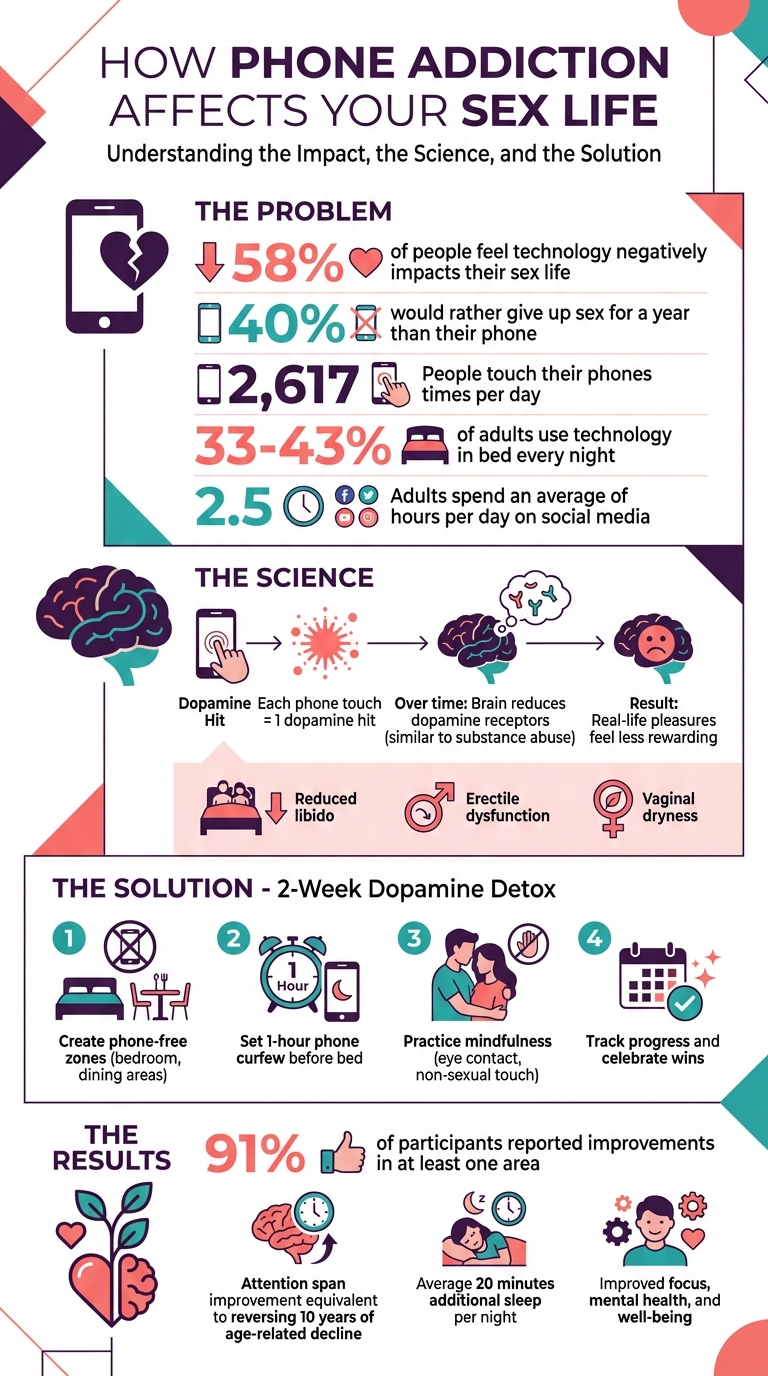
How Phone Addiction Affects Your Sex Life and Relationship
Dopamine and It's Impact on Your Relationships
sbb-itb-069f7a3
How Dopamine Works in Your Brain and Relationships
Dopamine, often called your brain's "reward chemical", is what gives you that feel-good sensation when you achieve something, connect with others, or experience pleasure. It plays a key role in reinforcing behaviors that are essential for survival and connection - like eating, bonding, intimacy, and accomplishing goals. For example, a meaningful conversation, a shared laugh, or an intimate moment can all trigger dopamine, strengthening your desire to repeat those experiences.
But here's the catch: smartphones have found a way to hijack this ancient system. Every notification, like, or new piece of content delivers a quick dopamine spike. On average, people touch their phones an astonishing 2,617 times a day[7]. That’s 2,617 dopamine hits your brain wasn’t designed to handle. While this reward system is natural, modern technology has turned it into overdrive.
How Phones Overstimulate Your Dopamine System
Smartphones are built to keep you hooked. They operate on a "seek and reward" loop: you scroll endlessly, and in return, you’re rewarded with fresh content. The unpredictability of what you’ll see next makes it even more addictive, amplifying dopamine release with each swipe.
"Mobile phone manufacturers have created an item that on average we touch 2,617 times per day with the purpose of giving us the same mental stimulation as an orgasm."
- Dr. Danielle Forshee, Psy.D.[7]
All these dopamine surges come at a cost. Over time, your brain adapts by reducing the number of dopamine receptors. Studies show that this downregulation mirrors changes seen in substance abuse, like cocaine or alcohol addiction[8]. With fewer receptors, everyday pleasures - like a warm hug or a shared meal - start to feel less rewarding. It also weakens your prefrontal cortex, the part of the brain responsible for impulse control and decision-making. This makes it harder to resist the instant gratification of checking your phone, even when it’s at the expense of meaningful, face-to-face moments.
The impact is evident in our most intimate spaces. Between 33% and 43% of adults admit to using technology in bed every night[2], a time and place where connection with a partner should take precedence. These biochemical changes directly affect how we experience intimacy, both emotionally and physically.
What This Means for Your Sex Life
When screen time dominates, real-life intimacy takes a hit. Excessive dopamine stimulation from phones makes it harder to stay present, even when you’re physically with your partner. This doesn’t just dampen your mood - it can also reduce the physical sensations that make sexual experiences fulfilling.
"Doom scrolling and digital overstimulation can hijack the brain's reward system, making real-life intimacy feel less novel or exciting and draining your energy and time entirely."
- Holly Nelson, Certified EMDR Therapist[5]
Research links heavy social media use to higher rates of sexual issues, including erectile dysfunction, vaginal dryness, and low libido[5]. With adults spending an average of 2.5 hours a day on social media[5], mental energy that could go toward nurturing a relationship is instead drained by screens.
Emotional disconnection is another consequence. When digital distractions interrupt shared time, it sends a clear signal that your partner isn’t your priority. This behavior, often called "phubbing" (phone snubbing), can erode trust and connection. Dr. Sharif Mowlabocus, Associate Professor at Fordham University, captures this sentiment perfectly:
"Their phones are still the first thing they touch when they wake up and the last thing they touch before they go to sleep. That should really be their partner."[6]
The Science Behind Dopamine Detox
What Is a Dopamine Detox?
A dopamine detox, also known as "dopamine fasting", is a behavioral approach aimed at stepping back from high-stimulation activities like social media scrolling, video gaming, or binge-watching shows[9][11]. The idea isn't to eliminate dopamine itself - this neurotransmitter is crucial for motivation and pleasure - but rather to take a break from the behaviors that overwhelm your brain with artificial rewards.
When you're constantly bombarded with digital stimulation, your brain adjusts by downregulating dopamine receptors. This recalibration can make everyday activities - like chatting with a friend, enjoying a walk, or even physical affection - feel less rewarding[11][13].
"Our brain starts to downregulate our own dopamine production and transmission, to bring it back to baseline... Now we need to keep engaging in these behaviors - ingesting digital media - not to feel good and happy, but just to feel normal."
- Dr. Anna Lembke, Psychiatry Professor, Stanford University School of Medicine[12]
By stepping away from these high-stimulation triggers for 10–14 days, your brain's reward system gets a chance to reset. This process restores receptor sensitivity, allowing you to find pleasure in simple, meaningful experiences once again[12]. It’s not just about feeling good - it’s about rediscovering authentic emotional and physical connections.
How Dopamine Detox Improves Emotional and Physical Connection
When your brain's reward system is recalibrated, the subtle joys of connection come back into focus. Everyday moments, like sharing a laugh or holding hands, feel more fulfilling. By reducing digital overstimulation, you free up mental space and attention to invest in your relationships[10][2]. Instead of being distracted by constant notifications, your partner becomes the center of your emotional energy.
A study led by Associate Professor Kostadin Kushlev at Georgetown University in November 2025 explored the effects of a two-week digital detox using the Freedom app. Nearly 500 participants took part, and although only 25% fully adhered to the detox for the entire two weeks, 91% reported improvements in at least one major area, such as better mental health, improved focus, or enhanced well-being. The study also found that attention spans improved to a level comparable to reversing a decade of age-related decline, and participants gained an average of 20 minutes of additional sleep per night[14].
"Even a little bit of digital detox - a little bit of reduction of the constant stimulation from our phones, social media, games and so forth - could actually help us reclaim our ingrained ability to sustain attention."
- Kostadin Kushlev, Associate Professor of Psychology, Georgetown University[14]
This renewed focus allows you to truly connect with your partner - whether it’s through meaningful eye contact, understanding nonverbal cues, or cherishing a gentle touch. When digital distractions are removed, these intimate moments have room to grow into deeper, more connected experiences.
How to Do a Dopamine Detox for Better Sex
Create Phone-Free Zones and Times
Set boundaries for where and when devices are allowed in your home. For example, keep your bedroom and dining area completely phone-free. These spaces should be about connection, not distractions. Here’s a reality check: 33–43% of adults use their phones in bed every night, and over half admit their partner gets distracted by their device during conversations [2]. That constant digital interference quietly chips away at emotional intimacy.
If your excuse is "I need my phone for an alarm", swap it for an old-school alarm clock and charge your phone in another room overnight. Make it a habit to put devices away at least an hour before bedtime. This creates the perfect environment for the "pillow talk" that therapist Negin Motlagharani recommends to deepen emotional bonds [4].
"Every time you glance at your phone during a conversation, you're sending a message... that the person in front of you isn't your priority." - Shivanii Ray [3]
Set a phone curfew and stick to it. For example, allow yourself 10 minutes to check your phone, then dedicate 20 minutes of undistracted time to your partner. During conversations, practice "single tasking" - put your phone completely out of sight. Even a silenced, face-down phone can drain your attention [18]. These small changes pave the way for more mindful, meaningful moments with your partner.
Practice Mindfulness Exercises Together
Use your phone-free time to reconnect in simple but effective ways. Try a minute of uninterrupted eye contact, a 20-second hug, or breathing in sync with your partner. These small gestures can trigger oxytocin release, which works alongside dopamine to create a natural, feel-good response [17].
"When we make intimate human connections, oxytocin binds dopamine, releasing neurons in the reward pathway and dopamine is released and it feels really good." - Dr. Anna Lembke, Psychiatrist and Author, Stanford Medical School [17]
Focus on non-sexual touch during this detox period. Hold hands while watching TV, cuddle on the couch, or give each other a quick shoulder massage. These simple actions activate oxytocinergic neurons in your brain, which play a role in both emotional bonding and physical attraction [15][16]. These small moments of connection can strengthen your relationship.
Take this time to embrace radical honesty as well. Share your daily highlights, talk about your goals, or open up about your feelings. Dr. Anna Lembke describes this kind of vulnerability as an "incredibly valuable and potent source of dopamine" [17].
Use Personalized Erotic Stories to Reignite Passion
As you clear out digital distractions, you’ll notice a boost in creativity - energy you can channel into shared experiences, like creating personalized erotic stories together. Roma Llama offers customizable romance stories for $4.99, letting you adjust the spice level and include personal details. You can even use the "Roll The Dice" feature for spontaneous variety or share the story as an e-card, all without subscriptions or logins.
Turn this into a connection ritual. Read these stories together during your phone-free hour before bed, or take turns reading them aloud. This shared activity not only sparks imagination but also redirects your energy and attention toward each other, building anticipation and intimacy.
Track Your Progress and Celebrate Wins
Tracking your progress helps you see how these small changes impact your relationship. Keep a journal to note improvements in mood, sleep, and intimacy. Write down how often you have meaningful conversations, initiate physical touch, or pick up on your partner’s subtle cues. Remember, getting less than six hours of sleep can increase irritability and anxiety, which can strain your relationship [4].
Celebrate your milestones together. After a week of consistent phone-free bedtimes, treat yourselves to a special date night. After a couple of weeks, reflect on how your connection has grown. Studies show that 91% of participants in a digital detox reported improvements in at least one area of their lives [14]. Why not let your relationship be one of them?
How to Maintain the Benefits Long-Term
Set Healthy Boundaries with Technology
To keep the positive effects of a digital detox, it’s essential to establish clear boundaries around tech use. Create agreed-upon phone-free times, like during meals, the first half-hour after work, or before bed. These moments help preserve meaningful connection.
Boundaries don’t have to feel like rules. As Dr. Baya Mebarek explains, "Boundaries are not restrictions. They are agreements that say: Our relationship deserves protected space." [19] Framing them as shared commitments makes it about nurturing your relationship rather than controlling behavior.
Simple steps like disabling unnecessary notifications and setting short, scheduled scrolling periods (e.g., 10:20–10:30 PM) can make a big difference. If a boundary slips, gently reset by saying something like, "Can we pause phones? I’d like your attention." [19] These small adjustments create room for deeper emotional and physical connection, boosting intimacy and overall satisfaction.
Do Periodic Detoxes to Reset
Daily boundaries are crucial, but periodic detoxes add an extra layer of reset to ensure your habits stay on track. Every few months, try a structured detox cycle: two phone-free days followed by five days of mindful use, repeated over three weeks. [22] Research suggests it takes about 66 days to cement a new habit, giving your brain and body time to adjust to a healthier lifestyle. [21]
Stay alert for signs that it’s time for a reset. If late-night scrolling interferes with your sleep, if you’re turning to social media to share personal thoughts instead of your partner, or if you’re lying side-by-side in bed but feel emotionally distant because of screens, it’s a signal to reevaluate. [2] Monthly check-ins and quarterly goal-setting sessions can also help you and your partner stay aligned on your priorities. [20]
During detox periods, replace screen time with activities that encourage connection. Try journaling together, giving each other massages, or reading a physical book as a couple. You could even incorporate something like Roma Llama’s personalized romance stories - reading them aloud can become a fun, screen-free ritual. These alternatives not only strengthen your bond but also give your brain a much-needed dopamine break. By resetting your digital habits, you’re protecting your well-being and keeping the passion alive in your relationship.
Conclusion
Your phone might be stealing more than just time - it’s taking away intimacy. Recent studies reveal that 40% of people would rather give up sex for a year than their smartphone [2], and 58% feel technology negatively impacts their sex life [1]. Somehow, we've allowed screens to edge out connection. But the good news? You can reclaim it with small, intentional changes. Create phone-free zones, set a one-hour curfew before bed, and focus on being present. These shifts can help replace fleeting digital distractions with meaningful, real-world rewards.
Research shows that stepping away from constant digital stimulation allows you to notice the subtle emotional and physical cues that nurture intimacy [2][6]. Simple practices like holding eye contact for a minute, syncing your breathing, or even reading personalized stories from Roma Llama as part of a screen-free ritual can help rebuild the closeness that endless scrolling erodes. By embracing a dopamine detox, you pave the way for these deeper moments. These habits don’t just restore connection - they lay the foundation for a more fulfilling and lasting sex life.
"Tonight, instead of choosing pixels as a wind-down routine, choose real presence with your partner right next to you." - Dr. Cheralyn Leeby, Ph.D., LMFT [2]
The choice is simple: put down your phone and reconnect with the intimacy that’s been waiting for you. Start tonight - your relationship and sex life will thank you.
FAQs
How do I know if my phone is hurting my sex life?
Your phone could be taking a toll on your sex life if it pulls your attention away during intimate moments, eats into quality time with your partner, or leaves you feeling disconnected. Excessive phone use can interfere with both emotional and physical closeness, making it more challenging to nurture intimacy and maintain a strong connection.
What can I do if my partner won’t join the detox?
If your partner isn’t ready to cut back on screen time, start by focusing on your own habits. Create phone-free moments, practice mindfulness, and make undistracted quality time a priority. Sometimes, leading by example can be powerful - when they notice the positive changes in your life, they might feel encouraged to join you later. Keep the lines of communication open by discussing how digital distractions impact your relationship and sharing the potential benefits of a detox. Over time, this can motivate them to participate willingly.
What should we do instead of scrolling at night?
Put your phone away and prioritize moments that deepen your connection - like making eye contact, holding hands, sharing a kiss, or exchanging kind and loving words. These simple yet powerful gestures help replace digital distractions with real, heartfelt interactions, strengthening the emotional bond between you and your partner.
Key Takeaways
- 1
sbb-itb-069f7a3
- 2
A dopamine detox, also known as "dopamine fasting", is a behavioral approach aimed at stepping back from high-stimulation activities like social media scrolling, video gaming, or binge-watching shows[9][11].
- 3
To keep the positive effects of a digital detox, it’s essential to establish clear boundaries around tech use.

Written By
Dr. Julian ChenCognitive Scientist
Dr. Julian Chen is a researcher studying the neurobiology of love and the impact of advanced technology on human emotional connection. His work explores how expertly-crafted personalized content can serve as a catalyst for real-world intimacy and self-expansion.
View Expert Profile →Keep Reading
Explore Related Stories

The Rival Chefs
Chef {NAME1} and rival {NAME2} are forced to share a tiny kitchen for a charity event. As they fight over counter space and ingredients, their professional bickering turns into an intense physical hunger.

The Slice of Life Arrangement
{NAME1} and her reclusive neighbor {NAME2} enter into a fake relationship to solve their social problems. As they navigate family events and quiet dinners, their 'arrangement' turns into a real, heartwarming passion.
Reference Sources
This article was developed using research and insights from the following clinical and narrative authorities: