Expert Summary
Healing your personal triggers, not fixing your partner, unlocks deeper emotional and sexual intimacy through journaling, mirroring, and honest communication.

Shadow Work for Couples: Healing Your Triggers to Unlock Deeper Passion
Shadow work focuses on addressing suppressed emotions and unresolved issues that shape your reactions in relationships. Often, your partner’s actions can trigger old wounds, leading to conflicts or emotional barriers. By identifying and working through these triggers, couples can build stronger emotional connections and reduce recurring conflicts.
Key insights:
- Emotional triggers often stem from past experiences, like childhood neglect or past betrayals.
- Triggers manifest physically (e.g., tight chest, racing heart) and influence conflict patterns.
- Journaling, reflective exercises, and open communication can help you address these patterns.
- Techniques like the Trigger Journal, Empty Chair Exercise, and Letter Writing allow couples to process emotions together.
- Shadow work helps shift reactions from blame to self-awareness, paving the way for deeper emotional and physical intimacy.
This approach isn’t about fixing your partner or relationship but understanding yourself better to create meaningful growth and connection.
Why Shadow Work Is The Key To Healing Anxious & Avoidant Relationship Patterns
sbb-itb-069f7a3
How to Identify Emotional Triggers in Your Relationship
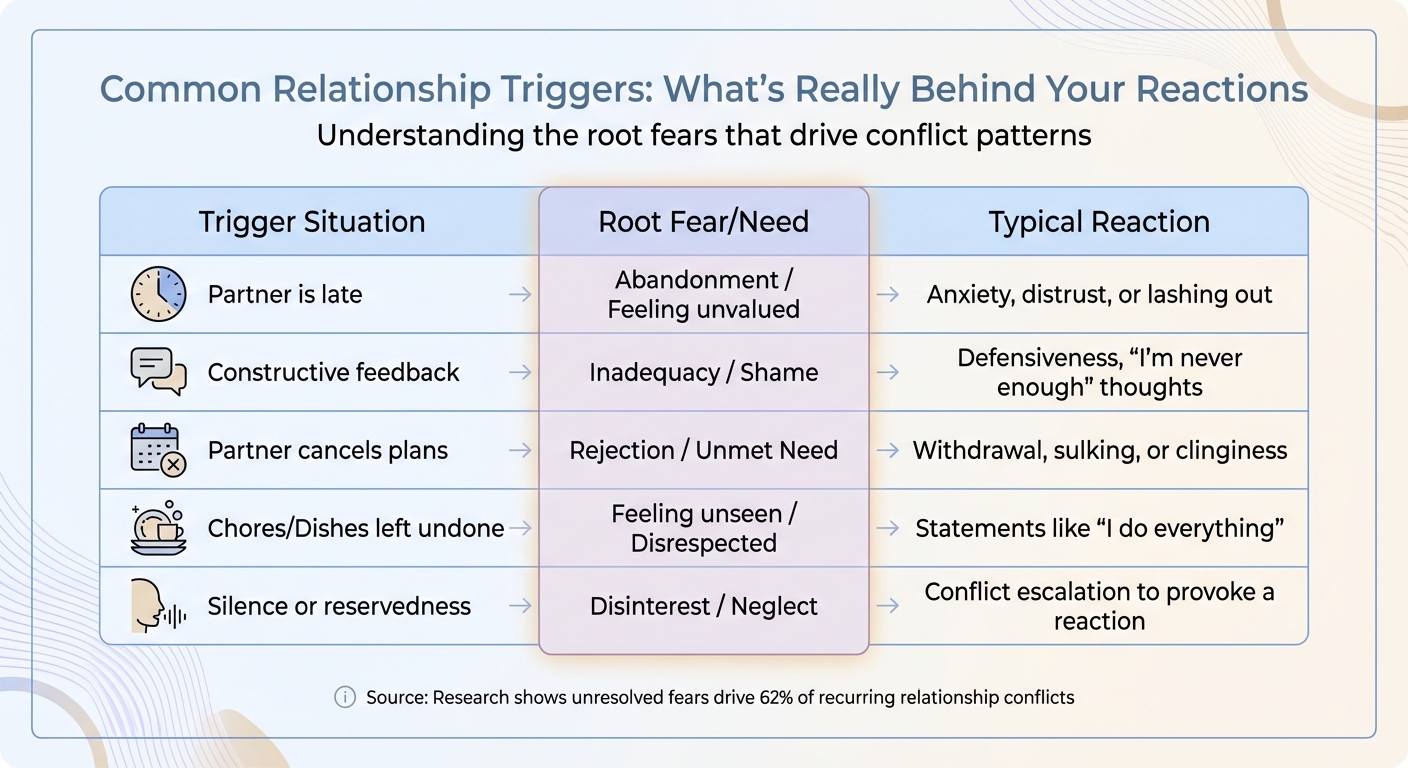
Common Relationship Triggers and Their Root Causes
Emotional triggers are those moments when a specific event, word, or action stirs up an intense reaction rooted in past experiences. Often, these reactions trace back to childhood - perhaps neglect or inconsistency - or even past betrayals in relationships that left emotional scars. When something your partner does feels like an echo of these old wounds, your nervous system might respond as if you're in immediate danger, even if the situation isn't threatening.
Your body often signals a trigger before your mind can process it. You might feel a tight chest, shallow breathing, a racing heart, or even a knot in your stomach. Emma Stein, a Clinical Specialist at Spilove Psychotherapy, shares: "Emotional triggers are not inherently 'bad.' In fact, they are a natural part of being human. They signal that something in our past has not yet been fully processed" [8]. These physical sensations are like clues, pointing to unresolved emotions surfacing.
Triggers also show up in how you handle conflict. You might yell, shut down completely (stonewalling), get defensive, or try to please others just to avoid confrontation. These behaviors - known as fight, flight, freeze, or fawn responses - were once survival strategies but now often block deeper connection. Research suggests unresolved fears are at the heart of 62% of recurring relationship conflicts, and stonewalling alone is a strong predictor of divorce, with over 80% accuracy [10].
The reality is that intense reactions are rarely about the present. For example, if your partner’s lateness causes you to panic about abandonment or if constructive feedback feels like a personal attack, it’s likely a "hook" - a moment where past wounds cast their shadow on the present. As Crystin Nichols, MS, RMFTI from Lotus Therapy FL, puts it: "Your partner becomes a mirror - reflecting not just your love, but also your fears, insecurities, and pain" [1].
Understanding where these triggers come from is the first step to addressing them. The following exercises can help you track these moments, trace them back to their origins, and uncover the patterns that keep you in reactive cycles.
The Trigger Journal Technique
This journaling method helps turn raw emotional reactions into meaningful reflections, offering insight into your inner world. The Trigger Journal follows a seven-step process designed to shift you from reaction to awareness. Interestingly, research shows that writing by hand improves emotional recall by 23% compared to typing, and short, five-minute journaling sessions have proven easier to maintain over 12 weeks [10].
Here’s how to use the Trigger Journal:
- Trigger Snapshot: Jot down the facts of what happened without adding judgment or interpretation. This helps calm your emotional response and provides clarity.
- Emotion Label + Body Map: Identify the emotion you felt (e.g., anger, fear, shame) and note where you felt it in your body.
- Origin Memory Search: Reflect on the earliest memory tied to that sensation. Ask yourself, "When did I first feel this same tightness in my chest?"
- Hidden Belief Extraction: Pinpoint the automatic thought behind your reaction, such as "I’m not important" or "I’ll never be enough."
- Self-Compassion Reframe: Write a kind, understanding note to the younger version of yourself who first experienced that wound.
- Ownership Statement: Create an "I" statement to share with your partner, focusing on your feelings rather than blaming. For instance, "I felt anxious when you didn’t text back because it reminded me of feeling forgotten as a kid."
- Shadow Dialogue: Ask yourself, "What are you trying to protect me from?" and thank that part of you for its role in your emotional survival [6].
Through consistent journaling, patterns start to emerge, offering a clearer picture of the deeper issues at play. As Mehwish Qurayshi, Emotional Intelligence Coach at Inner Mastery Hub, explains: "The hidden parts are not enemies; they are hand-written letters from your earliest self asking to be heard" [6].
Recognizing Patterns in Conflict
Many couples fall into repetitive arguments that seem to recycle the same emotions, just with different details. For example, one partner’s fear of abandonment might trigger the other’s fear of being controlled, creating a push-and-pull dynamic. These patterns aren’t random - they’re rooted in shared triggers that feed off one another.
Here are some common relational triggers and their underlying fears:
| Trigger | Root Fear/Need | Typical Reaction |
|---|---|---|
| Partner is late | Abandonment / Feeling unvalued | Anxiety, distrust, or lashing out [9][11] |
| Constructive feedback | Inadequacy / Shame | Defensiveness, "I’m never enough" thoughts [8][9] |
| Partner cancels plans | Rejection / Unmet Need | Withdrawal, sulking, or clinginess [8][10] |
| Chores/Dishes | Feeling unseen / Disrespected | Statements like "I do everything" [7][10] |
| Silence or reservedness | Disinterest / Neglect | Conflict escalation to provoke a reaction [11] |
To break these cycles, it takes vulnerability and curiosity. One way to start is by discussing which emotions were "off-limits" in your childhood homes - this "Family Rule Audit" can help uncover shared emotional patterns. When you feel a strong reaction brewing, pause and ask yourself, "What story am I telling myself right now?" This simple question can disrupt automatic responses and open the door to deeper self-awareness. These insights lay the groundwork for the practical exercises that follow.
Shadow Work Exercises for Couples
When you truly understand your emotional triggers, you can start transforming those reactive patterns into opportunities for deeper connection. The exercises below are designed for couples to explore their shadows together. These practices require vulnerability and patience, but when done consistently, they can help strengthen your mutual understanding.
Mirroring for Emotional Understanding
Mirroring is a technique that encourages you to see your partner’s reactions not as personal attacks, but as reflections of their own unhealed wounds. Relationships often act as mirrors, revealing hidden fears and unmet needs that get projected onto one another. As Collette O'Mahony, author, explains:
"Accepting the shadow side within you allows more tolerance of other people's shadows. When you blame another person for their unresolved fears and a past which shaped their belief system, you are wasting an opportunity to see a mirror of truth" [12].
The key is shifting your mindset from blame to curiosity. Instead of thinking, "Why are they doing this to me?" ask yourself, "What part of me is being triggered here?" Start by taking deep breaths to center yourself. When one partner stays calm and grounded, it creates a safe space for both to explore their feelings.
During this exercise, one partner shares their emotions while the other practices active listening. Reflect back not just the words but also the underlying emotions. Using "I" statements - like, "I feel afraid of being abandoned when you don’t text back" instead of "You always ignore me" - can help keep the conversation constructive. Another helpful tool is the "Where Does This Live in Me?" inquiry. If your partner’s behavior irritates you, pause and ask yourself if that same trait exists within you. This can help you reclaim parts of your own shadow while growing empathy for your partner.
This reflective practice can naturally lead into deeper techniques, like the Empty Chair exercise, which helps address long-held emotions.
The Empty Chair Exercise
The Empty Chair Exercise is a visualization tool that allows you to connect with a disowned part of yourself - often your inner child. This exercise creates space to address wounds from your past. To begin, sit facing an empty chair and imagine a younger version of yourself sitting there, representing the part of you that first experienced the pain you're addressing. Speak out loud to this younger self, acknowledging their feelings: "I see you. I know you felt invisible when no one listened to you." Then, switch seats and respond as your inner child, letting any raw emotions surface.
When practiced as a couple, one partner can witness the other’s process, offering silent support and validation without interrupting or trying to fix anything.
You can pair this exercise with Letter Writing to further explore and share the insights you uncover.
Letter Writing to the Shadow
Letter writing is a way to externalize hidden emotions and uncover patterns in your reactions. This practice can help you identify which "younger version" of yourself is speaking during a trigger.
Start by writing a letter to a shadow part of yourself - perhaps the part that feels unworthy, fears rejection, or tries to control everything. Ask it questions like, "What are you trying to protect me from?" and listen for the answers. For instance, you might realize that your controlling tendencies stem from a fear of chaos, or that people-pleasing is a way to avoid abandonment. Once you’ve written the letter, consider sharing it with your partner if you feel comfortable. Sharing these letters can open up new levels of vulnerability and trust. A 2023 study on expressive writing for couples found that partners who shared their reflections experienced a noticeable boost in closeness [10].
When sharing, use ownership statements to express your reflections. For example, say, "I felt scared when you raised your voice because it made me feel unsafe" instead of placing blame. To keep the process manageable, establish a traffic-light system to pause if emotions become overwhelming. Creating a dedicated safe space - like silencing phones and setting a time limit - can also help. If either of you notices signs of physical tension (like shallow breathing or a clenched jaw) for more than two minutes, pause and use grounding techniques before continuing.
Building Trust and Vulnerability Through Shadow Work
Shadow work uncovers the hidden layers of your personality, and embracing this vulnerability can pave the way for deeper intimacy. Studies reveal that on days when satisfaction dips, both partners are more likely to experience heightened stress and disrupted sleep patterns [6]. Your emotions don’t just stay bottled up - they ripple through your relationship. Shadow work encourages you to take ownership of your emotional triggers instead of relying on your partner to manage them for you.
This process isn’t a walk in the park. Defensiveness often creeps in subtly - maybe it’s a tight chest, a clenched jaw, or shallow breathing signaling unresolved emotions [1][6]. Instead of ignoring these cues or shutting down, take a moment to pause and name what’s happening. Research in Couples’ Cognitive Behavioral Therapy shows that exercises challenging core beliefs can improve satisfaction by 35% [6]. The secret lies in mutual accountability. Both partners need to approach this work with a growth mindset, taking responsibility for their reactions rather than pointing fingers [13][12]. Trust built through shadow work naturally lays the groundwork for practical ways to create a safe and nurturing environment.
Creating a Safe Space for Exploration
Vulnerability thrives in a space where boundaries are respected. Start by removing distractions like phones, setting a time limit (45 minutes works well), and agreeing on a "traffic-light" system so either partner can pause the conversation if it becomes overwhelming [10]. This isn’t about sidestepping discomfort; it’s about avoiding retraumatization. Begin with "soft awareness warm-ups", such as positive prompts like, “When did I feel appreciated today?” These can help lower physiological stress before diving into tougher subjects [10].
When communicating, use "I" statements to avoid triggering defensiveness. For instance, instead of saying, “You always shut down when I need to talk,” try something like, “I feel lonely when we don’t connect, and it reminds me of feeling invisible as a child” [4][6]. This structure - "I felt [emotion] when [action] because [underlying belief]" - allows your partner to understand your feelings without feeling attacked. Unresolved core fears are linked to 62% of recurring conflicts in relationships [10]. Creating safety means both partners commit to curiosity rather than judgment.
Supporting Each Other Through Discomfort
When your partner shares their shadow material, your role is to listen. Your presence matters more than offering solutions. For example, if your partner admits their frustration over unwashed dishes stems from childhood chaos, resist the urge to justify your actions. Just listen. Emotional shutdowns, or stonewalling, are a strong predictor of divorce, with over 80% accuracy [10]. Staying present, even when it’s uncomfortable, reassures your partner that they are safe with you.
Activities like journaling can help uncover emotions and deepen your connection. Writing by hand, for instance, has been shown to improve recall of emotional details by 23% compared to typing [10]. Try a shared journaling exercise where both of you respond to the same prompt separately, then exchange pages. This approach fosters intimacy through shared vulnerability without the pressure of face-to-face confrontation. If either of you struggles with resistance, a therapist can provide a neutral space to navigate these challenges [2]. Shadow work is a team effort - both partners need to be willing participants. By building trust and embracing vulnerability together, couples can transform emotional triggers into opportunities for deeper connection and passion.
How Shadow Work Deepens Connection and Passion
Shadow work does more than just help resolve conflicts - it can transform your relationship. It replaces old defense mechanisms with presence, which is the cornerstone of genuine intimacy [1]. Couples who engage in shadow work together often report fewer arguments and a stronger bond, built on truly seeing and accepting one another.
From Reactivity to Presence
Healing your emotional triggers can reshape how your brain reacts during disagreements. By naming your feelings and noticing where they show up in your body, you activate your prefrontal cortex, which helps calm the brain's "threat" response by reducing amygdala activity [6][10]. This means instead of snapping at your partner over a forgotten task, you can pause and recognize that the reaction stems from an old fear, like the fear of being ignored or undervalued.
This internal shift turns conflicts into opportunities for growth. Your partner stops feeling like an opponent and becomes more like a mirror. The qualities that frustrate you most - like their need for control or emotional distance - often point to traits you've suppressed in yourself [12][3]. When you notice these projections, the dynamic can shift from blame to curiosity. Using "I" statements to express these shadow feelings has been shown to improve conflict resolution, even helping couples recover their heart rates faster during arguments [6]. Instead of staying stuck in frustration, you both begin to explore what's really beneath the surface.
Creating Space for Emotional and Sexual Intimacy
This change in how you respond creates a foundation for deeper emotional and physical connection. By integrating your shadow, you not only improve how you handle conflict but also open up new levels of intimacy. Addressing the "sexual shadow" - those hidden desires, shame, or guilt tied to sexuality - can help remove barriers to authentic closeness [14]. When you stop hiding parts of yourself, you invite your partner to do the same, and this mutual vulnerability becomes the key to deeper passion.
Interestingly, consistent expressive writing over a 12-week period has been linked to a 30% reduction in conflict and a 15% boost in self-reported intimacy [10]. The real breakthrough happens when both partners reclaim their "golden shadow" - the strengths they've disowned and projected onto each other. For example, if you've admired your partner's confidence while downplaying your own, reclaiming that confidence creates a more balanced, interdependent dynamic [5]. You shift from "I need you to complete me" to "I choose you because I see you, and you see me." This mutual recognition is where authentic passion thrives, laying the groundwork for practical techniques to deepen your connection even further.
Conclusion: Deepening Passion Through Shadow Work
Shadow work offers a path toward greater self-awareness and connection. By recognizing your triggers, engaging in practices like mirroring or letter writing, and fostering trust through vulnerability, you can turn moments of conflict into opportunities for deeper understanding. As Rumi eloquently put it:
"Your task is not to seek for love, but merely to seek and find all the barriers within yourself that you have built against it" [15].
The focus here isn’t on achieving perfection but on building a consistent practice. A manageable routine - like dedicating 45 minutes spread over the week - can be far more effective than sporadic, intense sessions. Research shows that even short journaling exercises over a 12-week period can significantly reduce conflict and enhance intimacy [10]. Just make sure not to let more than 14 days pass between sessions to keep the momentum going [10].
"Shadow work is not about fixing what's broken. It's about reclaiming what's been buried." - Crystin Nichols, MS, RMFTI [1]
FAQs
When should we do shadow work on our own vs together?
Shadow work can be approached either on your own or with your partner, depending on what you’re aiming to achieve. Doing it solo allows you to explore personal triggers and emotions, helping you develop greater self-awareness and emotional control. This personal growth can lay the groundwork for better communication. On the other hand, working together as a couple can deepen trust and connection by tackling shared patterns and triggers. It’s often a good idea to begin individually to build a solid base before moving into joint practices. If things feel too overwhelming, seeking professional guidance can provide added support.
How do we stay safe if shadow work brings up trauma?
To navigate shadow work that may bring up trauma, it’s crucial to establish an environment where both individuals feel safe and valued. Focus on emotional and physical well-being by setting clear boundaries, engaging in self-care routines, and fostering open, honest communication. If things become too intense or unmanageable, reaching out to a trauma-informed professional can provide the necessary guidance and help minimize the risk of retraumatization.
How fast can shadow work improve intimacy and sex?
Shadow work has the potential to enhance intimacy and improve sexual relationships in just a few months. By addressing unresolved conflicts, fostering a deeper emotional bond, and encouraging vulnerability, couples can create a stronger connection. That said, the timeline for progress depends on the unique dynamics of each individual and relationship. The real game-changers? Consistent effort and open communication. These are essential for achieving meaningful growth together.
Key Takeaways
- 1
sbb-itb-069f7a3
- 2
Shadow work uncovers the hidden layers of your personality, and embracing this vulnerability can pave the way for deeper intimacy.
- 3
Shadow work offers a path toward greater self-awareness and connection.

Written By
Marcus ThorneLicensed Marriage and Family Therapist (LMFT)
Marcus Thorne specializes in transforming high-conflict relationships into resilient partnerships. With a background in behavioral therapy, Marcus focuses on practical communication frameworks that help couples move from "fighting" to "connection." He has led over 200 workshops on the Gottman Method.
View Expert Profile →Keep Reading
Why "Happily Ever After" Is A Myth (And What's Actually Better)
Read Article →The #1 Thing Couples Fight About (And It's Not What You Think)
Read Article →The #1 Thing That Kills a Couple's Sex Drive (and How to Fix It)
Read Article →Decoding the 'Relationship Slump' and How to Pull Yours Out of It
Read Article →Explore Related Stories

The Rival Chefs
Chef {NAME1} and rival {NAME2} are forced to share a tiny kitchen for a charity event. As they fight over counter space and ingredients, their professional bickering turns into an intense physical hunger.

The Slice of Life Arrangement
{NAME1} and her reclusive neighbor {NAME2} enter into a fake relationship to solve their social problems. As they navigate family events and quiet dinners, their 'arrangement' turns into a real, heartwarming passion.
Reference Sources
This article was developed using research and insights from the following clinical and narrative authorities: