Expert Summary
Many couples choose separate bedrooms to sleep better, reduce conflict, and preserve intimacy through intentional rituals.

The "Sleep Divorce" Revolution: Why Happy Couples are Choosing Separate Bedrooms
Sleeping apart might be the secret to better rest and stronger relationships.
About 33% of Americans already sleep separately, and the trend is gaining traction, especially among Millennials. The idea, called "sleep divorce", focuses on improving sleep quality by using separate beds or rooms - not as a sign of relationship trouble, but as a way to reduce sleep disruptions like snoring, tossing, or mismatched schedules.
Key takeaways:
- Poor sleep leads to irritability, health problems, and relationship strain.
- Couples sleeping apart gain an average of 37 extra minutes of sleep per night.
- Separate bedrooms allow for personalized sleep environments (temperature, noise, etc.).
- Intimacy can thrive with planned rituals like pre-sleep cuddles or morning coffee together.
While the concept challenges traditional norms, better sleep often means fewer arguments, improved health, and even a boost in physical connection. Sleeping apart isn’t about creating distance - it’s about making rest a priority for a happier, healthier relationship.
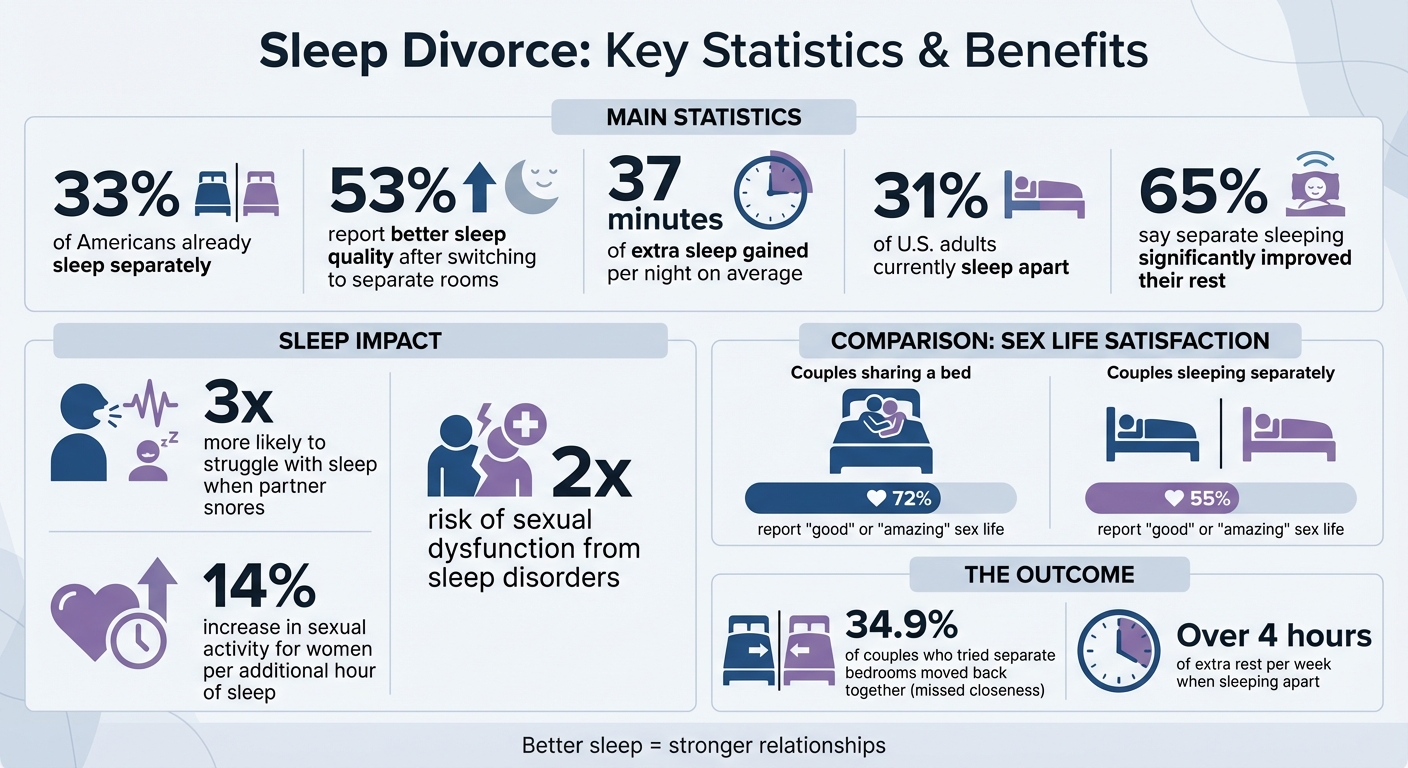
Sleep Divorce Statistics: Benefits of Separate Bedrooms for Couples
The Problem: How Sharing a Bed Affects Sleep and Relationships
Common Sleep Problems in Shared Beds
Sharing a bed can often throw a wrench into a good night's sleep. Take snoring, for instance - if you’re sleeping next to a heavy snorer, you’re three times more likely to struggle with falling or staying asleep [2]. And snoring is just the tip of the iceberg. Tossing and turning, restless legs, or even the dreaded blanket hogging can leave one or both partners battling chronic sleep deprivation.
Then there’s the issue of mismatched sleep habits. Night owls and early risers often find themselves at odds, creating friction over bedtime routines. Add in temperature disagreements - one partner piling on blankets while the other kicks them off - and things get even trickier. Even small habits, like using a reading light or watching TV in bed, can disrupt harmony and chip away at sleep quality [2][8]. These constant interruptions don’t just leave you tired; they can have serious effects on health and relationships.
Health and Relationship Effects of Poor Sleep
The impact of poor sleep goes far beyond feeling groggy. Chronic sleep deprivation can weaken your immune system, increase the risk of heart issues, and even slow your metabolism, contributing to weight gain [1][7]. Mentally, it’s no better - lack of sleep can lead to irritability, anxiety, and depression, while also making it harder to focus on daily tasks.
For relationships, the fallout is often immediate. Sleep-deprived couples tend to argue more and show increased hostility toward each other. Unsurprisingly, this can make both partners feel less satisfied with the relationship [1]. On top of that, sleep disorders can double the risk of sexual dysfunction, reducing both libido and physical sensitivity [7]. Despite these clear downsides, many couples hesitate to explore alternative sleeping arrangements because of societal norms.
Why Separate Bedrooms Carry a Social Stigma
Even though sleeping apart could solve many of these issues, the idea of separate bedrooms still carries a heavy stigma in American culture. This mindset dates back to the 1950s, when the master bedroom became a symbol of a successful marriage [6]. Jade Wu, a behavioral sleep-medicine specialist, challenges this notion:
"I think it's a social construct that we've made up that a couple should sleep together. I don't think it's necessary"
[5]
This cultural pressure often prevents couples from considering separate sleeping arrangements, even if it could improve their health and relationship. The term "sleep divorce" doesn’t help either - it’s loaded with negativity, making partners worry that sleeping apart signals a failing relationship. Wendy M. Troxel, Senior Behavioral Scientist at RAND Corp, explains:
"All these beliefs that we have [about sleeping apart] prevent us from considering that sleeping apart might improve our sleep and it'd be good for our relationship"
[5]
This stigma creates a real barrier, keeping couples from exploring solutions that might be better for both their rest and their connection.
sbb-itb-069f7a3
The Solution: Why Separate Bedrooms Work
How Separate Bedrooms Lead to Better Sleep
Sleeping in separate bedrooms gives you complete control over your sleep space. You can adjust the temperature to your liking - whether you prefer it warmer or cooler - without compromising for your partner. The same goes for lighting and noise levels. Want a white noise machine or total silence? No problem. No more battles over blankets or thermostat settings.
Research backs this up: 53% of people who tried sleeping in separate rooms reported better sleep quality[1]. On average, couples sleeping apart gain an additional 37 minutes of sleep per night compared to sharing a bed[1]. That adds up to over four extra hours of rest each week - time your body uses to recover and recharge. This boost in sleep quality paves the way for a deeper look into the pros and cons of separate sleeping arrangements.
Pros and Cons of Sleeping in Separate Rooms
| Feature | Pros | Cons |
|---|---|---|
| Sleep Quality | 53% report better sleep; gain 37 minutes more per night[1] | Some feel less secure or experience lighter sleep[1] |
| Relationship | Better rest reduces conflicts and irritability[1] | Risk of emotional distance if communication weakens[6] |
| Environment | Full control over temperature, light, and noise[2] | Increased costs for maintaining two bedrooms[1] |
| Intimacy | Encourages intentional date nights and planned connection[6] | May reduce spontaneous closeness and cuddling[1] |
These points highlight how customized sleeping setups can improve personal rest and relationship dynamics. Interestingly, 34.9% of couples who tried separate bedrooms eventually moved back together because they missed the closeness[5]. This doesn’t mean the arrangement failed - it simply shows that every couple needs to find what works best for them.
How Better Sleep Strengthens Relationships
The benefits of better sleep go beyond just feeling rested; they ripple into your daily interactions with your partner. When you’re well-rested, you’re less irritable and more emotionally present[1]. This can lead to fewer arguments and a stronger connection overall.
Sleep also plays a role in your sex life. For women, every additional hour of sleep increases the likelihood of engaging in intimacy by 14% the next day[7]. On the flip side, sleep disorders double the risk of sexual dysfunction for both men and women[7]. Simply put, better rest can naturally boost your libido and improve physical intimacy.
"It's hard to be a good partner when you're sleep-starved. You become moody, and you're more prone to depression and to engage in conflict."
- Wendy Troxel, Senior Behavioral Scientist, Rand Corporation[10]
Real-life stories echo these findings. Take Michael Solender from Charlotte, North Carolina, who has slept in a separate room for 32 of his 42 years of marriage. Initially a solution for his snoring and sleep apnea, the arrangement stuck because he and his wife preferred different room temperatures. He credits this setup for their healthier relationship[9]. Similarly, Tracey Daniels from Tryon, North Carolina, cherishes a nightly ritual where her husband tucks her in with a kiss before they retreat to separate rooms. For her, this balance of connection and restful sleep works perfectly[9].
How to Keep Intimacy Alive While Sleeping Apart
Daily Habits to Stay Connected
Sleeping in separate bedrooms can improve rest, but maintaining intimacy requires effort and intention. Many couples worry about losing the closeness that comes naturally at night. However, intimacy isn’t just about the time spent in bed together - it’s built through thoughtful habits during the day. The trick is to replace those spontaneous nighttime moments with deliberate rituals that nurture both emotional and physical connection.
One effective practice is creating a pre-sleep ritual. Dedicate 30 minutes to two hours together in one bed before heading to your separate rooms. Use this time to cuddle, share your thoughts about the day, read, or watch TV together[11][12][14]. Dr. Sarah Allen refers to this as building a "shared sanctuary", a safe and private space for meaningful conversations and physical closeness before parting for the night[11].
Morning routines can also help. The first person awake might join the other for morning cuddles or share a cup of coffee[12][14]. Amy McHugh, in August 2024, shared how she and her husband maintained a strong connection while sleeping apart for over a decade. Their routine included weekend "Netflix binges" in one bed and enjoying coffee together in the mornings. McHugh emphasized that eliminating frustrations like snoring and phone notifications actually enhanced their intimacy[15].
Physical touch throughout the day is equally important. Without the natural physical contact that happens at night, prioritize non-sexual touches like holding hands, hugging, or giving back rubs[14]. These small gestures create a foundation of closeness that supports both your individual sleep needs and your shared relationship.
Using Roma Llama to Build Anticipation and Connection

In addition to daily habits, playful activities can help keep the spark alive. When sleeping apart, it’s essential to nurture mental and emotional connection. One fun way to do this is with Roma Llama, a platform for co-creating personalized romance stories. You and your partner can customize everything from the spice level to character details and story settings.
This activity, available for $4.99, can become part of your pre-sleep cuddle time or serve as a surprise for your partner. You might send them a personalized e-card to enjoy in their own space. Roma Llama’s "Roll The Dice" feature adds an element of surprise, and since it doesn’t require a login or subscription, it’s easy to use whenever inspiration strikes.
The Truth About Sex and Separate Bedrooms
Statistics show that 72% of couples sharing a bed report having a "good" or "amazing" sex life, compared to 55% of those sleeping separately[13]. But this doesn’t mean separate bedrooms spell doom for intimacy - it simply requires more intentional effort.
Here’s the upside: better sleep can boost your libido. For women, every additional hour of sleep is linked to a 14% increase in sexual activity with their partner[15][16]. Well-rested partners are more patient, energetic, and ready for intimacy. Plus, 75% of people who have sex before bed report sleeping better afterward[12].
Think of intimacy as a planned date night. Schedule it, build anticipation, and make it a priority[14][15]. This approach helps avoid a "roommate" dynamic. As Sharon Bober, Associate Professor of Psychology at Harvard Medical School, explains:
"Just because you don't always sleep in the same bed doesn't mean that you feel separated as a couple"
[8]. Couples who thrive while sleeping apart are those who communicate openly and establish rituals that keep their connection strong - both inside and outside the bedroom.
How to Start Sleeping in Separate Bedrooms
How to Decide If Separate Bedrooms Are Right for You
Before making any changes, take a week to track how often your sleep is interrupted. Keep a log of disturbances like snoring or restless movements - this can give you a clear picture of how much sleep you're losing. It's also a good idea to rule out any medical issues first. For example, snoring might be linked to sleep apnea, and frequent movements could point to a treatable condition. Consulting a doctor can help you address these concerns.
Once you've gathered this information, have an open and honest conversation with your partner. Use "I" statements to focus on your own sleep needs rather than assigning blame. Approach the idea of separate bedrooms as a way to form a "sleep alliance", not as a sign of relationship trouble. As Wendy M. Troxel, Ph.D., Senior Behavioral Scientist at RAND Corp., explains:
"By forming a 'sleep alliance,' you both can get the sleep you need … so that you can be the best partners you can be." [5]
Consider starting with a two-week trial period. This allows both of you to test the arrangement without feeling locked into a permanent decision. If one of you feels lonely or uncomfortable during the trial, you can tweak the setup or return to sharing a bed.
Once you've decided to try separate bedrooms, the next step is creating a space that feels like your own personal haven.
Setting Up Your Individual Sleep Space
Avoid treating the second bedroom like a spare room or a guest space. It should feel like a reflection of you, not a place of exile. Neil Stanley, coauthor of A Sleep Divorce, advises:
"It should be your room... decorated the way you want with the mattress, duvet, and pillows you want." [6]
When choosing a mattress, focus on your specific needs. For instance, one partner might prefer a plush memory foam mattress, while the other might need a firmer option for better support. Adjust the room’s temperature to suit your comfort - if you sleep best at 65°F and your partner prefers 72°F, separate spaces allow you both to rest comfortably. Add blackout curtains and white noise machines to block out distractions and create a serene environment.
If you find yourself missing your partner's presence, try using a body pillow or a weighted blanket for a sense of comfort and closeness.
Establishing Rules and Expectations
Once your sleep spaces are set, clear communication and agreed-upon guidelines can help maintain both intimacy and harmony. The goal of sleeping apart is to improve your rest and your relationship.
Decide together on "visiting" rules. Some couples enjoy spending quiet moments together - like sharing coffee or cuddling - before heading to their separate rooms. Others might schedule specific times to reconnect. You could designate the master bedroom as the primary space for intimacy and keep the second room strictly for sleeping. This approach helps maintain a romantic connection without slipping into a "roommate" dynamic. Another option is to sleep apart during the workweek and share a bed on weekends.
Regular check-ins are essential. Whether it's daily or weekly, talk about what’s working and what might need tweaking. Wendy Troxel emphasizes:
"Communication is vital. Understand the preferences and habits of your partner, talk about what's working and what's not, and don't let the other person feel blamed." [17]
If you have kids, explain the arrangement in a way they’ll understand, such as saying it helps you both sleep better so you can be more present as parents. Keep in mind that about 35% of couples who tried sleeping apart eventually went back to sharing a bed because they missed each other [5]. The key is finding a setup that works for both of you while keeping your connection strong.
What is a sleep divorce and is it right for you?
Conclusion: Better Sleep Leads to Happier Relationships
Tackling sleep disruptions can transform not just your nights, but also your relationship. Opting for separate bedrooms isn't about creating distance - it's about strengthening your bond. Over 50% of couples who make this choice report better sleep, gaining an average of 37 extra minutes per night [1]. And when you're well-rested, you're naturally more patient, less irritable, and better equipped to support your partner.
Fatigue has a way of turning small annoyances into big arguments. Prioritizing quality rest allows for clearer communication and better stress management, creating a stronger foundation for your relationship. This focus on sleep benefits both individuals and the partnership as a whole.
Improved sleep also has a positive impact on intimacy. For women, just one additional hour of sleep is associated with a 14% increase in sexual activity with their partner [15]. When you're not drained or frustrated from interrupted sleep, you're more likely to feel connected and energized for moments of closeness.
Interestingly, nearly one-third (31%) of U.S. adults already sleep apart, and 65% of them say it has significantly improved their rest [4][3]. Better sleep doesn't just ease nighttime frustrations - it helps you tackle challenges together during the day. When you're well-rested, you're more present, patient, and engaged in the moments that matter most.
FAQs
How can we discuss sleeping separately without causing hurt feelings?
When discussing this topic, approach it with understanding and a focus on shared well-being. Highlight the positive aspects, such as improved sleep and fewer disruptions, while framing it as a mutual benefit. For instance, you might say, "I've read that some couples sleep better in separate beds, and it could be a way for both of us to get more restful sleep." By focusing on health and happiness, the conversation can feel considerate and centered on a joint effort to improve your quality of life.
What’s the best way to try a “sleep divorce” without making it permanent?
If you're considering a temporary "sleep divorce", start by easing into it and keeping communication open with your partner. Begin by sleeping in separate spaces one or two nights a week to see how it affects both of you. Small adjustments, like setting different bedtimes or using a vibrating alarm, can help reduce disruptions. Be upfront about your intentions - frame it as a trial to improve sleep and strengthen your relationship. This way, both partners stay engaged and comfortable throughout the process.
How can we keep intimacy strong if we sleep in separate rooms?
To keep your connection strong while sleeping apart, prioritize meaningful interactions and emotional closeness throughout the day. Spend time together having heartfelt conversations, enjoying shared hobbies, or expressing affection through small gestures. You can also create special rituals, like regular date nights, morning snuggles, or winding down together in the evening, to maintain a sense of togetherness. By staying open and communicative, and putting thought into nurturing your bond, separate sleeping arrangements won’t stand in the way of your emotional or physical intimacy.
Key Takeaways
- 1
Sharing a bed can often throw a wrench into a good night's sleep.
- 2
Before making any changes, take a week to track how often your sleep is interrupted.
- 3
Tackling sleep disruptions can transform not just your nights, but also your relationship.

Written By
Marcus ThorneLicensed Marriage and Family Therapist (LMFT)
Marcus Thorne specializes in transforming high-conflict relationships into resilient partnerships. With a background in behavioral therapy, Marcus focuses on practical communication frameworks that help couples move from "fighting" to "connection." He has led over 200 workshops on the Gottman Method.
View Expert Profile →Keep Reading
Explore Related Stories

The Rival Chefs
Chef {NAME1} and rival {NAME2} are forced to share a tiny kitchen for a charity event. As they fight over counter space and ingredients, their professional bickering turns into an intense physical hunger.

The Slice of Life Arrangement
{NAME1} and her reclusive neighbor {NAME2} enter into a fake relationship to solve their social problems. As they navigate family events and quiet dinners, their 'arrangement' turns into a real, heartwarming passion.
Reference Sources
This article was developed using research and insights from the following clinical and narrative authorities: