Expert Summary
Friendship is the most common and durable path to romance, often developing into love after nearly two years.

Study: How Friendships Become Romantic
Surprisingly, 66% of romantic relationships begin as friendships, not through chance encounters or dating apps. Research shows these relationships thrive because they’re built on trust, shared experiences, and emotional closeness. On average, couples spend 22 months as friends before transitioning to romance, often without initial romantic intentions.
Key findings:
- 70% of friends-first couples didn’t plan for romance initially.
- 85% of LGBTQ+ relationships and 84% of married adults under 30 started as friendships.
- Emotional bonds in friendships often evolve into romantic attraction, with 42% of married couples reporting a “friends-with-benefits” phase.
While the fear of losing the friendship is a risk, starting as friends often leads to stronger, longer-lasting relationships.
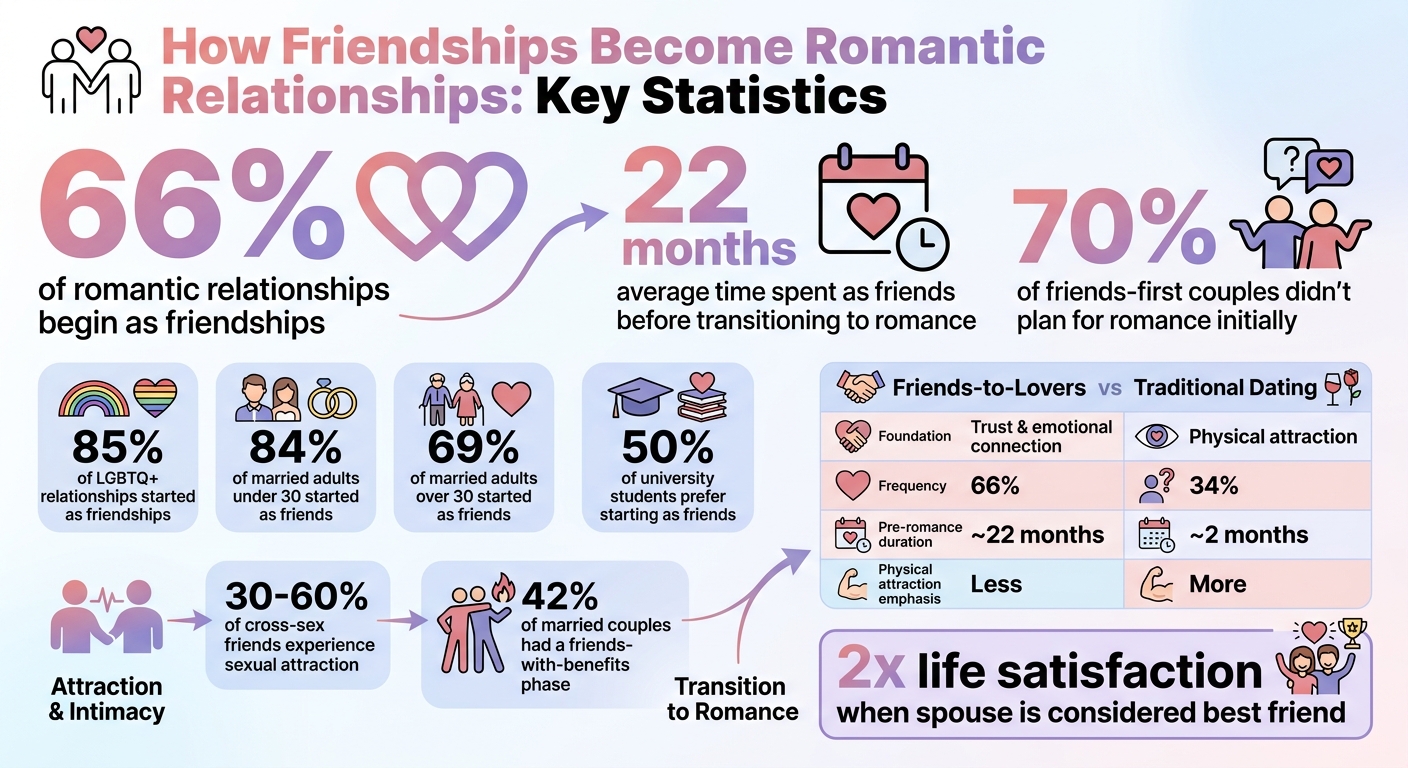
How Friendships Become Romantic Relationships: Key Statistics and Timeline
What Research Shows About Friends-to-Lovers Relationships
How Common Are Friends-First Relationships
Recent studies emphasize just how often romantic relationships start with friendship. A meta-analysis of 1,900 participants found that 68% of romantic relationships began as friendships, with even higher numbers among specific groups. For same-gender or queer relationships, this figure jumps to 85%. Similarly, 84% of married adults under 30 reported that their relationship started as a friendship, compared to 69% of those over 30 [2][4].
The trend is equally evident among university students. Nearly 50% of students say they prefer starting as friends before transitioning into a romantic relationship [3]. Of those who do make the leap from friends to lovers, 71% began their relationship as friends [2]. These statistics underline the importance of friendship as a foundation for romantic connections.
How Emotional Closeness Leads to Romantic Attraction
Friendship-based intimacy - marked by warmth, mutual understanding, and emotional interdependence - often paves the way for romantic and even sexual attraction [2]. Over time, this emotional closeness can ignite passion and desire, creating a bridge between platonic and romantic feelings. Interestingly, research reveals that the connection works both ways: while sexual attraction can sometimes lead to friendship, deep emotional ties can also foster romantic feelings [2].
Between 30% and 60% of cross-sex friends report experiencing moderate sexual attraction [2][4]. Additionally, 42% of married couples who began as friends acknowledged going through a friends-with-benefits phase before committing to a romantic relationship [2][4]. This highlights how the line between platonic and romantic relationships can blur, with emotional bonds often fueling physical attraction.
"Friendship-based intimacy is also the foundation of long-lasting romantic bonds, and thus understanding how and when people transition from friendship to romance may help researchers to understand the social–psychological foundations of strong and satisfying romantic relationships."
– Danu Anthony Stinson, Professor of Psychology, University of Victoria [2]
sbb-itb-069f7a3
How Friendships Transition to Romance
Building a Strong Friendship and First Attraction
The path from friendship to romance often starts with a solid foundation of trust, mutual understanding, and emotional closeness. This stage, rooted in genuine connection, develops over time without the pressure of romantic expectations. Friends build a sense of safety and openness, which can later pave the way for deeper emotional and even physical attraction.
Unlike the instant spark that might occur between strangers, romantic feelings between friends tend to grow more gradually. Spending time together - whether in group settings or one-on-one - can lead to a shift in dynamics. Studies suggest that 30% to 60% of cross-sex friendships involve at least some level of sexual attraction, highlighting how this transition can naturally unfold over time [4]. The intimacy already established in the friendship creates fertile ground for these feelings to deepen.
Recognizing Romantic Feelings and Starting to Flirt
The shift from platonic to romantic feelings can catch people off guard. It’s not uncommon for someone to "friend zone" a person they’re attracted to, as a way to protect themselves from potential rejection [5]. But as feelings grow, interactions often change. Communication becomes more frequent and intentional - think daily FaceTiming or constant texting - signaling a shift in priorities and emotional investment [5].
This stage often involves subtle changes, like testing boundaries with physical closeness or engaging in deeper, more meaningful conversations. Many people seek advice from close friends or mentors to help process these evolving emotions and decide how to move forward [5]. These small but significant changes often set the stage for honest discussions about romantic feelings.
Expressing Feelings and Becoming a Couple
The turning point comes when both individuals openly share their feelings and discuss the future of their relationship.
"The transition from friendship to relationship was founded on truth, external accountability and self-awareness." – Hayley Mulenda [5]
Interestingly, for 42% of married couples who started as friends, the journey included a friends-with-benefits phase before transitioning into a committed relationship [2]. Whether the shift happens gradually or through a defining moment - like a sudden spark of physical intimacy [6] - clear communication is key. Honest conversations about boundaries and expectations help distinguish casual encounters from a meaningful romantic commitment [6].
Risks and Benefits of Dating a Friend
The Risk of Losing the Friendship
One of the biggest challenges in transitioning from friendship to romance is the fear of losing the friendship entirely if the relationship doesn't work out. A breakup can make it hard - or even impossible - to return to the comfort of a platonic connection, leaving both individuals in an awkward or painful situation [9]. This tension can also ripple through shared friend groups, creating uncomfortable dynamics where mutual friends may feel caught in the middle or forced to pick sides [8].
Shifting from friends to romantic partners also requires establishing new boundaries and expectations, which can be stressful [9]. In some cases, especially in opposite-sex friendships, small actions might be misinterpreted as romantic gestures, complicating the once-easygoing nature of the bond [7].
That said, the trust and familiarity that exist in a friendship can serve as a strong foundation for a romantic relationship, despite these risks.
Why Starting as Friends Can Strengthen Romance
Building a relationship on friendship offers some clear advantages. The trust and understanding that have already been established remove much of the pressure to put on a "perfect" persona, which is often a part of traditional dating [9]. Josephine Ferraro, a licensed psychotherapist based in New York City, explains:
"Being friends first provides an opportunity to build a strong foundation of trust and understanding" [9].
This sense of emotional safety encourages couples to have open and honest conversations about their concerns and future goals before committing to a romantic relationship [9]. Additionally, the time spent as friends allows both individuals to see each other’s authentic selves - their personality, communication style, and values - without the pretense that can come with early-stage dating [9].
Comparison: Friends-to-Lovers vs. Traditional Dating
Weighing the risks and rewards of dating a friend highlights some key differences between friends-to-lovers relationships and those that begin through traditional dating. Interestingly, 66% of romantic relationships start as friendships [8], making it the most common path to romance - even though it’s less studied compared to other dating approaches. For adults under 30, this figure climbs to 84%, and for LGBTQ+ couples, it reaches 85% [4][8].
| Feature | Friends-to-Lovers | Traditional Dating |
|---|---|---|
| Foundation | Built on trust and emotional connection [4] | Often based on physical attraction and chemistry [4] |
| Frequency | ~66% of relationships [8] | ~34% of relationships [8] |
| Pre-romance Duration | Around 22 months [8] | Roughly 2 months |
| Gender Dynamics | More equal expectations [4] | Often shaped by traditional gender roles [4] |
| Physical Attraction | Less emphasis on appearance [4] | Stronger focus on looks [4] |
Couples who transition from friends to lovers typically spend about 22 months as friends before taking the romantic leap [8]. Interestingly, most of these friendships don’t start with romantic intentions [8]. This extended period allows for a natural development of compatibility, unlike the faster-paced dynamics of stranger-to-partner relationships, which often rely on an initial spark.
From Friends to Lovers: How to Transition a Friendship into Romance
How Friendship Foundations Affect Long-Term Relationship Success
Building on earlier insights into the importance of emotional closeness, this section delves into how friendships lay the groundwork for lasting romantic relationships.
How Trust and Openness Lead to Lasting Relationships
The emotional bonds developed in friendships offer a unique advantage when they transition into romantic relationships. Unlike the surface-level thrill often found in traditional dating, friendships foster a deeper intimacy characterized by warmth, mutual understanding, and shared reliance. These traits form the bedrock of companionate love, which is crucial for long-term relationship success [4].
Friends who become romantic partners benefit from skills they’ve already honed together, like being open with one another, offering support during difficulties, and resolving disagreements. Studies reveal that such supportive interactions can lower physical stress markers, like heart rate and blood pressure, compared to less secure relationships [10]. This calming effect often carries over into romance, enabling couples to handle conflicts with greater ease and understanding.
"All the qualities that make a good friend, and the closeness from being friends, strengthen romantic relationships"
Lisa Hoplock and Jessica Cameron explain [1]. The trust built over time in a friendship eliminates the need to put on a façade or hide imperfections, creating an environment where vulnerability feels safe. This emotional safety becomes crucial when couples face life's inevitable ups and downs. Strong friendship foundations not only help manage conflict but also contribute to a greater sense of satisfaction in life overall.
Research on Relationship Duration and Happiness
The emotional security rooted in friendship has a measurable impact on long-term happiness and relationship stability. Research shows that individuals who consider their spouse their best friend report double the life satisfaction compared to those who don’t share that bond with their partner [10]. This isn’t just about fleeting joy - it reflects a deeper, enduring stability that comes from truly knowing and understanding each other.
Friendship-based relationships also offer mental health benefits. High-quality friendships help protect against anxiety and depression, and when these friendships evolve into romance, those benefits persist [10]. On the other hand, the absence of meaningful friendships can have serious consequences - people with no friends or poor-quality friendships are twice as likely to face premature death [10]. These findings highlight just how essential such connections are to overall well-being.
"Friendship-based intimacy is also the foundation of long-lasting romantic bonds"
Researchers Stinson, Cameron, and Hoplock stress [4]. Understanding each other’s authentic selves creates a relationship that can endure challenges, rooted in something far deeper than initial attraction alone.
Conclusion
Research highlights that friendships often lay the groundwork for enduring romantic relationships. Around 66% of romantic relationships start as platonic friendships, offering a strong base of trust, mutual understanding, and support - key ingredients for long-term success [1]. Interestingly, these friendships tend to last nearly two years before evolving into romance, with 70% of people reporting that romantic intentions weren’t part of the equation at first [1].
Whether your relationship began as a friendship or is still in its early stages, focusing on the core elements of friendship - like trust, openness, and shared understanding - can help strengthen your bond and navigate life’s ups and downs.
Create Custom Romance Stories with Roma Llama

Building intimacy doesn’t have to be routine. Roma Llama offers a creative way to explore your connection through personalized romance stories. You can tailor everything from character details to spice levels, creating narratives that reflect your unique bond. At just $4.99 per story, these stories can spark meaningful conversations about intimacy. Plus, they’re easy to share as e-cards - no logins or subscriptions needed. Head over to romallama.com to craft your first personalized romance story today.
FAQs
How do I know if my feelings for a friend are romantic?
When your feelings start to shift toward something more romantic, it’s often tied to a deeper emotional connection. You might notice things like increased trust, a stronger sense of intimacy, or a growing desire to be closer to them in ways that go beyond a typical friendship.
Some telltale signs? You catch yourself thinking about them more often, feeling a twinge of jealousy in certain situations, or even imagining romantic moments with them. Physical attraction or craving more personal, intimate moments can also be clues that your emotions are moving from platonic to romantic territory.
When is the right time to tell a friend I like them?
When it comes to sharing your feelings, timing is everything. The ideal moment is when you’ve established a strong emotional connection, can sense mutual romantic interest, and feel assured that your friendship will be treated with care and respect during the conversation. Before opening up, weigh the possible risks and rewards, and make sure the timing feels comfortable for both of you.
Can we stay friends if dating doesn’t work out?
Friendships can often stay strong even if a romantic relationship doesn’t work out. Studies indicate that many romantic relationships start as friendships, and these connections frequently survive beyond the romantic stage. The key to keeping the friendship intact lies in maintaining trust and practicing open communication.
Key Takeaways
- 1
Recent studies emphasize just how often romantic relationships start with friendship.
- 2
One of the biggest challenges in transitioning from friendship to romance is the fear of losing the friendship entirely if the relationship doesn't work out.
- 3
Building on earlier insights into the importance of emotional closeness, this section delves into how friendships lay the groundwork for lasting romantic relationships.

Written By
Marcus ThorneLicensed Marriage and Family Therapist (LMFT)
Marcus Thorne specializes in transforming high-conflict relationships into resilient partnerships. With a background in behavioral therapy, Marcus focuses on practical communication frameworks that help couples move from "fighting" to "connection." He has led over 200 workshops on the Gottman Method.
View Expert Profile →Keep Reading
Why "Happily Ever After" Is A Myth (And What's Actually Better)
Read Article →From Roommates to Lovers Again: Escaping the Relationship Rut
Read Article →Monogamy on Trial: A Look at the Data Behind Lifelong Partnerships
Read Article →Is "Situationship" the New Normal? The Pros and Cons of Undefined Relationships
Read Article →Explore Related Stories

The Rival Chefs
Chef {NAME1} and rival {NAME2} are forced to share a tiny kitchen for a charity event. As they fight over counter space and ingredients, their professional bickering turns into an intense physical hunger.

The Slice of Life Arrangement
{NAME1} and her reclusive neighbor {NAME2} enter into a fake relationship to solve their social problems. As they navigate family events and quiet dinners, their 'arrangement' turns into a real, heartwarming passion.
Reference Sources
This article was developed using research and insights from the following clinical and narrative authorities: