Expert Summary
Younger daters are choosing libraries and parks over apps, using shared activities and regular visits to form natural, low-pressure relationships.

The Comeback of the "Third Place": Why We’re Meeting Lovers at Libraries and Parks Again
Dating apps aren’t cutting it anymore. Younger generations are turning to libraries, parks, and other public spaces - what sociologist Ray Oldenburg calls "third places" - to meet people in a more natural way. These spaces, free from the pressure of spending money or performing, allow connections to grow through shared activities and repeated interactions.
Key takeaways:
- Dating app fatigue: Only 23% of Gen Z adults met their partner online in 2026.
- The appeal of third places: Libraries and parks are neutral, welcoming spaces where connections feel effortless.
- Shared experiences matter: Activities like yoga, book clubs, or park cleanups create low-pressure opportunities to meet people.
If you’re tired of swiping, try spending time in places you enjoy. Consistent visits to these spaces can lead to meaningful relationships - without the stress of algorithms or curated profiles.
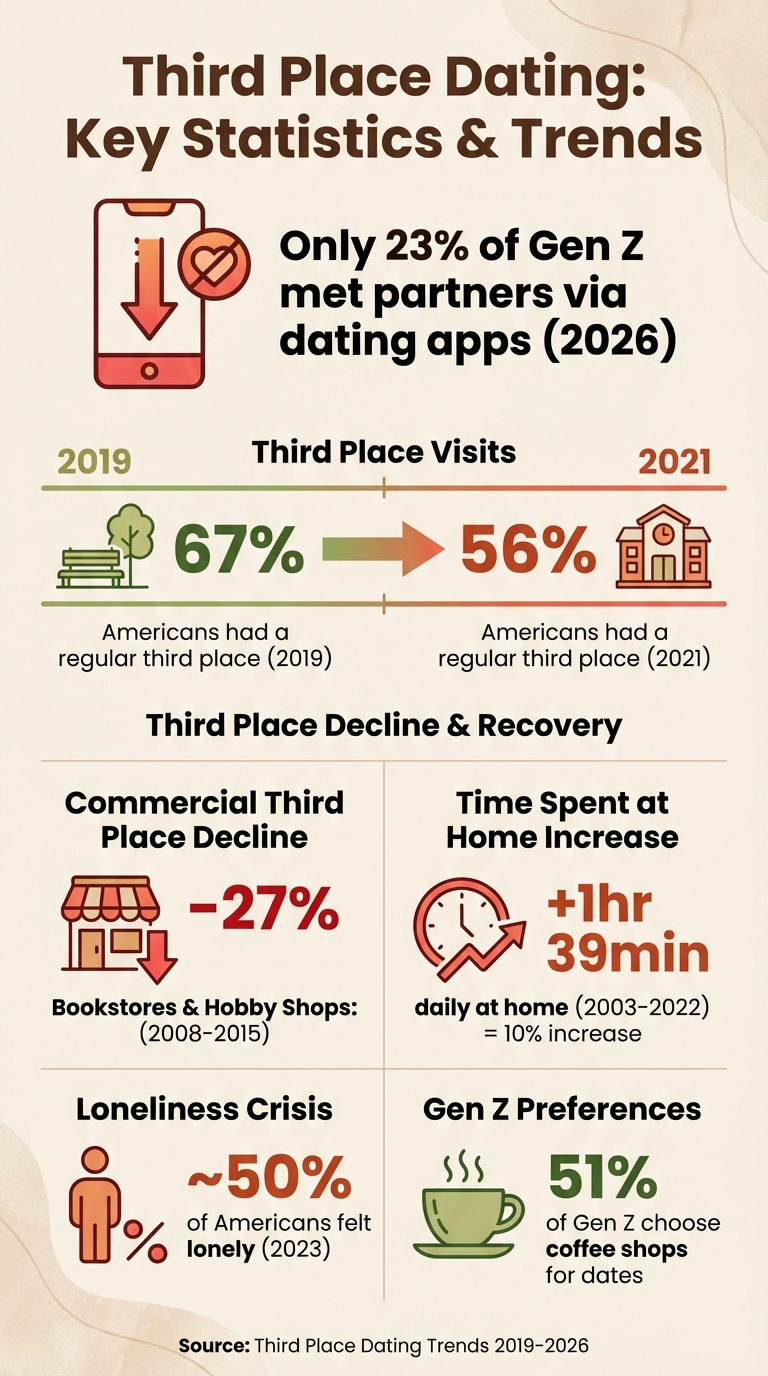
Third Place Dating Statistics and Trends 2019-2026
What Are Third Places? Libraries, Parks, and More
The term "third place" was introduced in 1989 by sociologist Ray Oldenburg. It describes public spaces outside of home and work where people can relax and connect with others through casual, everyday interactions [9][10].
Core Features of Third Places
A third place isn’t simply any public area - it’s defined by how it functions. These spaces share a few key characteristics that set them apart:
- Neutral ground: These spaces allow people to come and go freely without the pressures of performance or spending money [9][12].
- Social equalizers: Social hierarchies are left at the door, creating an environment where everyone is treated equally, regardless of their background or status [9][12].
- Conversation-focused: Informal, relaxed conversations are at the heart of third places, rather than transactional or goal-driven exchanges.
- Accessible: They are easy to reach, often free or low-cost, making them inclusive and welcoming to everyone [9][11].
- The regulars: A core group of frequent visitors gives these spaces their unique character and helps create a welcoming atmosphere for newcomers [9][12].
These traits make spaces like libraries and parks ideal examples of third places, where unplanned, genuine connections can flourish.
Why Libraries and Parks Work Best
Libraries and parks stand out because they meet all the criteria of third places, while also offering something increasingly rare: spaces where you can spend hours without needing to spend money [11][1].
Libraries have transformed from their quiet, book-focused image into bustling community hubs. For instance, the King County Library System in Washington describes its locations as "dynamic Third Places" where people can "live, learn, and connect" [2]. In Arlington, Virginia, the Central Library organizes events like crafting meetups and sewing workshops, designed to combat social isolation [2].
Parks, on the other hand, are natural spaces for forming "bridging ties" - connections between people from different walks of life who might not otherwise meet [7]. Activities like picnics, yoga sessions, sports, and concerts encourage organic interactions [7][10]. A great example is The Gathering Place in Tulsa, Oklahoma, which offers diverse amenities and cultural events that draw people of all ages and backgrounds [10].
These spaces are stepping in to fill the gap left by the decline of traditional commercial social spots. Between 2008 and 2015, bookstores and hobby shops saw a 27% decline [7]. Coffee shops are also shifting to "grab-and-go" models, removing seating to discourage lingering [2]. Libraries and parks, however, remain open and inviting. As Japonica Brown-Saracino, a sociology professor at Boston University, puts it:
"open for long stretches of time, relatively affordable, and cultivate the opportunity for informal interaction among strangers" [1]
The need for these spaces is clear. In 2021, only 56% of Americans said they had a third place they visited regularly, down from 67% in 2019 [7]. Libraries and parks are helping to reverse this trend, offering places where people can naturally connect and enjoy meaningful, offline interactions - the kind of connections that this article delves into further.
sbb-itb-069f7a3
Why Third Places Are Popular for Romance Again
The renewed interest in libraries, parks, and similar spaces for romantic connections isn’t a coincidence - it stems from growing dissatisfaction with modern dating. Swiping endlessly on apps and sifting through carefully curated profiles has left many feeling unfulfilled. This backdrop explains why third places, with their sense of history and community, are once again becoming central to how people meet and fall in love.
Moving Beyond Online Dating
Dating apps promised simplicity and efficiency but have instead led to what some call "algorithm fatigue." Only 23% of Gen Z adults say they met their partner through dating apps, highlighting their limited success. Events like Jessica Hope Evans' BODA in Liverpool and Maxine Simone Williams' We Met IRL show that offline interactions often lead to deeper, more meaningful connections [8].
Third places offer something apps can’t: authentic interactions. Here, you can gauge chemistry, humor, and body language in real-time without worrying about being misled by curated profiles or potential catfishing [8]. For example, Jessica Hope Evans launched "Bored Of Dating Apps" (BODA) in 2022 to encourage offline dating. The first event in Liverpool drew over 200 attendees and has since expanded across the UK and New York, resulting in engagements, weddings, and even a baby [16]. Similarly, Maxine Simone Williams started "We Met IRL" in 2022 after becoming frustrated with dating apps and the lack of diversity in traditional dating spaces [8]. These initiatives prove that people are ready to trade algorithms for real-world connections, where shared experiences pave the way for lasting romance.
The Power of Shared Activities
Romance in third places doesn’t begin with questions like, "Are we a perfect match?" Instead, it starts with something simpler: "Do I enjoy spending time with this person?" This shift from evaluation to observation is crucial [6].
Modern libraries, for instance, have transformed into community hubs offering everything from crafting sessions to chess tournaments and workshops. These activities act as natural conversation starters [2][14]. When you’re participating in a shared activity - whether it’s a crafting meetup or yoga in the park - conversations flow more easily than they might during a formal dinner. As Finkel et al. explain:
"Romantic attraction is more likely to emerge when people feel psychologically safe and emotionally connected through shared goals or group meaning" [4].
This approach allows attraction to grow gradually through repeated, low-pressure interactions rather than forced or performative moments. The result? A more organic connection, built on genuine enjoyment of each other’s company.
The Return to Simple, Genuine Interactions
In 2023, nearly half of Americans reported feeling lonely [17]. While the pandemic worsened this isolation, the trend has been building for years. Between 2003 and 2022, Americans increased their time spent at home by an average of 1 hour and 39 minutes per day - a 10% jump [13].
Third places counteract this isolation by creating a sense of community, often before romance even enters the picture. These spaces allow people to be "alone together quietly" [13], offering a sense of belonging without the constant pressure to engage. This relaxed environment takes some of the weight off romantic relationships, which are often expected to fulfill all emotional needs [15][16].
In a world dominated by screens and algorithms, meeting someone in a park or library feels refreshingly simple. Without profiles or performance, connections are built on mutual enjoyment and discovery. That return to unfiltered, human connection is why third places are becoming an increasingly appealing setting for modern romance.
How to Build Romance in Third Places
Now that you understand how third places can ignite romance, it’s time to apply that knowledge. The secret lies in choosing activities and locations that feel natural for both of you and showing up often enough for authentic connections to take root. These ideas build on the advantages of third places discussed earlier.
Activities to Try Together
Libraries aren’t just about books - they’re full of opportunities for connection. Try organizing a book scavenger hunt, where you challenge each other to find titles based on quirky themes like birth years or fun cover art [18][19]. At the Central Library in Arlington, Virginia, there’s a space called "The Incubator" that hosts events designed to spark creative connections [2]. You could even leave secret notes in books for future readers or take turns reading poetry aloud in a quiet corner [18][19].
Parks are another fantastic option, especially when you add physical or group activities into the mix. Sign up for a run club or join a weekly outdoor yoga class - these shared experiences naturally encourage conversation [6]. In November 2024, Tinder teamed up with the running app Runna to create "SoleMates Run Clubs", an initiative aimed at helping singles connect in third places through running [22]. Even simpler activities, like exploring a new neighborhood together or hosting a literary-themed picnic, can trigger the dopamine rush often associated with the early stages of love [21]. These kinds of interactions mimic the organic connections found in traditional third places, making them perfect for building authentic relationships.
Of course, where you choose to go matters just as much as what you do.
Picking the Right Location
The right setting can elevate your experience. Pick a third place that reflects your shared interests. For example, 51% of Gen Z singles say coffee shops are their go-to third place for casual dates because they provide a relaxed, low-pressure atmosphere [22]. But if you’re both book lovers seeking a quieter vibe, a silent reading night at a local cafe might be more appealing than a busy social club [7]. You can even let the design of a location guide your choice - historic spaces like the New York Public Library might charm history enthusiasts, while sleek, modern spots such as the Stuttgart City Library could captivate art lovers [18].
Consistency is crucial. Becoming a regular at a specific spot helps build comfort and allows attraction to grow naturally. As Debbie Rudman, a Health Sciences Professor at Western University, points out:
"It's the doing that becomes the point of connection... The relationships, sense of belonging, and community build from that" [5].
Building Emotional Closeness Through Time Together
Third places allow you to see your partner in a more natural light - whether they’re being curious, awkward, or brave - before the pressures of traditional dating kick in [4]. Walking side-by-side in a park can make deep conversations feel more relaxed [21]. Meanwhile, libraries offer quiet intimacy, where whispered conversations or handwritten notes can create subtle but meaningful connections [20].
Shared rituals also play an important role in strengthening your bond. Whether it’s a pottery class or a Saturday morning walk, consistent weekly routines build empathy and create lasting memories [21][6]. These regular, genuine interactions highlight the beauty of romance that grows naturally - beyond the fast-paced world of dating apps. Neutral spaces like these allow your relationship to thrive without the distractions of everyday stress [21].
How Roma Llama Adds to Your Third Place Romance

Third place romance thrives on those unscripted, genuine moments - like splitting a table at the library, striking up a conversation on a park bench, or losing track of time during a long coffee chat. Roma Llama takes these everyday interactions and turns them into personalized stories that celebrate your unique journey.
Writing Stories Set in Your Favorite Third Places
Third places naturally lend themselves to romance, and Roma Llama helps you capture those moments in a way that feels deeply personal. With its AI-powered story generator, you can create custom narratives that reflect the settings and experiences of your relationship. Whether it’s the serene greenery of your local park or the iconic spiral staircases of a historic library, Roma Llama allows you to weave sensory details into your story, making it feel alive and meaningful.
The platform's "Make It Yours" feature gives you the tools to tailor stories with your names, character traits, and the little moments that define your relationship. Maybe it’s the yoga class where you first exchanged smiles or the book club where you bonded over a shared love for mystery novels. You can even explore the Story Template Library to find a romance trope that mirrors your dynamic, then customize it with your own details. For just $4.99 per story, you can celebrate milestones, like the shift from casual meet-ups to something deeper.
As sex therapist Olivia A. puts it:
"Roma Llama is a breakthrough in digital intimacy. It provides a safe, imaginative space for couples to rediscover one another through shared creative exploration."
Sharing Stories to Celebrate Your Connection
Once your story is written, Roma Llama makes sharing it easy and meaningful. With the e-card feature, you can send your personalized story to your partner without any need for subscriptions or logins. Whether it’s to mark a micro-anniversary, like your first library date, or the start of a running club tradition, these stories become a way to celebrate the moments that matter most.
These personalized narratives act as private milestones, capturing the natural evolution of your relationship through shared experiences. They honor the kind of slow, meaningful connections that third place romance is all about.
Conclusion
The revival of third places marks a shift away from the burnout of dating apps toward genuine, everyday connections formed through shared routines and organic interactions. Spaces like libraries, parks, and community centers offer something digital platforms simply can't - the chance to witness someone's true personality develop naturally, free from the pressures of meticulously curated profiles or the intensity of high-stakes first dates. As journalist Iraa Paul aptly puts it, "Third place dating isn't about chasing love. It's about building a life you enjoy - and allowing connection to emerge naturally within it" [6].
What makes these spaces so effective is their ability to strip away the transactional feel of modern dating. Instead of making snap judgments based on a bio or a quick coffee meetup, you get to see someone in their element - their kindness during a book club discussion, their humor at a community event, or their curiosity while exploring library shelves. Romance becomes a happy outcome of living a fulfilling life, rather than a goal you're actively chasing.
The numbers paint a clear picture: in 2021, only 56% of Americans reported having a third place they visited regularly, a drop from 67% in 2019 [7]. But things are beginning to change. Younger generations, especially Gen Z and Millennials, are rediscovering the charm of libraries and parks as spaces that foster authenticity. As content creator Henry Grey Earls observes, "I think people my age are craving something more authentic and looking for something real. What's more real than books and physical material?" [3].
If you're looking to deepen connections - whether you're single or in a relationship - consistency is key. Start frequenting a place that genuinely excites you. Join the library's writing group, attend the Saturday yoga sessions in the park, or spend time at the community garden nearby. By showing up regularly, you'll naturally create opportunities for connection. The strongest relationships often begin when two people find themselves in the same spaces they love. Third places aren't just about meeting someone new - they're about building a life filled with meaning, community, and shared moments, creating the perfect environment for love to flourish naturally, without pretense or pressure.
FAQs
What counts as a “third place” for dating?
A “third place” for dating refers to any social setting beyond the realms of home and work - think libraries, parks, cafes, or community centers. These spaces naturally promote connection and closeness by offering shared experiences, making them perfect for building deeper, more meaningful relationships.
How can I meet someone at a library or park without it feeling awkward?
To meet someone naturally at a library or park, focus on enjoying the moment and engaging in activities that genuinely interest you. Whether you're reading, strolling, or attending a community event, these settings create opportunities for organic interactions. A simple comment about a book someone is holding or a friendly remark about the surroundings can open the door to conversation. The key is to stay patient, be approachable, and let connections unfold naturally without forcing them.
What should I do if I’m new to a third place and don’t know anyone?
If you're exploring a new third place, participating in shared activities can help you form natural connections. Spend time there regularly, attend events, or join groups that align with your interests. For instance, libraries often host programs or study groups, creating opportunities for casual interactions. Similarly, parks may feature organized activities where conversations can flow naturally. By being open, consistent, and actively present, you can gradually build relationships and a sense of belonging in these inviting spaces.
Key Takeaways
- 1
The term "third place" was introduced in 1989 by sociologist Ray Oldenburg.
- 2
Now that you understand how third places can ignite romance, it’s time to apply that knowledge.

Written By
Dr. Julian ChenCognitive Scientist
Dr. Julian Chen is a researcher studying the neurobiology of love and the impact of advanced technology on human emotional connection. His work explores how expertly-crafted personalized content can serve as a catalyst for real-world intimacy and self-expansion.
View Expert Profile →Keep Reading
Explore Related Stories
The Rival Chefs
Chef {NAME1} and rival {NAME2} are forced to share a tiny kitchen for a charity event. As they fight over counter space and ingredients, their professional bickering turns into an intense physical hunger.
The Slice of Life Arrangement
{NAME1} and her reclusive neighbor {NAME2} enter into a fake relationship to solve their social problems. As they navigate family events and quiet dinners, their 'arrangement' turns into a real, heartwarming passion.
Reference Sources
This article was developed using research and insights from the following clinical and narrative authorities: