Expert Summary
Being upfront about money on a first date—frame choices as values, suggest budget-friendly plans, and use “I” statements to build trust.

Navigating "Loud Budgeting" on the First Date: How to Be Transparent About Money
Navigating finances on a first date can feel tricky, but being upfront about your money values - what some call "loud budgeting" - can help set the tone for trust and alignment. This approach isn’t about saying “I can’t afford it” but reframing it as “I choose not to spend.” Here’s how to handle money conversations early on:
- Be clear about your financial values: Reflect on your spending habits, goals, and limits before the date.
- Plan budget-friendly dates: Coffee, picnics, or free activities can be meaningful without overspending.
- Start the money talk naturally: Bring it up when discussing goals or passions, and use “I” statements to share your perspective.
- Handle the bill gracefully: Ask how your date prefers to split it or suggest sharing the cost.
Talking about money early can help identify compatibility and avoid future conflicts. Pay attention to how your date reacts to these discussions - it can reveal shared values or potential red flags. If your financial outlooks don’t match, it’s okay to walk away respectfully.
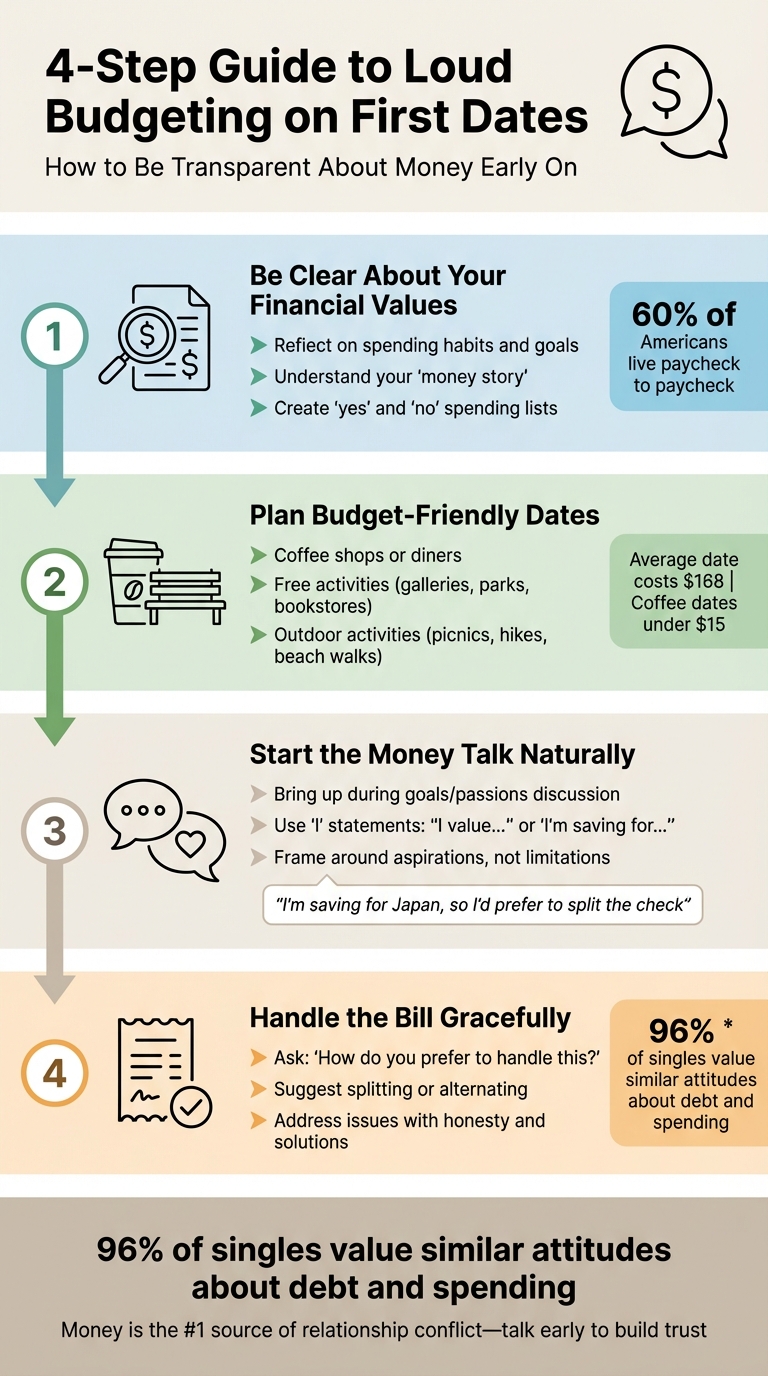
4-Step Guide to Loud Budgeting on First Dates
Preparing for Money Conversations Before the First Date
Understanding Your Own Financial Values
Before diving into money talks, take some time to reflect on your own financial habits and values. Start by thinking about how your upbringing has influenced your approach to money. Did your parents argue about finances, or did they model contrasting behaviors like saving diligently versus spending freely? These early experiences shape your "money story", which often guides the way you handle finances today [5, 10, 12].
Next, do a personal financial check-in. Write down your income, debts, savings, and any financial boundaries that are important to you. This kind of self-audit gives you clarity and confidence. For perspective, nearly half of Americans can’t cover a $1,000 emergency expense, and over 60% live paycheck to paycheck [6]. Being clear about your financial situation helps you communicate openly without seeming evasive [7, 13].
"Numbers give you outcomes. But you need to know how they got there... If you only look at the score, you don't know the mindset that produced it."
- Shavon Terrell-Camper, Life Coach [6]
Take it a step further by defining your spending priorities. Create a "yes" list for things you value spending on, like travel or wellness, and a "no" list for things you’d rather avoid, such as luxury items or convenience purchases [5]. When you’re ready to discuss finances, frame your thoughts with "I" statements like, "I value..." to keep the conversation personal and non-confrontational [6, 13].
Once you have a clear sense of your financial identity, you can plan date ideas that align with your values.
Choosing Affordable First Date Ideas
The first date doesn’t have to break the bank. Pick a setting that matches your financial priorities. Coffee shops or diners are great low-cost options that encourage conversation without the pressure of an expensive meal. On average, Americans spend about $213 per month on dating, with a single date costing around $168 [8]. Choosing something like a morning coffee or breakfast - where most items are under $15 - can subtly showcase your commitment to mindful spending [15, 16].
Activity-based dates are another great way to ease into money conversations. Explore a bookstore, visit a local art gallery on a free admission day, or take a stroll through a scenic neighborhood. These options allow for meaningful interactions without a hefty price tag. Outdoor activities like park picnics, hikes, or beach walks offer uninterrupted time to connect - completely free of charge [15, 18].
"The person you're dating doesn't necessarily want something expensive; they want to feel prioritized and know you're being intentional."
sbb-itb-069f7a3
How to Bring Up 'Loud Budgeting' on a First Date
When to Bring Up Money During the Date
The money conversation starts as soon as you’re deciding where to meet. Once you’re face-to-face, it’s best to wait until some comfort and connection have been built before diving into specifics about financial goals. These moments often come up naturally when discussing topics like passions, career plans, or travel dreams - subjects that tend to reveal spending habits and financial priorities without much effort [14, 26]. For example, if your date mentions wanting to explore Europe, it’s a great opportunity to share your own savings goals for travel. By opening up about your goals, you encourage them to do the same without making the conversation feel like an interrogation [1]. Once the timing feels right, you can transition into a more focused and goal-oriented discussion.
What to Say: Phrasing Examples That Work
When the moment comes, the way you phrase things matters. Your words should reflect your priorities while fostering trust and mutual understanding. Instead of saying something like, "I can't afford this", try framing it around your goals: "I’m saving for Japan, so I’d prefer to split the check" [1]. This shifts the focus from limitations to aspirations, making the conversation more positive and relatable [24, 25].
You could also try phrases like, "I’m being mindful of my spending because I’m saving for [specific goal]", or, "I’ve really enjoyed our time, but I’m keeping an eye on my expenses" [10]. Want to keep things light? Ask a fun question like, "If you got an extra $500 this month, how would you spend it?" [11]. Using “I” statements - like, "I’ve been really focused on my savings goal lately" - helps keep the tone personal and avoids sounding accusatory or awkward [13, 23].
"If there's a reason you're dating on a budget, use the date as an opportunity to share with your date why this is the case. Perhaps you're putting yourself through school, or you're saving up for something important - share this."
- Natalia Juarez, Dating Coach [10]
Money & Dating: The Conversations You're Avoiding That Will Make or Break Your Relationship
Handling Common Money Situations on First Dates
Navigating financial moments on a first date can set the tone for openness and trust moving forward. Whether planned or unexpected, how you handle these situations speaks volumes about your communication style and values. Here’s how to approach some common scenarios.
Splitting the Bill and Payment Discussions
When the check arrives, it’s best to address the situation directly. A simple question like, "How do you prefer to handle this?" invites honesty and ensures both parties feel heard. Many people see splitting the bill as a way to promote equality and independence. If you’re comfortable suggesting it, you could say, "I really enjoyed this. Would you be open to splitting the check?" Alternatively, you might propose a trade-off, such as, "How about you get this one, and I’ll grab the next one?" [12].
Talking about money before the date can help avoid any awkward moments later. While planning, you might ask, "What kind of budget feels right for this outing?" This allows both of you to set expectations early [2]. If your date insists on paying but you’d prefer to share the cost, it’s okay to express your personal values. For example, you could say, "I really appreciate the offer, but it’s important to me that we share the cost of our first few dates so it feels balanced" [7].
"Replacing phrases like 'we have to' or 'we should' with 'it's important to me because' keeps the conversation personal rather than prescriptive." - Stefanie O'Connell, Millennial Money Expert [3]
By setting these expectations, you create a framework for handling any surprises that might come up during the date.
Dealing with Unexpected Financial Issues
If a financial mishap happens - like a declined card or a forgotten wallet - it’s crucial to address it immediately with honesty. Trying to hide the issue can be a red flag, as certified financial planner Kaylin Dillon points out [4]. A straightforward approach works best. For instance, you might say, "I’m really embarrassed, but I seem to have forgotten my wallet." Follow it up with a solution, such as, "I’ll Venmo you right now" or "I’ll cover our next date" to show accountability [5, 11].
If your date runs into a financial issue, responding with empathy instead of criticism can reveal how you both handle stressful situations. This kind of moment can be a chance to build trust and see how each of you approaches unexpected challenges [3, 5].
Sharing Information About Debt or Financial Challenges
When it comes to discussing debt or financial struggles, focus on your plan rather than just the numbers. For example, you could say, "I’m working on paying off $15,000 in student loans and have a plan to clear it in three years." Keep the details concise to avoid overwhelming your date. Research shows that 96% of singles value similar attitudes about debt and spending in a partner [1]. Pay close attention to your date’s reaction - a supportive or curious response can signal shared values, while judgment or dismissiveness may indicate a mismatch [4].
Building Trust Through Shared Financial Values
Evaluating Compatibility Through Money and Lifestyle
Once you've started discussing finances, it's time to evaluate how well your financial habits align with your broader lifestyle goals. Shared financial values often reflect a shared life vision. As licensed therapist Beverley Andre puts it, "Money highlights your values. It shows the kind of life you're trying to live. The earlier you start these conversations, the earlier you see if your visions align" [6]. Simple, open-ended questions like "Are you saving for anything fun?" or "Have you thought about owning a home?" can guide these discussions naturally.
You can also learn a lot by observing how your date handles everyday financial situations. Pay attention to small spending behaviors - how they tip, their reaction to budget-friendly activities, or their comfort level with splitting costs. These moments can be revealing. To dig deeper, you might ask about their spending priorities: What do they enjoy splurging on, and what do they prefer to save on? These questions help uncover their values without diving into formal budget details [5]. Another great way to gauge compatibility is by asking about their "ideal vacation." Whether they dream of camping trips or luxury resorts, their answer can shed light on how they approach budgeting for shared experiences [5].
Understanding someone's financial habits also involves learning their "money story." Ask about their first job or how their family managed money to understand the roots of their current approach. Life coach Shavon Terrell-Camper explains it well: "Numbers give you outcomes. But you need to know how they got there... If you only look at the score, you don't know the mindset that produced it" [6]. And if debt comes up, focus on whether they have a plan to manage it. Financial educator Ross Mac reminds us, "Habits don't disappear at the altar" [6]. A proactive attitude toward improvement often matters more than the debt itself.
Ending Things Respectfully When Money Values Don't Match
If you find that your financial values don't align, it's important to recognize when it's time to step away. Differences in money attitudes aren't inherently wrong, but they can signal challenges for a shared future. For example, if your date dismisses your financial goals or avoids money discussions altogether, these could be signs of deeper incompatibility. Dating coach Sandy Weiner offers this advice: "If you find your date disrespecting your opinions about money and how you spend it, that's a red flag... just walk away" [2].
When ending things, focus on the differences rather than assigning blame. A respectful approach could sound like, "I've really enjoyed getting to know you, but I think we have different approaches to finances that might make things challenging long-term." This allows both of you to move on and find someone whose financial outlook aligns more closely with your own. Respectful closure paves the way for healthier connections in the future.
Conclusion: Key Points for 'Loud Budgeting' on First Dates
Talking about finances on a first date can set the tone for trust and reveal whether you're on the same page - especially since 96% of singles prioritize shared attitudes toward debt and spending [1]. Money also happens to be the top source of conflict in relationships [4], so tackling this topic early can help you gauge compatibility before things get serious.
Approach these conversations with curiosity, not judgment. Be clear about your financial boundaries and use "I" statements to express your perspective without blame. Pay attention to the little things: how they tip, their reaction to splitting the bill, or their enthusiasm for budget-friendly plans. These small actions can give you a glimpse into their financial mindset. As Certified Financial Planner Bill Nelson explains:
"The earlier couples start talking about money, the better. It helps you get to know the person more" [4].
Being upfront about money strengthens your connection while also shedding light on potential differences. If financial values don't align, it’s an opportunity to decide if those differences are manageable. Conflicting money habits aren't always dealbreakers, but openness and a willingness to compromise are non-negotiable. Watch out for warning signs like financial secrecy or dismissiveness about your goals - these can signal deeper issues.
FAQs
How soon is too soon to talk about money on a first date?
Many believe that talking about money on a first date is jumping the gun. Experts often recommend waiting several months - around six to eight - before getting into the nitty-gritty of things like income or debt. That said, discussing broader financial values early in the relationship can lay a foundation of trust and alignment. The ideal timing, though, really hinges on how comfortable both people feel and where they are in their relationship journey.
How can I set a budget for a date without sounding cheap?
Setting a date budget can be simple and thoughtful by focusing on openness and shared experiences. For instance, you might say something like, "Let’s plan something enjoyable that fits both of our budgets." If a pricey idea is suggested, you could propose a more budget-friendly option, like meeting at a cozy coffee shop or going for a casual walk. This way, you show consideration for both the experience and your financial boundaries.
What should I do if my date reacts badly to splitting the bill?
If your date doesn’t respond well, it’s important to stay composed and respectful. Listen to their concerns without being defensive, and calmly explain that bringing up finances early is about fostering trust and understanding each other’s values. If their reaction doesn’t improve, it might be worth reflecting on whether your financial priorities are compatible. Mutual respect is essential, and it’s okay to step away if the connection doesn’t feel right.
Key Takeaways
- 1
Before diving into money talks, take some time to reflect on your own financial habits and values.
- 2
Navigating financial moments on a first date can set the tone for openness and trust moving forward.
- 3
Talking about finances on a first date can set the tone for trust and reveal whether you're on the same page - especially since 96% of singles prioritize shared attitudes toward debt and spending [1].

Written By
Marcus ThorneLicensed Marriage and Family Therapist (LMFT)
Marcus Thorne specializes in transforming high-conflict relationships into resilient partnerships. With a background in behavioral therapy, Marcus focuses on practical communication frameworks that help couples move from "fighting" to "connection." He has led over 200 workshops on the Gottman Method.
View Expert Profile →Keep Reading
The #1 Thing Couples Fight About (And It's Not What You Think)
Read Article →5 Unique Date Night Ideas That Cost Almost Nothing (But Mean Everything)
Read Article →The Financial "Talk": How to Discuss Money With Your Partner Without a Fight
Read Article →Is "Situationship" the New Normal? The Pros and Cons of Undefined Relationships
Read Article →Explore Related Stories

The Rival Chefs
Chef {NAME1} and rival {NAME2} are forced to share a tiny kitchen for a charity event. As they fight over counter space and ingredients, their professional bickering turns into an intense physical hunger.

The Slice of Life Arrangement
{NAME1} and her reclusive neighbor {NAME2} enter into a fake relationship to solve their social problems. As they navigate family events and quiet dinners, their 'arrangement' turns into a real, heartwarming passion.
Reference Sources
This article was developed using research and insights from the following clinical and narrative authorities: