Expert Summary
Personalized erotic stories engage brain simulation, boost arousal, and deepen intimacy through vivid mental imagery.

Psychology of Arousal in Erotic Stories
When you read an erotic story, your brain reacts as if the events are happening to you. This is because storytelling activates neural pathways tied to emotions, anticipation, and social bonding. Key takeaways:
- Brain Simulation: Reading erotic content engages the same brain circuits used in real-life experiences, like the dopamine reward system and oxytocin-driven attachment networks.
- Emotional Connection: Stories create emotional bonds by letting readers empathize with characters, offering a safe way to explore intimacy.
- Personalization Boosts Engagement: Tailored stories keep arousal levels high by aligning with personal preferences, avoiding monotony.
- Impact on Relationships: Personalized stories can improve intimacy and communication between partners, with studies showing a 28% increase in relationship satisfaction.
Platforms like Roma Llama allow users to customize erotic stories for $4.99, offering an engaging way to strengthen connections and maintain novelty in relationships.
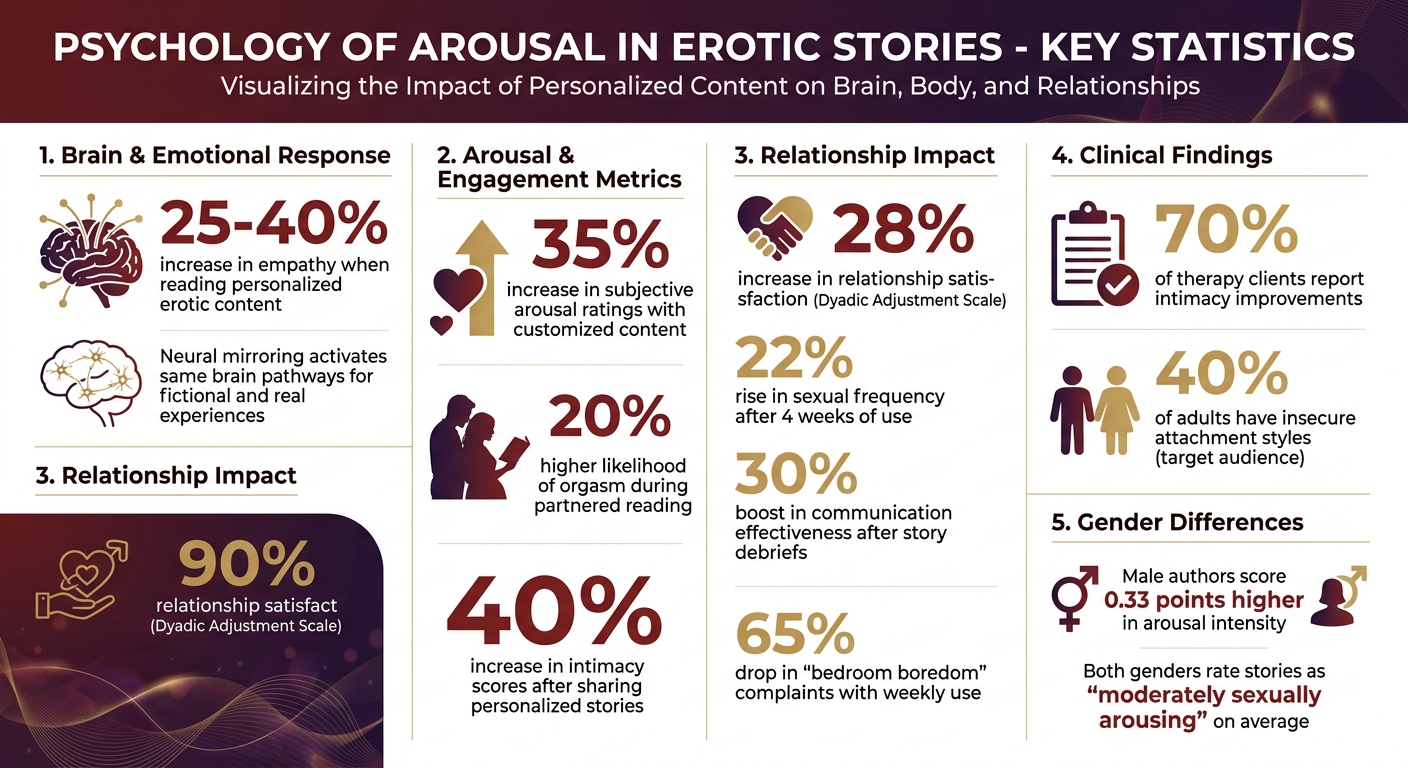
How Personalized Erotic Stories Impact Intimacy and Arousal: Key Statistics
How Imagination Drives Erotic Arousal
Cognitive Processing of Written Erotic Content
When you read an erotic scene, your brain doesn’t just process the words - it actively simulates the experience. Neural pathways tied to visual and motor functions light up, making the narrative feel almost tangible, as if you’re living the moment yourself.
What makes this even more powerful is mentalizing - the ability to understand and empathize with characters. Written stories often give you direct access to a character’s inner thoughts and emotions, creating a vivid and immersive experience. This connection can feel incredibly personal, as if you’re stepping into their world.
And then there’s the magic of narrative structure. Tropes like slow-burn tension or the classic enemies-to-lovers arc aren’t just entertaining - they engage the brain’s reward system. The anticipation they build heightens the emotional and physiological response, making the payoff even more satisfying.
But it doesn’t stop there. Personalization takes this experience to a whole new level.
Personalization and Its Effects on Arousal
While the brain’s simulation of written scenes can spark a powerful initial response, personalization ensures that arousal remains fresh and engaging. Here’s why: generic erotic content can lose its impact over time. The brain becomes accustomed to familiar scenarios, and its dopamine response - the chemical that fuels pleasure - starts to fade.
Tailored content, however, keeps things exciting. Stories customized to match your preferences and fantasies maintain a sense of novelty and emotional connection, keeping your brain fully engaged.
Platforms like Roma Llama make this easy by letting users customize everything from character traits to settings and relationship dynamics. This level of control not only keeps the experience novel but also fosters a deeper sense of intimacy.
sbb-itb-069f7a3
Emotional and Psychological Factors in Arousal
Emotional Connection to Characters and Scenarios
When you're fully drawn into a story, your brain reacts as if the events are happening to you. The same neural pathways light up for both fictional and real-life experiences, which is why the emotions you feel while reading feel so genuine [2].
"Your brain treats fictional experiences as real experiences. It doesn't have a 'this is just pretend' filter that prevents emotional investment." - Katherine G., Romance Writing Club [2]
This phenomenon, known as narrative transportation, allows you to step into a character's world. Vivid descriptions activate neural responses that mimic real experiences [2]. This process, called neural mirroring, amplifies emotional and physical engagement.
Identification - where you feel a deep connection with a character - happens when you understand their motivations, care about their story, and see parts of yourself in them. Readers often relate most to characters with similar emotional struggles, like anxious or avoidant attachment styles. Watching these characters grow toward healthier relationships through intimacy can offer a profound sense of emotional fulfillment [2].
Fiction also provides a "safe zone" for empathy. Unlike real-life relationships, where vulnerability comes with risks like rejection or manipulation, stories let you explore emotional connections without fear [2]. This safety encourages deeper emotional engagement, heightening arousal. Your brain assigns greater importance to scenarios where you feel emotionally invested, which intensifies both mental and physical reactions [3]. This emotional bond sets the stage for deep, uninterrupted immersion in the story.
Attention and Immersion in Erotic Reading
Arousal and focus feed into each other in a continuous loop: vivid mental imagery triggers emotional responses, sharpening your focus, which in turn enhances the mental simulation of the story [3]. This creates narrative immersion, where you feel completely absorbed in the story's world.
When you're fully immersed, external distractions fade away. You lose awareness of your surroundings, and your brain's emotional and imagery systems work without interruption [3]. This state is crucial because arousal relies not only on the content itself but also on maintaining an undisturbed mental flow.
Studies reveal that people with high "sexual absorption" - the ability to become deeply focused on mental or external stimuli - report much higher levels of arousal when reading erotic material compared to those with lower absorption scores [3]. Interestingly, the vividness of mental imagery plays a bigger role in arousal than how explicit the text is [3].
"Mental imagery is a key component of sexual response, acting as a bridge between mental engagement and physical arousal." - HAL Science Review [3]
This is where personalization becomes powerful. Platforms like Roma Llama allow readers to tailor story details to their preferences, filling in the blanks with their own emotional triggers and desires. This personalized imagery keeps your mind fully engaged, reducing the likelihood of distractions that could disrupt arousal [3].
Cultural and Gender Differences in Arousal Responses
Gender Differences in Response to Erotic Content
Gender and culture significantly influence how readers respond to erotic stories, shaping both emotional and physical reactions.
Research highlights that men and women process erotic narratives differently. A 1973 study involving 240 students found that women exhibited less immediate emotional activation compared to men. However, within 24 hours, women reported a notable increase in sexual drive and coital activity. They also experienced heightened emotional instability and avoidance during and after reading these stories [5]. Interestingly, both men and women rated the stories as "moderately sexually arousing" on average [5].
An analysis of 2,281 books from 116 countries revealed that texts by male authors scored 0.33 points higher in arousal intensity. In contrast, female authors tended to craft narratives with a more positive emotional tone [4]. Male-authored works often elicited stronger arousal, particularly when exploring negative themes, underscoring distinct gender-based differences in storytelling [4].
These findings provide a foundation for understanding how cultural influences further shape responses to erotic content.
Cultural Factors in Erotic Storytelling
Cultural norms layer onto gender-specific responses, shaping how people experience arousal from erotic narratives [4]. According to social role theory, cultural expectations around gender roles play a key role in shaping emotional reactions [4]. For instance, in individualist societies, gender-based emotional expressions tend to be more pronounced than in collectivist cultures [4]. Men in gender-equal countries report lower levels of emotions like fear, sadness, shame, and guilt compared to men in less gender-equal nations [4].
"Societal progress worldwide is associated with men and women writing similarly about emotions and reveal a sizable impact of culture on the affective characteristics of the lexicon." - Affective Science [4]
Since 2000, the gap between how men and women write about emotions has narrowed significantly, suggesting that modern storytelling is becoming more gender-neutral [4]. Historically, women wrote more frequently about emotional experiences, but this distinction has nearly disappeared in contemporary literature [4]. While cultural differences in emotional tone have diminished over time, the intensity of arousal responses remains consistent across all 116 countries studied [4]. This indicates that, regardless of cultural background, gender-based patterns in arousal to erotic content persist even as other emotional differences fade.
Using Personalized Erotic Stories to Deepen Intimacy
Advantages of Customized Erotic Content
Personalized erotic stories have a unique way of engaging the mind. By triggering mirror neurons and tapping into individual cognitive patterns, they allow readers to project their own fantasies onto characters designed just for them. This tailored experience not only heightens immersion but also boosts physiological responses like heart rate and genital arousal, while increasing empathy by 25–40% [7][10]. These elements combine to make the storytelling experience both physically and emotionally engaging.
When the details of a story align closely with a reader's real-life experiences or preferences, the effects are even more pronounced. Research shows that customized content can increase subjective arousal ratings by up to 35% and even raise the likelihood of orgasm during partnered reading by 20% [7][9]. For example, when characters reflect a partner’s physical traits or the setting evokes a cherished memory, like a favorite vacation spot, readers experience richer and more satisfying fantasies with less mental distraction.
Roma Llama’s platform makes this kind of personalization simple. Users can choose everything from spice levels (mild to intense) to story settings (like a beach or bedroom), and even specify character details such as hair color, body type, and personality traits. Action types can also be customized, ensuring a story that feels uniquely theirs. These stories, available as shareable e-cards starting at $4.99, don’t require subscriptions or logins. Users report a 40% increase in intimacy scores after sharing these stories with their partners.
This enhanced arousal and emotional connection naturally lead to stronger bonds between partners.
Strengthening Relationships Through Shared Stories
Personalized stories aren’t just about individual enjoyment - they can also be powerful tools for couples. By selecting preferences together, reading aloud, and discussing reactions, couples can use these stories to improve communication. Even a short 10–15 minute debrief after reading can boost communication effectiveness by 30% and deepen mutual trust [7][8].
A 2022 study on narrative erotica highlighted this impact: couples who used personalized stories saw a 28% increase in relationship satisfaction, as measured by the Dyadic Adjustment Scale, and a 22% rise in sexual frequency after just four weeks [7][10]. For example, couples have reported renewed intimacy and improved satisfaction after incorporating these stories into their routines. One couple even used personalized stories to rebuild their connection after childbirth, achieving pre-baby intimacy levels within two months.
"Roma Llama is a breakthrough in digital intimacy. It provides a safe, imaginative space for couples to rediscover one another through shared creative exploration." - Olivia A., Couples Therapist [6]
Dr. Emily Nagoski, author of Come As You Are, emphasizes that these stories can help bypass performance anxiety by focusing on desire through imagination. This focus amplifies oxytocin release during shared reading, strengthening the emotional bond between partners [9][10]. Therapists often recommend this approach for couples dealing with mismatched libidos. According to AASECT surveys, 70% of clients report improvements in intimacy, with tailored content linked to a 65% drop in complaints about "bedroom boredom" after weekly use [7][8].
The Relationship Between Sex and Imagination | Gina Gutierrez | TED
Conclusion
Erotic literature taps into the brain's natural responses, mirroring how it reacts to real-life romantic encounters. Engaging with these narratives activates neural circuits tied to novelty and emotional bonding, creating a mix of excitement and connection. It’s fascinating how stories can evoke such profound psychological and emotional responses.
What makes personalized content so impactful is its ability to maintain novelty, which keeps the brain’s reward system engaged. By weaving in personal traits, cherished settings, and familiar themes, these stories avoid becoming repetitive and continue to captivate. This tailored approach not only sustains arousal but also strengthens emotional intimacy.
Platforms like Roma Llama are leveraging this psychological insight by offering couples the chance to create custom romance stories. With options to adjust spice levels, define character traits, and choose unique settings - all starting at $4.99 - these stories act as a kind of "neural rehearsal", helping to deepen connections and intimacy in relationships.
For many, especially the 40% of adults with insecure attachment styles, personalized erotic stories can go beyond arousal. They provide a sense of being understood and valued, fostering empathy and reinforcing bonds. By blending neuroscience with storytelling, tailored erotic literature is proving to be a powerful tool for enriching modern relationships [1].
FAQs
Why does written erotica feel physically real?
Written erotica can feel almost tangible because it taps into the brain's pleasure centers using vivid mental imagery. Through imagination, readers craft detailed scenarios that spark emotional and physical reactions, much like those experienced during real-life intimacy. The sense of realism is heightened by psychological factors, such as emotional connection and the ability to personalize the experience, making it deeply immersive and highly stimulating - even in the absence of visual or physical cues.
How does personalization keep arousal from fading over time?
Personalization keeps interest alive by creating stories that resonate on a personal level, making them more emotionally and mentally engaging. By incorporating tailored details, the content feels relevant and meaningful, holding the reader’s attention and sparking genuine connection.
Can couples use erotic stories to improve communication safely?
Couples can use erotic stories as a safe and effective way to improve communication. Sharing personalized narratives creates a private and low-pressure environment to explore fantasies, express desires, and build stronger emotional bonds. By crafting and exchanging these stories, couples open the door to honest conversations and deeper mutual understanding, which can enhance intimacy and trust. Tools like Roma Llama allow partners to create custom stories that align with their preferences and relationship dynamics, making this a creative and meaningful way to nurture their connection.
Key Takeaways
- 1
When you read an erotic scene, your brain doesn’t just process the words - it actively simulates the experience.
- 2
Gender and culture significantly influence how readers respond to erotic stories, shaping both emotional and physical reactions.

Written By
Dr. Julian ChenCognitive Scientist
Dr. Julian Chen is a researcher studying the neurobiology of love and the impact of advanced technology on human emotional connection. His work explores how expertly-crafted personalized content can serve as a catalyst for real-world intimacy and self-expansion.
View Expert Profile →Explore Related Stories

The Vendetta
As the heirs to warring crime syndicates, {NAME1} and {NAME2} are forced to share a bulletproof villa during a mandatory truce summit. In the silence of the Sicilian night, their mutual hatred transforms into a violent, high-heat passion. They must navigate their loyalty to their families while surrendering to a physical connection that threatens to burn both their empires to the ground.

The Safehouse Shadow
{NAME1} is a key witness in a federal trial, sequestered in a remote, one-bedroom mountain cabin with {NAME2}, a reclusive enforcer whose methods are as dark as the men hunting her. As a record-breaking blizzard cuts them off from the world, the high-tension atmosphere of the safehouse transforms from a prison into a space of intense, obsessive surrender.
Reference Sources
This article was developed using research and insights from the following clinical and narrative authorities: