Expert Summary
Solo polyamory centers personal autonomy: maintain multiple meaningful relationships without cohabitation or hierarchy, focusing on growth and clear boundaries.

Solo Polyamory: The Growing Trend of Putting Your Own Growth Above a Primary Partner
Solo polyamory is a relationship style where individuals maintain multiple meaningful connections while prioritizing their independence. Unlike conventional relationships or hierarchical polyamory, solo polyamory centers on personal autonomy, avoiding cohabitation, shared finances, or societal milestones like marriage. Instead, it focuses on self-growth and relationships that align with individual goals.
Key points:
- Independence first: Solo polyamorists prioritize their own needs and goals, treating themselves as their "primary partner."
- Non-hierarchical: No partner is ranked above another; each relationship is valued for its unique qualities.
- No "relationship escalator": Solo poly rejects traditional milestones like moving in together or merging lives.
- Emotional benefits: It promotes self-awareness, communication skills, and reduced dependency on any single partner.
This lifestyle appeals to those seeking connection without sacrificing their independence, emphasizing honest communication and personal growth over societal norms.
Solo Polyamory 101: What It Is And What It Isn’t
sbb-itb-069f7a3
What Is Solo Polyamory?
Solo polyamory is a type of ethical non-monogamy where you maintain multiple meaningful relationships while prioritizing an independent, "single-adjacent" lifestyle. You’re not romantically single - you have ongoing, committed connections with others - but you intentionally avoid structuring your life around a single partner. Certified somatic sexologist Alice Child describes it as:
"practiced by individuals who enjoy multiple romantic and/or sexual relationships at the same time, and who still want to maintain an independent or 'single' lifestyle" [12].
In solo polyamory, your personal growth, autonomy, and needs take priority. It’s not about waiting for "the one" or basing major life decisions on a partner's preferences. Instead, you create a life that aligns with your values and invite others to share parts of that journey - without blending your entire existence with theirs.
This approach is non-hierarchical, meaning no partner is labeled as "primary" or "secondary." Each relationship is valued for its unique qualities, not ranked against others. Solo polyamorists often maintain separate living arrangements (sometimes with platonic roommates or family), keep finances independent, and make decisions like career moves or relocations based on their own goals. Let’s break down the core principles that define this relationship style.
Core Principles of Solo Polyamory
Radical independence lies at the heart of solo polyamory. This isn’t a temporary phase where you’re living alone until a "serious" relationship comes along - it’s a deliberate, long-term lifestyle. You control your space, schedule, and choices, ensuring they align with your own priorities rather than defaulting to a partner's needs.
Another key principle is rejecting traditional relationship milestones. Solo polyamorists opt out of the societal script that often dictates exclusive dating, cohabitation, marriage, and having children. Instead, relationships are defined by mutual desires, not by cultural expectations. As sex and relationships therapist Nikita Fernandes explains:
"We live in a world where relationship 'success' usually means climbing the relationship escalator - dating, moving in, marrying, having kids... solo poly folks reject this - preferring to operate and present themselves as individuals" [10].
Finally, autonomy drives every decision. Whether it’s choosing where to live, how to spend your time, or which career opportunities to pursue, decisions are made independently - not negotiated with a "main" partner. Amy Gahran, author of Stepping Off the Relationship Escalator, notes:
"When people are able to create as much autonomy as possible, they make better decisions in all of the relationships they're in" [6].
This doesn’t mean solo polyamorists are unwilling to compromise. It means they build relationships that complement their lives, rather than requiring them to sacrifice their core identity.
How Solo Polyamory Differs from Conventional Relationships
Solo polyamory stands in sharp contrast to traditional relationship models. In conventional partnerships - whether monogamous or polyamorous - there’s often an expectation of relationship progression. You date, become exclusive, move in together, and perhaps get married. Lives become increasingly intertwined, and decisions like job offers or social plans typically involve consultation with a partner.
Solo polyamory takes a different path. There’s no merging of lives through shared finances or cohabitation. Instead of creating a "we" that overshadows the individual "I", solo polyamorists prioritize their personal goals and independence. As Jack, a solo polyamorist, explains:
"a lifestyle and relationship philosophy predicated on a practitioner's primary focus of being a self-fulfilled, stable, and financially-secure individual. Or, put more simply, to be at the center of your own life" [3].
This focus on autonomy sets solo polyamory apart from both traditional and hierarchical relationship models.
In hierarchical polyamory, multiple partners exist, but one is designated as "primary", often holding veto power over other relationships or priority in major decisions. Solo polyamory rejects this ranking system. No partner dictates the terms of other connections, and no relationship takes precedence over personal autonomy.
It’s also distinct from simply being single. Single people are often "between relationships" or searching for a partner to settle down with. Solo polyamorists, on the other hand, are not in a transitional phase. They may have multiple deep, loving relationships, all while maintaining the independence and freedom often associated with single life.
Psychological and Emotional Benefits of Solo Polyamory
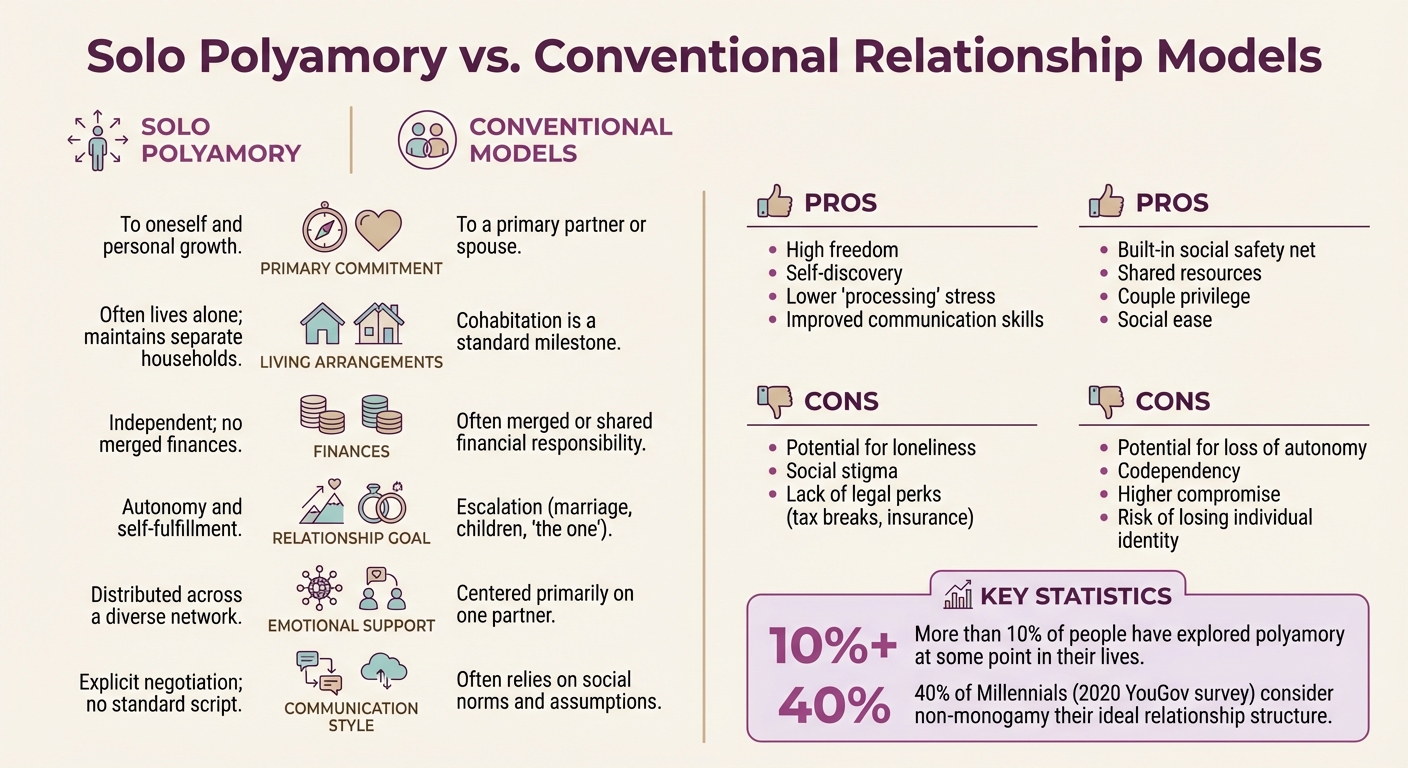
Solo Polyamory vs Conventional Relationships Comparison Chart
Solo polyamory brings a unique focus to personal development by placing self-reliance and individual growth at the forefront. By treating yourself as your own "primary partner", you develop emotional resilience and inner stability, reducing the need for external validation. As relationship coach Melina puts it:
"A Primary Self Relationship offers you liberation from the beliefs that you need another person to validate your existence" [9].
This approach also eases the pressure tied to traditional relationship milestones. There's no constant need to evaluate moving in together, combining finances, or reaching other societal benchmarks. According to sex and relationships therapist Nikita Fernandes, solo polyamorists are often:
"some of the most self-aware, emotionally intelligent, and secure people I've met - who are transparent and honest with their capacity and ability to get entangled with others" [10].
Without rigid relationship scripts, solo polyamory sharpens communication skills and emotional intelligence. A study published in the Journal of Sex Research in September 2024 found that individuals in consensually non-monogamous relationships experienced higher levels of communication satisfaction compared to those in monogamous relationships [14].
This model also challenges patterns of codependency and people-pleasing. Sex and relationships educator Jayda Kissed describes it as:
"resistance in a highly monogamous society that's telling you that you need to sacrifice your freedom in order to receive love" [6].
By spreading emotional support across a network of romantic, platonic, and community connections, solo polyamorists are less affected by the natural ups and downs of any one relationship.
Benefits of Prioritizing Independence
Solo polyamory creates room for self-discovery and the freedom to pursue personal goals, hobbies, and interests without being tied to a partner's schedule or preferences. This independence often leads to better decision-making in all relationships. Amy Gahran, author of Stepping Off the Relationship Escalator, explains:
"When people are able to create as much autonomy as possible, they make better decisions in all of the relationships they're in" [6].
Research backs this up. Studies show that single individuals, who often share the independent mindset of solo polyamorists, tend to be less stressed, more optimistic, and healthier than married individuals [6]. This lifestyle can be especially beneficial for introverts or neurodivergent people who might find the demands of cohabitation or traditional polycules overwhelming [1].
Solo polyamory also encourages emotional growth by expanding what therapists call the "window of tolerance" for complex emotions. Managing multiple partnerships requires navigating ambiguity, addressing jealousy as a signal of unmet needs, and understanding personal limits for connection [14].
Solo Polyamory vs. Conventional Relationship Models
The table below highlights how solo polyamory differs from traditional relationship structures:
| Feature | Solo Polyamory | Conventional Relationship Models |
|---|---|---|
| Primary Commitment | To oneself and personal growth [2][7] | To a primary partner or spouse [1][3] |
| Living Arrangements | Often lives alone; maintains separate households [1][4] | Cohabitation is a standard milestone [2][5] |
| Finances | Independent; no merged finances [2][3] | Often merged or shared financial responsibility [2][5] |
| Relationship Goal | Autonomy and self-fulfillment [1][6] | Escalation (marriage, children, "the one") [2][3] |
| Emotional Support | Distributed across a diverse network [10] | Centered primarily on one partner [10] |
| Communication Style | Explicit negotiation; no standard script [10] | Often relies on social norms and assumptions [15] |
| Pros | High freedom, self-discovery, lower "processing" stress, improved communication skills [1][3][14] | Built-in social safety net, shared resources, couple privilege, social ease [6][3] |
| Cons | Potential for loneliness, social stigma, lack of legal perks (tax breaks, insurance) [1][6] | Potential for loss of autonomy, codependency, higher compromise, risk of losing individual identity [6][9] |
Interestingly, more than 10% of people have explored polyamory at some point in their lives [1]. Additionally, a 2020 YouGov survey revealed that 40% of Millennials consider non-monogamy their ideal relationship structure [13]. These figures reflect a growing shift toward embracing individual autonomy over traditional relationship norms.
How to Practice Solo Polyamory
Practicing solo polyamory means intentionally shaping your relationships and communicating clearly. Unlike traditional relationships that follow a set path, solo polyamory gives you the freedom - and the responsibility - to design how your connections work.
Setting Clear Boundaries
To create fulfilling relationships, it’s important to establish boundaries in areas like time, space, communication, emotional needs, sexual guidelines, and conflict resolution. These boundaries should be flexible, adapting as your circumstances change. Consider keeping a living document of your agreements and revisiting it every few months.
Regular check-ins with your partners can help keep things on track. Spend 20–30 minutes weekly or bi-weekly discussing how things are going, using "I" statements to express your feelings without assigning blame. For example, you might say, "I feel overwhelmed when plans change last minute", instead of "You always change plans."
When meeting new people, be upfront about your solo polyamory status. This transparency helps filter out those who might be looking for a more traditional relationship style. Once your boundaries are clear, the next step is learning how to manage your time effectively to avoid burnout. [17][11][3]
Managing Time and Preventing Burnout
Time management is essential in solo polyamory. With multiple connections and personal priorities to juggle, it’s easy to feel stretched thin. To avoid this, start by scheduling "me-time" before planning dates with partners. Protecting your alone time ensures you have the energy to show up fully in your relationships.
Pay attention to your energy levels throughout the day. For example, if you’ve had a busy week, you might opt for a short coffee date instead of a long dinner. Communicating this upfront helps set expectations while respecting your limits. A survey by the Polyamory Research Institute found that solo poly individuals often achieve a more balanced lifestyle, experiencing less co-dependence compared to those in traditional relationship structures. [17][18]
Using Tools to Explore Romantic Expression
With boundaries and schedules in place, you can explore romance in creative ways. Tools like Roma Llama allow you to create personalized romance stories, helping you reflect on your values and experiment with different relationship dynamics in a safe space.
For the practical side of managing multiple relationships, shared calendars and scheduling apps are invaluable. They help coordinate plans while ensuring you still have time for yourself. Additionally, understanding the five love languages can deepen your connections. Knowing how each partner feels loved - whether through words, acts of service, or quality time - enables you to nurture meaningful relationships, even when time is limited.
Regular compatibility check-ins are another powerful tool. Ask questions like, "Does this relationship still feel good?" or "Is it supporting my growth?" These conversations ensure your connections evolve alongside your needs and priorities. [18][16][6]
Challenges of Solo Polyamory and How to Address Them
While solo polyamory offers flexibility and personal freedom, it also comes with its share of challenges. Navigating societal judgment and managing emotional complexities can feel overwhelming without the right tools. But with awareness and thoughtful strategies, these hurdles can be addressed effectively.
Dealing with Social Stigma
One of the biggest obstacles is combating misconceptions about solo polyamory. Critics may unfairly label solo poly individuals as selfish or accuse them of avoiding commitment. This overlooks the intentionality behind crafting unique commitments that deviate from traditional norms. Additionally, polyamory is often misunderstood as a cover for infidelity, ignoring the core principles of honesty and consent that define ethical non-monogamy [11][4].
Another layer of difficulty comes from "couple privilege." This refers to the societal and systemic advantages - like tax breaks or shared health insurance - typically reserved for couples, which can leave solo poly individuals feeling marginalized despite the growing recognition of polyamorous relationships [1][6].
To address stigma, consider being open about your solo poly identity early on in dating or social interactions. Sharing educational resources, like articles or podcasts, can help friends and family better understand your lifestyle. And don’t underestimate the importance of building a strong support system to counter external judgment.
Building a Support Network
Living outside traditional relationship structures can sometimes feel isolating. That’s where cultivating a chosen family becomes essential. These are the people who provide emotional support and celebrate your milestones, even if they don’t align with conventional societal expectations [8][18].
Finding community through online groups or local meetups can also be a game-changer. Engaging with others who share your values not only normalizes your lifestyle but also offers practical advice and camaraderie [1][18]. Keeping your connections alive doesn’t have to be complicated - regular texts, memes, or casual check-ins can go a long way in maintaining those bonds. Also, having clear protocols and designating emergency contacts within your chosen circle ensures you’re supported when it matters most.
Prioritizing Self-Care
Balancing multiple relationships while nurturing your personal growth requires intentional self-care. Think of yourself as your own primary partner. Schedule non-negotiable "me time" to recharge and avoid burnout. Tools like shared calendars can help you manage your time effectively, while clear boundary-setting scripts ensure your emotional energy is preserved.
Incorporating regular self-reflection through journaling, therapy, or meditation can also keep you aligned with your needs and goals. These practices help you maintain the emotional reserves necessary to thrive in this lifestyle.
"Solo polyamory allows individuals to embrace their independence while still engaging in meaningful, diverse relationships. It's a balancing act that requires self-awareness and open communication, but the rewards in personal growth are immense."
– Dr. Riley Hart, Relationship Therapist [18]
Conclusion
Solo polyamory goes beyond being just a relationship style - it’s a conscious decision to prioritize personal autonomy while fostering deep and varied connections. By stepping away from traditional relationship norms, you open up opportunities for self-exploration and growth without sacrificing meaningful intimacy [1].
The advantages aren’t limited to relationships alone. Studies show that individuals with a strong sense of independence often enjoy better health, broader social networks, and higher rates of community involvement compared to their married peers [6]. For instance, the 2024 State of Dating report found that Millennials and Gen X increasingly favor ethical non-monogamy as their relationship approach [10].
This lifestyle calls for radical honesty, clear boundaries, and regular self-check-ins to ensure your relationships align with your evolving goals. It’s about viewing yourself as your primary partner while maintaining a network that supports and celebrates your choices.
"Solo poly is resistance in a highly monogamous society that's telling you that you need to sacrifice your freedom in order to receive love." – Jayda Kissed, Sex and Relationships Educator [6]
Choosing solo polyamory means committing to ongoing self-reflection and open communication. For those seeking love and connection without giving up independence, it offers a path to create relationships on your own terms. It’s not just a relationship framework - it’s a journey toward self-fulfillment and genuine connections. While it requires self-awareness and emotional responsibility, the rewards of personal freedom and authentic relationships make the effort worthwhile.
FAQs
How do I know if solo polyamory is right for me?
Solo polyamory is about maintaining multiple romantic or sexual relationships while keeping your primary focus on yourself. If independence, personal growth, and autonomy are important to you, this approach might resonate. It’s ideal for those who prefer not to cohabit or merge finances with a partner, valuing non-traditional relationship dynamics. Solo polyamory allows for meaningful connections without placing them in a hierarchy or adhering to conventional commitments.
How do I explain solo polyamory to a partner who wants a primary relationship?
Solo polyamory is all about balancing meaningful romantic relationships with a strong sense of personal independence. At its core, it emphasizes being your own primary partner, prioritizing self-growth and autonomy over traditional relationship structures like living together or merging finances.
This doesn't mean solo poly individuals avoid deep or committed relationships. Instead, they approach commitment in a way that aligns with their personal values and boundaries. It's a way to build connections without sacrificing individuality or self-ownership.
What should I do if I feel lonely or unsupported in solo polyamory?
Solo polyamory emphasizes independence, but it's perfectly normal to feel lonely sometimes. To navigate these moments, work on creating a solid social circle, dive into activities that bring you joy, and take time for self-care. Let yourself experience your emotions without criticism - loneliness isn't exclusive to any particular relationship style. If it feels overwhelming, consider reaching out to community groups or a therapist for support. This can help you stay emotionally balanced while honoring your independence.
Key Takeaways
- 1
sbb-itb-069f7a3
- 2
Solo Polyamory vs Conventional Relationships Comparison Chart
- 3
While solo polyamory offers flexibility and personal freedom, it also comes with its share of challenges.

Written By
Dr. Julian ChenCognitive Scientist
Dr. Julian Chen is a researcher studying the neurobiology of love and the impact of advanced technology on human emotional connection. His work explores how expertly-crafted personalized content can serve as a catalyst for real-world intimacy and self-expansion.
View Expert Profile →Keep Reading
What No One Tells You About Open Relationships
Read Article →Is "Situationship" the New Normal? The Pros and Cons of Undefined Relationships
Read Article →Why "You Complete Me" Is the Worst Relationship Advice Ever Given
Read Article →Soft Launching Non-Monogamy: How to Explore ENM Without Blowing Up Your Life
Read Article →Explore Related Stories

The Rival Chefs
Chef {NAME1} and rival {NAME2} are forced to share a tiny kitchen for a charity event. As they fight over counter space and ingredients, their professional bickering turns into an intense physical hunger.

The Slice of Life Arrangement
{NAME1} and her reclusive neighbor {NAME2} enter into a fake relationship to solve their social problems. As they navigate family events and quiet dinners, their 'arrangement' turns into a real, heartwarming passion.
Reference Sources
This article was developed using research and insights from the following clinical and narrative authorities: